


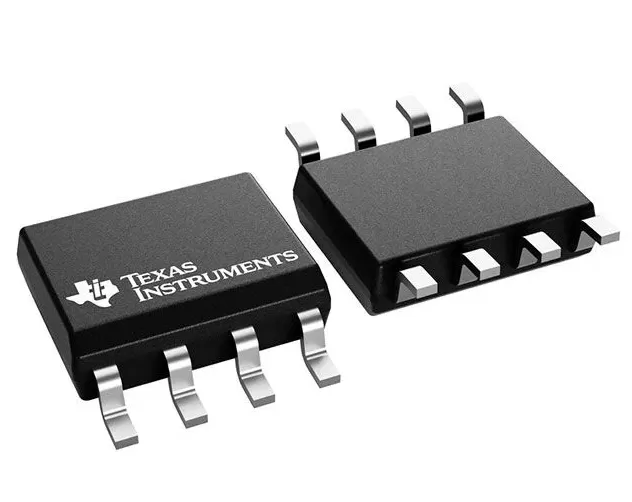

CD4098
Brand: Texas Instruments
Texas Instruments CD4098 is a power management component designed for Industrial Automation and related applications. In stock at Superb Automation — request a quote for competitive pricing and fast delivery.
Product Specifications
CD4098
Texas Instruments — Power Management & Signal Chain
Product Overview
The CD4098 from Texas Instruments is a power management / signal chain IC delivering high efficiency, precision regulation, and robust protection. Texas Instruments (TI) is a global leader in analog ICs, power management solutions, and embedded processors.
Superb Automation partners with leading brands including Qorvo, TI, ADI, XILINX, NVIDIA, Intel, ST, MACOM, Renesas, and Coilcraft to provide complete BOM and supply-chain solutions.
Key Features
- High-efficiency power conversion with low quiescent current
- Wide input voltage range with precision output regulation
- Integrated over-current, over-temperature, and short-circuit protection
- Small footprint packaging for space-constrained designs
- AEC-Q100 qualified options available for automotive applications
- Flexible sequencing and soft-start control
Key Specifications
| Input Voltage | V |
| Output Voltage | V |
| Output Current | A |
| Switching Frequency | kHz |
| Efficiency | % |
| Quiescent Current | µA |
| Topology | — |
| Package | — |
| Operating Temp | °C |
| Protection | — |
Applications
Industrial Automation
Automotive Electronics
Telecom Infrastructure
Server & Data Center Power
Medical Devices
Consumer Electronics
Request Quote — In Stock, 100% New & Original, Full Warranty
CD4098: the dual monostable multivibrator and the bare string on the drawing
The CD4098 is the catalogue string without a body suffix, and the vendor addendum does not publish that string. The device is the CD4098B, a dual monostable multivibrator in a 16-lead body, and the rows a purchase order can actually match are CD4098BE in the plastic DIP, CD4098BM96 in the small outline reel, CD4098BPWR in the thin shrink reel and the ceramic rows on the same addendum. A drawing that says CD4098 and nothing else cannot be ordered, and that is the first thing this page has to say.
The function is a one shot with an external resistor and capacitor per section. The vendor describes a retriggerable and resettable circuit where the trigger and reset propagation delays are independent of RX and CX, which is what allows the timing to be set by the external parts rather than by the die. Leading edge and trailing edge trigger inputs are both provided, an unused positive trigger ties to the negative rail, an unused negative trigger ties to the positive rail, and the reset is active low. Those tie off rules are the ones a test engineer checks first on a board that uses only one section.
The CD4098B rows as the addendum publishes them
| Part class | Dual monostable multivibrator, retriggerable and resettable |
| Vendor descriptor | Dual precision monostable multivibrator |
| Vendor status | ACTIVE, catalogue rating |
| Data sheet | SCHS097 or later revision, acquired from Harris Semiconductor |
| Package addendum date | 18 September 2026 |
| Supply range | 3 V to 18 V, 20 V type rating in the headline |
| Output drive | 4 mA sink and source |
| Supply current | 600 microamps maximum |
| Timing formula | TX equal to half RX CX, for CX at or above 0.01 microfarad |
| Minimum external resistor | 5 kohm |
| Maximum external capacitor | 100 microfarad |
| Pulse width over temperature | Plus or minus 2.5 per cent typical, CX 1000 pF and RX 100 kohm |
| Pulse width over supply | Plus or minus 0.5 per cent at 10 and 15 V, 1 per cent at 5 V |
| Input current | 1 microamp at 18 V over temperature, 100 nA at 25 degrees |
| PDIP body | 16 leads, 181.42 square millimetres, 19.3 by 9.4 mm |
| PDIP rows | CD4098BE and CD4098BE.A, 25 pieces, Active |
| SOIC tube row | CD4098BM, Obsolete, blank quantity, Call TI |
| SOIC reel row | CD4098BM96, 2500 pieces, Active |
| Small reel row | CD4098BMT, Obsolete |
| TSSOP rows | CD4098BPW tube Obsolete, CD4098BPWR reel 2000 Active |
| Ceramic rows | CD4098BF and CD4098BF3A, 25 pieces, Active |
| Military rows | JM38510/17504BEA and M38510/17504BEA, 25 pieces, Active |
The bare string is not the only surprise. The surface mount tube is closed in both SOIC and TSSOP, so a prototype that needs twenty pieces has to come from the plastic DIP or from a cut reel. The ceramic side is fully active, which is unusual in this band and is good news for a customer who has to keep a wide temperature one shot alive. The military drawing JM38510/17504BEA is active at 25 pieces in a tube with a tin lead finish.
What the timing numbers actually say
The vendor formula is half the product of the external resistor and the external capacitor, and it holds for capacitors at or above 0.01 microfarad. Below that value the parasitic capacitance of the package and the board becomes part of the timing and the formula overstates the pulse. The minimum external resistor is 5 kohm, which is a limit on the discharge current through the internal transistor, and the maximum external capacitor is 100 microfarad, which is a limit on the leakage that would otherwise prevent the circuit from timing out.
The stability figures are the ones to use in a budget. With a 1000 pF capacitor and a 100 kohm resistor the pulse width varies by plus or minus 2.5 per cent typical over the full minus 55 to plus 125 degree range, and by plus or minus 0.5 per cent typical for a 5 per cent supply change at 10 and 15 V, or 1 per cent at 5 V. Those are typical figures, not limits, and they exclude the tolerance of the external resistor and capacitor, which usually dominates. A 1 per cent resistor and a 5 per cent film capacitor already put the pulse 6 per cent wide before the device contributes anything.
The trigger and reset delays are independent of the timing components, which is the property that makes the part usable as a pulse shaper rather than only as a timer. A reset terminates the output immediately, and the vendor recommends tying an unused reset to the positive rail while tying the reset of an unused section to the negative rail, which is a subtle difference that catches a board with one section wired and one left floating.
Where the dual one shot fits
Two sections in one package cover the two timing jobs that most control boards need: a pulse stretch on an input and a delay before an enable. The retriggerable mode extends the output by one period on each new trigger, which is a missing pulse detector when the input is periodic. The non retriggerable mode is wired by feeding Q back to the trigger input, and the vendor describes exactly that connection.
The 16-lead plastic DIP is 181.42 square millimetres, the SOIC is 59.4 and the TSSOP is 32. A board that is repaired in the field takes the DIP and a socket, and a board that is sealed takes the SOIC reel. There is no smaller body with a 2500 piece reel than the SOIC, and the TSSOP tube is closed, so the TSSOP only makes sense in volume.
The external parts are where the accuracy is decided. A 5 per cent film capacitor and a 1 per cent resistor give a pulse that is 6 per cent wide before the device contributes, so a customer who needs a 2 per cent pulse has to buy a 1 per cent capacitor or trim the resistor. The minimum resistor of 5 kohm also sets a floor on the current that the timing pin has to sink, and a board that uses a 1 kohm resistor to shorten the pulse is outside the vendor table rather than inside it with less accuracy.
The two sections are independent, so one can run as a retriggerable missing pulse detector while the other runs as a fixed delay. That is the arrangement most boards use, and it is the reason the dual package survives when a single one shot would be cheaper. Sharing the timing capacitor between the sections is possible and should be avoided, because the discharge path of one section then loads the timing node of the other.
What the documents do not publish
The page does not print a maximum pulse width error over temperature, only typical figures, and it does not print the trigger pulse width required to fire the circuit. Both are in the data sheet, and both matter when a short input pulse has to be stretched. The page also does not print the recovery time between two triggers, which sets the maximum repetition rate in the retriggerable mode.
Second source and long term availability
The vendor states that the CD4098B is similar to the MC14528, which is the cross reference most often used when the part is hard to find. Similar is not identical, and the trigger levels and the timing constant have to be checked before a substitution is released. The obsolete part cross reference hub collects those checks, and the last time buy and LTB planning page covers how a final order is sized when a body closes.
What to send with an enquiry
Send the full orderable string rather than the bare part number, the body, the quantity and the date. If the pulse width is critical, send the resistor and capacitor values as well, because the timing budget depends on them more than on the device. If the board is surface mount, confirm that a 2500 piece reel or a cut reel is acceptable, since the SOIC tube and the small reel are both closed. The BOM scrubbing page explains how a bare string is matched to a live row before a quote is issued.