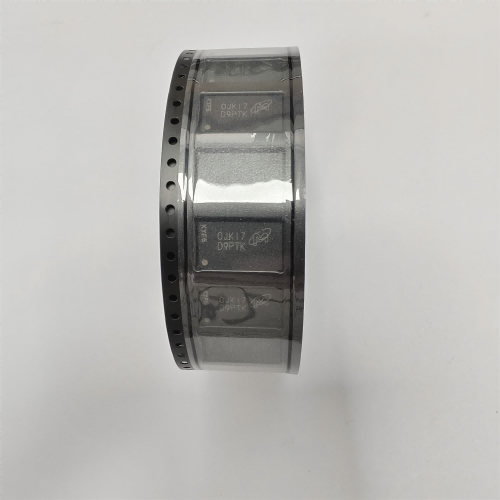
AD9240ASZ
Brand: Analog Devices
Analog Devices AD9240ASZ is a analog & mixed-signal component designed for Instrumentation and related applications. In stock at Superb Automation — request a quote for competitive pricing and fast delivery.
Product Specifications
AD9240ASZ
Analog Devices — Analog & Mixed-Signal ICs
Product Overview
The AD9240ASZ from Analog Devices is a high-performance analog / mixed-signal IC providing precision signal acquisition, conversion, and conditioning. Analog Devices (ADI) is a world leader in high-performance analog, mixed-signal, and DSP ICs for instrumentation, healthcare, automotive, and communications.
Superb Automation partners with leading brands including Qorvo, TI, ADI, XILINX, NVIDIA, Intel, ST, MACOM, Renesas, and Coilcraft to provide complete BOM and supply-chain solutions.
Key Features
- High-resolution data conversion with excellent SNR and THD
- Wide dynamic range and high linearity across operating conditions
- Integrated voltage reference with low temperature drift
- Flexible digital interface — SPI, I2C, or parallel options
- Industrial/automotive temperature range with guaranteed specs
- Low power consumption with power-down modes
Key Specifications
| Resolution | bits |
| Channels | — |
| Sample Rate | kSPS |
| Interface | — |
| Supply Voltage | V |
| Operating Temp | °C |
| Package | — |
| INL | LSB |
| SNR | dB |
| THD | dB |
Applications
Precision Instrumentation
Industrial Process Control
Medical Imaging & Diagnostics
Automotive Sensor Interfaces
Communications Infrastructure
Test & Measurement
Request Quote — In Stock, 100% New & Original, Full Warranty
AD9240ASZ: 14 bits at 10 MSPS in a 44-lead MQFP
The AD9240ASZ is a complete 14-bit 10 MSPS converter on a single 5 V supply, drawing 285 mW. It carries its own sample and hold and a programmable reference, so the BOM around it is decoupling and a clock. Published linearity is 2.5 LSB integral and 0.6 LSB differential, input referred noise is 0.36 LSB, and the 77.5 dB of signal to noise and distortion is 12.58 effective bits, which is the number most customers actually test against.
Published values
| Parameter | Value |
|---|---|
| Resolution | 14 bits, no missing codes over temperature |
| Sample rate | 10 MSPS, 100 ns per conversion |
| SINAD | 77.5 dB, 12.58 effective bits |
| SFDR | 90 dB |
| Integral nonlinearity | 2.5 LSB |
| Differential nonlinearity | 0.6 LSB |
| Input referred noise | 0.36 LSB |
| Supply | single 5 V |
| Power | 285 mW |
| Reference | on chip, programmable, external reference allowed |
| Input | differential sample and hold, 2 V p-p nominal |
| Output | straight binary, 14 bits, with an out of range flag |
| Package | 44-lead MQFP |
The MQFP is the first thing to check on a quote
The 44-lead metric quad flat pack is a large package with a fine lead pitch, and it is the part of this converter that drives assembly cost and inspection time. It is not a package that a low cost line will place without a check, and it is not stocked in the same depth as SOIC parts. When a customer asks for a price on the AD9240ASZ, the answer depends on whether the board can take the MQFP footprint or whether the 10 MSPS 14-bit function has to move to a different package class.
The 100 ns conversion interval is also the budget for everything around the converter. A clock with 1 ns of jitter on a 1 MHz input produces phase noise that shows up as a loss of SNR before the 77.5 dB figure is reached; at 10 MSPS the aperture uncertainty of the source matters more than the converter noise, and that is where field failures come from when a board is copied from an older, slower board.
2.5 LSB of integral nonlinearity in a 14-bit system
Two and a half codes of integral nonlinearity out of 16384 is 0.015 percent of full scale, which is fine for imaging and spectrum analysis and is not fine for a customer who wants a 16-bit absolute accuracy claim from a 14-bit part. The distinction to make in a quote is between resolution, which is 14 bits here, and accuracy, which is bounded by the 2.5 LSB figure and by the reference drift over temperature.
The 0.36 LSB of input referred noise sits inside one code, so the histogram at a DC input is narrow and averaging does buy a little. Averaging four samples gains one bit only if the noise is random and the input is stable; on a scanning or pulsed input the samples are not independent and the gain is smaller than the arithmetic suggests.
What a single 5 V rail changes
A single 5 V supply means the analogue input span sits around a mid supply common mode, and any front end that was built for plus minus 5 V has to be re referenced. The part allows an external reference where the application needs a different span or a better drift figure, and the data sheet shows the connections; the default is the internal reference, which is what most boards use.
At 285 mW the package runs warm but not hot, and the MQFP body spreads heat through the leads. The failure mode to watch on a reflowed board is solder voiding under the lead tips after thermal cycling, not junction temperature. Second source activity on this part should include a first article X ray, not only a curve trace.
Sourcing notes for this family: the ADI second source page holds the cross references, the obsolete part cross reference hub is the pre substitution check, and how to verify a drop in replacement is what we use when the part on the drawing is not on the shelf.
Two questions buyers ask
Is 14 bits at 10 MSPS enough for an ultrasound front end? It is the usual starting point, and the 12.58 effective bits are the figure to quote. Whether it is enough depends on the time gain compensation range the customer needs, because the echo returns span more than 70 dB before the converter sees them.
Does the ASZ suffix matter? It is the lead free, RoHS compliant version of the same die in the same 44-lead MQFP. The specification does not change; the assembly process and the documentation do.