An ADI part number in a released BOM is a specification written in shorthand. The converter, the amplifier, the clock part or the interface device was chosen against a set of conditions, and the number records which of them the circuit relies on. When that part goes short, goes end of life, or its lead time moves past the build date, the search starts for a part that can take its place without moving the specification.
An ADI part second source is not a copy of a part number. It is a replacement whose numbers hold at the supply, the temperature and the frequency the circuit actually runs at, and the work is to prove that line by line before the change reaches the line.
Where an ADI part second source goes wrong
Pin compatibility is the first trap. Two parts can share a footprint and differ in what the pins mean: a reference pin that sinks current on one and sources it on the other, a shutdown pin with the opposite polarity, a thermal pad tied to a different rail. The board fits and the failure appears where the bench did not look.
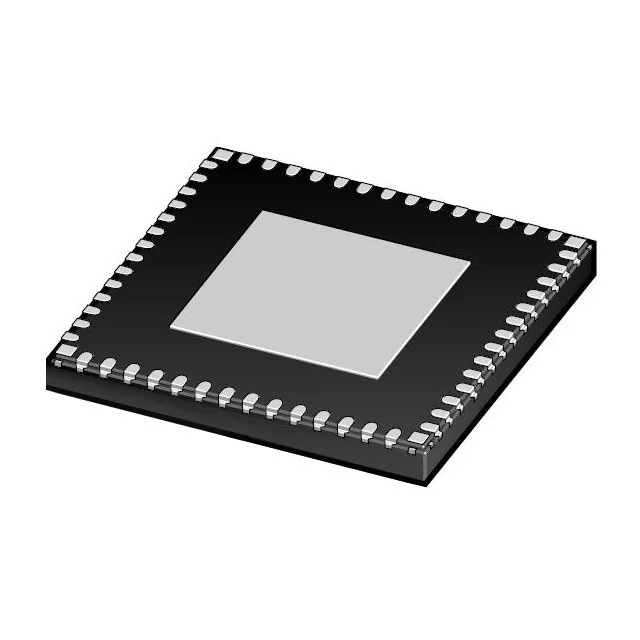
The package suffix is the second. The same body size can carry a different exposed pad and a different thermal resistance, so the junction temperature of the qualified part is not the junction temperature of the replacement. The suffix also carries the temperature grade, which is a screening claim rather than a wider printed range.
Settling and timing come third. A converter with a faster throughput can still need a longer acquisition window, and an amplifier with more bandwidth can still ring on the same feedback network. Where the part sits behind a serial interface, the register map, the power-up sequence and the latency between conversion and readout decide whether the system timing survives.
Linearities at the operating frequency are fourth. Gain and noise figure quoted at one frequency say little about a part used across a band, and the compression point at the actual supply voltage is the number that decides whether a blocker lifts the noise floor.
The candidate's own lifecycle is the fifth and it is usually skipped. A part chosen as the replacement for an end of life device can itself be not recommended for new designs.
The checks that decide an ADI replacement
| Check | Why it decides the outcome | What a weak comparison looks like |
|---|---|---|
| Pin function and polarity | Same footprint, different pin meaning changes the circuit | Footprint matched, pin functions not read |
| Package and thermal pad | Thermal resistance decides the junction temperature | Body size compared only |
| Temperature grade | The grade is screened data, not a printed range | Wide range part accepted as the same grade |
| Supply range and sequencing | Rail order decides start-up and latch-up risk | Nominal rail compared only |
| Reference behaviour | Source or sink, value and drift move every reading | Reference voltage compared, current direction not |
| Digital timing and latency | Interface mode, clocking and readout delay decide the loop | Throughput compared, latency not measured |
| Noise and offset drift | Drift at temperature decides accuracy after calibration | Typical noise at 25 C accepted |
| Linearity at the band edges | Compression and intermodulation decide the usable range | Centre frequency figure copied into the report |
| Candidate lifecycle status | A replacement that is itself end of life repeats the problem | Status not checked at the time of the swap |
| Change notification route | A silicon revision can invalidate a released board | No route from the maker to the quality team |
How SUPERB PCBA supports an ADI part second source search
Send the BOM lines with the full orderable part number, the function of each part, the rails, the temperature the board sees, the band or signal range and the build quantity. The reply marks each line as a direct replacement, a replacement that needs a board check, or a line with no route, and gives the data that settles each open point.
The family comparisons are already collected where the part type is common: converters in the ADC DAC cross reference, gain blocks and operational parts in the amplifier cross reference, and the general method in the pin to pin cross reference. Where the part is an established ADI device with a known domestic route, the part by part comparison sits in the ADI domestic alternatives comparison, so the shortlist and the price position arrive together.
Provenance is checked before a candidate is offered. Reels are counted by X-ray, markings and date codes are inspected against maker records, decapsulation is used where the risk justifies it, and aged stock gets a solderability check before it is quoted. Verified lots carry a 730 day warranty, and a replacement enters the BOM only after written approval from your side.
Proving the swap on the board
A replacement is proved on the assembled board, not in a datasheet comparison. First article inspection runs against released data, 3D SPI checks the paste before reflow, 3D AOI checks it after, X-ray runs in 2D and CT mode with voiding below 5 percent, and functional test runs on a fixture approved by your team at the rails and temperatures the unit sees.
SUPERB Assembly builds and tests those boards under IPC-A-610 Class 2 and Class 3 and ISO 9001, with placement down to 01005, boards supported from 500 MHz to 77 GHz, impedance held to plus or minus 5 percent and to plus or minus 2 percent where the circuit needs it, up to 68 layers, and every build recorded against its lot number. SUPERB Tech keeps the inspection record with the lot mapping, so a field return is traced to the parts that went into it.
ADI part second source questions
Is a pin compatible ADI part a drop in replacement?
It fits the footprint and that is all the pin map proves. The pin functions, the reference behaviour, the timing and the thermal path all have to be compared, and the result is a replacement that needs a board check rather than a drop in part.
Can a faster converter replace a slower one in the same socket?
It can, if the acquisition window, the interface timing and the driver stage are rechecked. A higher throughput figure does not shorten the time the analog input needs to settle to the required accuracy.
What if the replacement is only available in a different temperature grade?
Then the grade is a change to the qualification of the board: the screened data at the extremes has to be compared and the change approved as a qualification change.
How is the price difference explained?
By the route behind the part: the original maker line, a verified lot from the open market or a qualified alternative. Each carries a different inspection level, and the quote states which one it is.
Next step
Send the BOM lines with the full orderable part numbers, the function of each part, the rails, the temperature and the band, plus the build quantity and the date the line needs parts. You get every line marked with its state, the data still needed to release it, and the lifecycle position of both the original and the candidate.