


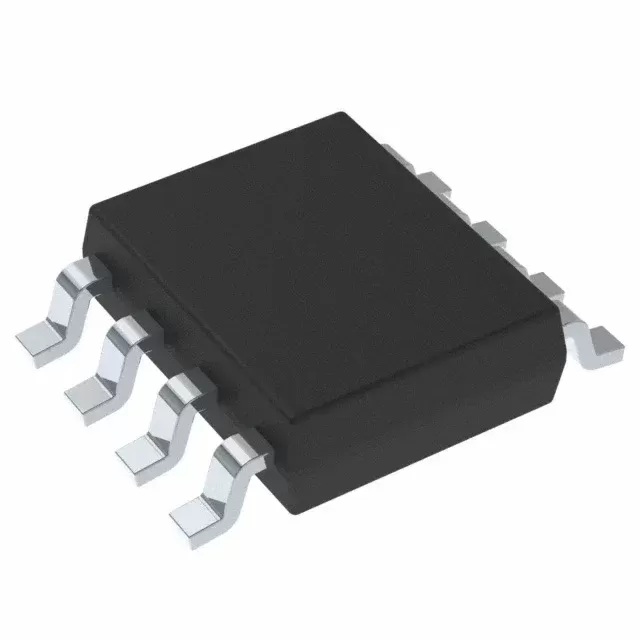

ISO7221BDR
Brand: Texas Instruments
Texas Instruments ISO7221BDR is a power management component designed for Industrial Automation and related applications. In stock at Superb Automation — request a quote for competitive pricing and fast delivery.
Product Specifications
ISO7221BDR
Texas Instruments — Power Management & Signal Chain
Product Overview
The ISO7221BDR from Texas Instruments is a power management / signal chain IC delivering high efficiency, precision regulation, and robust protection. Texas Instruments (TI) is a global leader in analog ICs, power management solutions, and embedded processors.
Superb Automation partners with leading brands including Qorvo, TI, ADI, XILINX, NVIDIA, Intel, ST, MACOM, Renesas, and Coilcraft to provide complete BOM and supply-chain solutions.
Key Features
- High-efficiency power conversion with low quiescent current
- Wide input voltage range with precision output regulation
- Integrated over-current, over-temperature, and short-circuit protection
- Small footprint packaging for space-constrained designs
- AEC-Q100 qualified options available for automotive applications
- Flexible sequencing and soft-start control
Key Specifications
| Input Voltage | V |
| Output Voltage | V |
| Output Current | A |
| Switching Frequency | kHz |
| Efficiency | % |
| Quiescent Current | µA |
| Topology | — |
| Package | — |
| Operating Temp | °C |
| Protection | — |
Applications
Industrial Automation
Automotive Electronics
Telecom Infrastructure
Server & Data Center Power
Medical Devices
Consumer Electronics
Request Quote — In Stock, 100% New & Original, Full Warranty
ISO7221BDR: the five megabit grade of the dual isolator on the large reel
ISO7221BDR is the B grade of the dual channel digital isolator in the eight pin SOIC, one channel in each direction, on a large reel of 2500. The B grade runs to 5 megabits per second with a propagation delay of 58 nanoseconds typical and 75 maximum, which is the middle of the four grades in the family.
The barrier is rated 2500 volts of withstand with 560 volts peak of repetitive isolation and 4 millimetres of clearance, and the supply window is 3 to 5.5 volts on each side. The B grade is the one that fits an isolated RS-485 or controller area network link at 1 to 5 megabits, where the A grade would be marginal and the C grade would be paid for and not used.
ISO7221BDR as the vendor document publishes it
| Channels | 2, one in each direction |
| Signaling rate | 1, 5, 25 or 150 megabits per second by grade |
| Propagation delay, A grade | 253 nanoseconds typical, 585 maximum |
| Propagation delay, B grade | 58 nanoseconds typical, 75 maximum |
| Propagation delay, C grade | 36 nanoseconds typical, 48 maximum |
| Propagation delay, M grade | 12 nanoseconds typical, 20 maximum |
| Common mode transient immunity | 25 kilovolts per microsecond minimum, 50 typical at 5 volts |
| Supply | 3 to 5.5 volts per side, 2.8 volts minimum on the C grade |
| Quiescent current | 8.5 milliamps typical, 17 maximum per side |
| Supply current at 1 megabit | 10 milliamps typical, 18 maximum |
| Withstand isolation | 2500 volts root mean square for 60 seconds |
| Maximum repetitive isolation | 560 volts peak |
| Maximum transient isolation | 4000 volts peak |
| Clearance and creepage | 4 millimetres |
| Distance through insulation | 8 micrometres |
| Temperature range | minus 40 to plus 125 degrees |
| Package | 8 pins, SOIC body D |
| Catalogue code | ISO7221BDR |
| Vendor status | active |
| Grade | B, 5 megabits per second |
| Carrier | large reel of 2500 |
| Moisture level | level 1, 260 degrees, unlimited floor life |
Two channels, one each way, in an eight pin body
ISO7221BDR is the dual channel member of the ISO722x family with the two channels in opposite directions: channel one passes from side one to side two, channel two passes back. The same-direction dual is a different part number, and the eight pin SOIC body is shared by both, so the direction is the only thing that decides which code goes on the order.
Each channel is a logic input and output buffer separated by a silicon dioxide barrier, with no integrated noise filter, which is why the propagation delay is short and the pulse width distortion is small. The part is specified over minus 40 to plus 125 degrees and runs from a 3 to 5.5 volt supply on each side.
Four speed grades, four propagation delays
The family is published in four grades that differ only in speed. The A grade runs to 1 megabit per second with a propagation delay of 253 nanoseconds typical and 585 maximum. The B grade runs to 5 megabits with 58 nanoseconds typical and 75 maximum. The C grade runs to 25 megabits with 36 nanoseconds typical and 48 maximum. The M grade runs to 150 megabits with 12 nanoseconds typical and 20 maximum.
The input pulse width follows the grade: 1 microsecond on the A, 200 nanoseconds on the B, 40 on the C and 6.67 on the M. Paying for a faster grade than the bus needs buys nothing, and the slower grade is the one with the lowest current at a given data rate, because the output stage is not switching faster than the signal.
Twenty five hundred volts, four millimetres, and eight micrometres
The barrier of ISO7221BDR is rated 2500 volts root mean square of withstand for 60 seconds, 560 volts peak of maximum repetitive isolation voltage and 4000 volts peak of maximum transient isolation voltage. The external clearance and creepage are both 4 millimetres, the distance through the insulation is 8 micrometres, and the barrier capacitance is about 1 picofarad.
The 8 micrometre figure is the one that decides the life of the barrier rather than its type test, because the insulation thickness is what the time dependent breakdown depends on. Four millimetres of creepage is the number the board has to preserve, and a mounting pad or a test point placed across the gap reduces it without changing anything on the drawing.
Eight and a half milliamps quiescent, ten at a megabit
Each side of ISO7221BDR draws 8.5 milliamps typical and 17 milliamps maximum with no load, and the supply current on side one rises to 10 milliamps typical with a 1 megabit signal applied, because the output stage and the barrier are both switching. On side two the same signal takes 10 milliamps typical at 1 megabit on the opposite direction channel.
The common mode transient immunity is 25 kilovolts per microsecond minimum and 50 typical on a five volt supply, dropping to 15 and 40 on a mixed 5 volt and 3.3 volt arrangement, and to 10 and 30 when both sides run at 3.3 volts. That drop is the reason a barrier is specified at the supply it will actually run at rather than at the highest one in the table.
The eight pin body, the reel, and the marking
ISO7221BDR is the eight pin SOIC body, published on a tube and on a large reel, with the R suffix marking the reel. The part is moisture level 1 at 260 degrees, so no bake is needed before reflow, and the lead finish is nickel palladium gold. The temperature range is minus 40 to plus 125 degrees on both carriers.
Level 1 is a real difference against the isolators in the wider bodies, several of which are level 2 or 3. A line that runs an eight pin isolator beside a sixteen pin one has two different floor life rules on the same board, and the handling instruction has to say which is which rather than applying the stricter rule to both and baking parts that do not need it.
Where a two channel isolator sits
ISO7221BDR belongs on an isolated universal asynchronous receiver transmitter, an isolated RS-485 or controller area network interface where the transceiver is already isolated on the bus side, a gate drive signal pair for a half bridge, and a serial peripheral interface link where only clock and data need to cross the barrier and the chip select stays local.
Two channels in opposite directions is the shape of a full duplex link, which is why this member of the family is the one used beside a transceiver: one channel carries the transmit data out and one carries the receive data back, and the direction control for a half duplex bus is generated on the isolated side rather than crossing the barrier.
What the grade letter decides besides speed
The four grades differ in more than the propagation delay. The A, B and C grades take fixed transistor transistor logic thresholds of 2 volts high and 0.8 volt low, while the M grade tracks the supply at 0.7 and 0.3 times the value. A driver that swings to 2.5 volts from a 3.3 volt rail works with the first three and not with the fourth.
The second difference is the input pulse width, which falls from 1 microsecond on the A grade to 6.67 nanoseconds on the M grade. A slow optocoupler replacement with a 100 microsecond pulse works with any grade, and a fast serial clock needs the narrow pulse width, so the grade follows from the signal rather than from the stock position.
The grade is a decision about the bit rate with margin, not about price alone. Our BOM scrubbing page covers the isolator against the bill of materials, and the vendor consolidation page covers holding one grade across boards.
How much margin does the B grade leave at 1 megabit? A 75 nanosecond maximum delay against a 1000 nanosecond bit is 7.5 per cent, so the grade is comfortable at 1 megabit and still has margin at 5 megabits where the bit is 200 nanoseconds.
Is the reel level 1? Yes. The eight pin body is level 1 at 260 degrees with an unlimited floor life, so no bake is needed before reflow.