


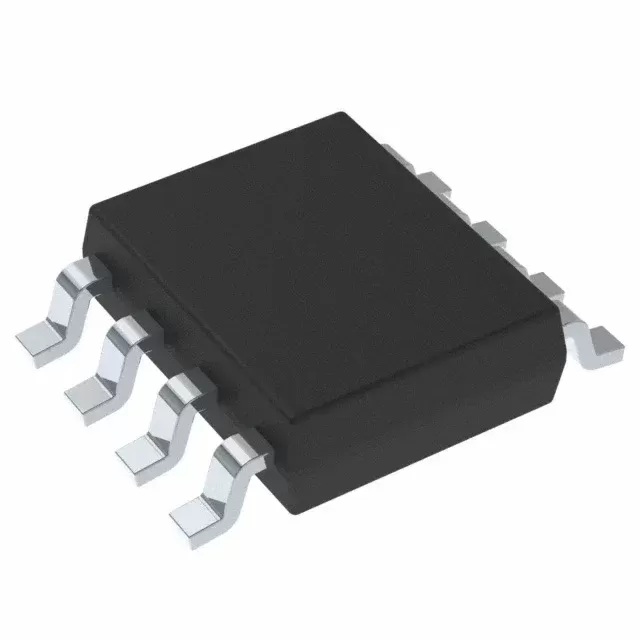

CD4077BM96
Brand: Texas Instruments
Texas Instruments CD4077BM96 is a power management component designed for Industrial Automation and related applications. In stock at Superb Automation — request a quote for competitive pricing and fast delivery.
Product Specifications
CD4077BM96
Texas Instruments — Power Management & Signal Chain
Product Overview
The CD4077BM96 from Texas Instruments is a power management / signal chain IC delivering high efficiency, precision regulation, and robust protection. Texas Instruments (TI) is a global leader in analog ICs, power management solutions, and embedded processors.
Superb Automation partners with leading brands including Qorvo, TI, ADI, XILINX, NVIDIA, Intel, ST, MACOM, Renesas, and Coilcraft to provide complete BOM and supply-chain solutions.
Key Features
- High-efficiency power conversion with low quiescent current
- Wide input voltage range with precision output regulation
- Integrated over-current, over-temperature, and short-circuit protection
- Small footprint packaging for space-constrained designs
- AEC-Q100 qualified options available for automotive applications
- Flexible sequencing and soft-start control
Key Specifications
| Input Voltage | V |
| Output Voltage | V |
| Output Current | A |
| Switching Frequency | kHz |
| Efficiency | % |
| Quiescent Current | µA |
| Topology | — |
| Package | — |
| Operating Temp | °C |
| Protection | — |
Applications
Industrial Automation
Automotive Electronics
Telecom Infrastructure
Server & Data Center Power
Medical Devices
Consumer Electronics
Request Quote — In Stock, 100% New & Original, Full Warranty
CD4077BM96: the quad exclusive-NOR gate on a 2500 piece SOIC reel
The CD4077BM96 is the large tape and reel entry for the CD4077B, four independent two input exclusive-NOR gates in a 14-lead small outline body. The vendor page lists the device as ACTIVE with a drive of 6.8 mA in both directions, an 8 Mbps data rate and an operating range of minus 55 to plus 125 degrees. The reel row is 2500 pieces, level 1 at 260 degrees, nickel palladium gold finish, and the marking on the body is CD4077BM rather than the orderable string.
The exclusive-NOR is the inverted twin of the exclusive-OR on the same document, and the difference is one digit in the string and one inverter on the die. An exclusive-NOR output is high when both inputs are equal, which makes it the natural equality comparator for a pair of lines, while the exclusive-OR is high when they differ. A buyer who orders by function has to say which one, because both parts are active in every body and a distributor will ship whichever string is on the order.
The CD4077B rows as the addendum publishes them
| Part class | Four independent two input exclusive-NOR gates |
| Vendor descriptor | 4-ch exclusive-NOR, 3 V to 18 V |
| Vendor status | ACTIVE, catalogue rating |
| Data sheet | SCHS052 or later revision, shared with the CD4070B |
| Package addendum date | 18 September 2026 |
| Supply range | 3 V to 18 V, 20 V type rating in the headline |
| Output drive | 6.8 mA sink and source at 15 V |
| Data rate | 8 Mbps in the parametric table |
| Propagation delay | 65 ns typical at 10 V into 50 pF |
| Input thresholds at 5 V | Low 1.5 V maximum, high 3.5 V minimum |
| Input current | 1 microamp at 18 V over temperature, 100 nA at 25 degrees |
| Noise margin | 1 V at 5 V, 2 V at 10 V, 2.5 V at 15 V |
| Thermal, PDIP | 80 degrees per watt junction to ambient |
| Thermal, SOIC | 86 degrees per watt junction to ambient |
| SOIC tube row | CD4077BM, 50 pieces, Active |
| SOIC reel row | CD4077BM96, 2500 pieces, Active |
| Small reel row | CD4077BMT, 250 pieces, Active |
| SOP reel row | CD4077BNSR, 2000 pieces, Active |
| TSSOP rows | CD4077BPW tube 90 pieces and BPWR reel 2000 pieces, both Active |
| PDIP row | CD4077BE, 25 pieces in a tube, Active |
| Ceramic rows | CD4077BF and CD4077BF3A, 25 pieces, Active |
This is the rare device in the band where every body is live. The SOIC tube at 50 pieces, the small reel at 250, the large reel at 2500, the SOP reel, the TSSOP tube at 90 and the TSSOP reel at 2000 all return an active status with a real quantity and a real finish. A buyer who is used to seeing the tube rows close should check the addendum before assuming this one behaves the same way, because a substitution made on that assumption adds cost for no reason.
What the parametric table fixes
The gate is specified over 3 to 18 V with parametric ratings at 5, 10 and 15 V, a drive of 6.8 mA and a typical propagation of 65 ns at 10 V. The input thresholds at a 5 V rail are 1.5 V low and 3.5 V high, so 40 per cent of the rail in the middle is undefined. The input current is 1 microamp at 18 V, and the noise margin is 1 V at 5 V, 2 V at 10 V and 2.5 V at 15 V over the full temperature range.
The 65 ns figure is the same as the exclusive-OR and five nanoseconds slower than the OR and AND gates in the same family. That difference is small enough to ignore in a static application and large enough to matter in a parity chain, where four stages add 260 ns typical and the guaranteed limit is worse. The 8 Mbps data rate in the table is not a chain figure and should not be read as one.
There is a documentation conflict that a buyer should know about. The parametric table on the product page lists four inputs per channel for this device, which cannot be right for a quad two input gate, and the data sheet describes four independent gates with two inputs each. The page reports both readings rather than choosing one, because a purchase order is written against the string and a drawing is checked against the function.
Where the equality function fits
An exclusive-NOR is the cheapest equality test in a discrete logic library. Two lines that must match, two address bits that must both be high or both low, two sensor outputs that must agree before a permit is issued, all of those are one gate. Four gates in one package compare four pairs, and the outputs can be combined with an AND gate from the same family to make a wider comparator.
Area is 51.9 square millimetres for the SOIC, 181.42 for the plastic DIP, 79.56 for the SOP and 32 for the TSSOP, and the thermal impedance runs 86, 80, 76 and 113 degrees per watt in the same order. At the static currents involved the thermal number is only a fault case. The area number is the one that decides the body, and a board that has room for the DIP usually takes it because the 25 piece tube is the cheapest way to hold a spare.
What the documents do not publish
No maximum propagation delay, no output capacitance, no short circuit current and no truth table appear on the product page. The data sheet carries the truth table, which for an exclusive-NOR is the whole specification: output high when the two inputs are equal, low when they differ. The page prints the function in the descriptor and leaves the table, the switching limits and the test circuit to the document.
The pack sizes decide the cost of a small build. The 250 piece small reel and the 2500 piece large reel are both active, and the price per piece usually falls faster between those two than between the tube and the small reel. A build of 500 pieces can be covered by two small reels or by one large reel cut down, and the cut reel is only cheaper if the remainder is consumed within the moisture life of the part, which is unlimited at level 1 but not at every level in the family.
One more reading should be recorded for the record. The parametric table lists a data rate of 8 Mbps, and the same table lists a propagation delay of 65 ns typical. Eight Mbps implies a 125 ns bit period, and 65 ns of typical delay already consumes half of it before any margin. The two entries are consistent only as catalogue descriptors, and a board that needs real throughput at 5 V should be measured rather than calculated from the page.
Second source and long term availability
The CD4077B is second sourced under the same number and every body is active at the time of this reading, which makes it one of the safer 4000 series parts to specify. The nearest alternative is a 74HC7266 or a 74HC86 with an inverter, and both change the pin out or the delay. The how to verify a drop in replacement page shows the bench checks, and the date code management page covers how a mixed stock of tubes and reels is rotated.
What to send with an enquiry
Send the string, the function, the body, the quantity and the date. Say exclusive-NOR rather than exclusive-OR in words as well as in the string, because the two parts share a document and a footprint and the only difference is the digit. The one stop BOM sourcing page explains how a mixed order of gates and registers is consolidated before a quote is issued.