


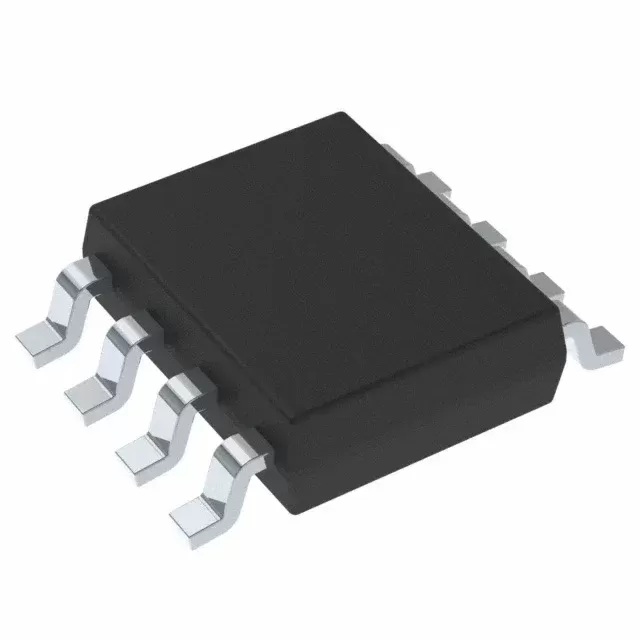

CD4060BM96
Brand: Texas Instruments
Texas Instruments CD4060BM96 is a power management component designed for Industrial Automation and related applications. In stock at Superb Automation — request a quote for competitive pricing and fast delivery.
Product Specifications
CD4060BM96
Texas Instruments — Power Management & Signal Chain
Product Overview
The CD4060BM96 from Texas Instruments is a power management / signal chain IC delivering high efficiency, precision regulation, and robust protection. Texas Instruments (TI) is a global leader in analog ICs, power management solutions, and embedded processors.
Superb Automation partners with leading brands including Qorvo, TI, ADI, XILINX, NVIDIA, Intel, ST, MACOM, Renesas, and Coilcraft to provide complete BOM and supply-chain solutions.
Key Features
- High-efficiency power conversion with low quiescent current
- Wide input voltage range with precision output regulation
- Integrated over-current, over-temperature, and short-circuit protection
- Small footprint packaging for space-constrained designs
- AEC-Q100 qualified options available for automotive applications
- Flexible sequencing and soft-start control
Key Specifications
| Input Voltage | V |
| Output Voltage | V |
| Output Current | A |
| Switching Frequency | kHz |
| Efficiency | % |
| Quiescent Current | µA |
| Topology | — |
| Package | — |
| Operating Temp | °C |
| Protection | — |
Applications
Industrial Automation
Automotive Electronics
Telecom Infrastructure
Server & Data Center Power
Medical Devices
Consumer Electronics
Request Quote — In Stock, 100% New & Original, Full Warranty
CD4060BM96: the 14-stage counter on a 2500 piece SOIC reel
The CD4060BM96 is the small outline reel member of the CD4060B family, a fourteen stage ripple carry binary counter with an on-chip oscillator. The vendor describes it as a CMOS 14 stage ripple carry binary counter divider and oscillator and marks it ACTIVE. The parametric table gives a counter function, ten bits, standard CMOS input, push pull output and an operating range of minus 55 to plus 125 degrees.
The row reads Active, SOIC body with 16 leads at 59.4 square millimetres, 2500 pieces on a large tape and reel, RoHS yes, nickel palladium gold finish, moisture level 1 at 260 degrees with unlimited floor life, minus 55 to plus 125 degrees and the marking CD4060BM. The tube row of the same body, CD4060BM, is also Active at 40 pieces, which is unusual in this catalogue and worth knowing before a reel is committed.
The CD4060BM96 row as the vendor addendum publishes it
| Part class | 14 stage ripple carry binary counter with on-chip oscillator |
| Vendor document | SCHS049C, revised October 2003, acquired from Harris Semiconductor |
| Package for this code | SOIC (D), 16 leads, 59.4 square millimetres at 9.9 by 6 mm |
| Packing | 2500 pieces on a large tape and reel |
| Status | Active, production |
| RoHS | Yes |
| Lead finish | NIPDAU |
| Moisture level | Level 1 at 260 degrees, unlimited floor life |
| Part marking | CD4060BM |
| Sibling row | CD4060BM96.A, same quantity |
| Tube row of the same body | CD4060BM, 40 pieces, Active |
| Obsolete SOIC row | CD4060BMT, quantity blank, Call TI |
| NRND SOP rows | CD4060BNSR and CD4060BNSR.A, 2000 pieces |
| TSSOP reel row | CD4060BPWR, 2000 pieces, marking CM060B |
| Obsolete TSSOP row | CD4060BPW, quantity blank, Call TI |
| PDIP row | CD4060BE, 25 pieces in a tube |
| Counter stages | 14, with ten outputs brought out |
| Clock rate | 12 MHz at 15 V |
| Oscillator | RC or crystal configuration, all active parts on chip |
| RC oscillator floor | 690 kHz minimum at 15 V |
| Reset and operation | Common reset, fully static, buffered inputs and outputs |
| Supply and current | 3 V to 18 V, quiescent current tested at 20 V on every unit |
The reel against the tube on the same body
Both formats are Active, so the choice is about quantity rather than availability. Forty pieces in a tube covers a pilot build, a repair kit or a small instrument run and never leaves a remnant. Two thousand five hundred on a reel covers a production build and leaves whatever is unused on a labelled reel. The crossover sits near three hundred pieces, and a buyer who orders a reel for a build of two hundred has bought a stock item rather than a component.
Moisture level 1 with unlimited floor life is what makes the tube format practical in both directions. A part at level 3 would have to be baked after a shift out of the bag, which turns a forty piece tube into a day of process time. At level 1 the tube can be opened, part used and closed again, and the remainder stays usable.
Counting, dividing and the oscillator inside
The oscillator and the first fourteen binary stages share one die, so a timer needs one resistor, one capacitor and this part. In RC configuration the frequency follows the passive components, and the vendor's 690 kHz minimum at 15 V is a floor rather than a target. In crystal configuration the accuracy follows the crystal and the internal oscillator becomes a buffer rather than a time base, which is the route for anything that has to keep time over a year.
Each output is a division of the previous stage, so the delay accumulates down the chain and outputs do not change simultaneously. A circuit that takes one output sees a clean divided clock; a circuit that compares two outputs has to allow for the skew between them. That is a property of every ripple counter and the reason a synchronous counter exists for the applications that cannot tolerate it.
Where this counter still earns its place
Long interval timers, blinking indicators, watchdog chains, tone generators and simple frequency dividers are the five jobs this part still does better than a microcontroller in one respect: it needs no code, no clock configuration and no supply sequencing. On a product that has to work for twenty years in a sealed enclosure, that is a real advantage. On a product that already has a microcontroller, the counter is usually redundant and the divider can be done in software.
The power budget is the other half of the argument. A counter that draws almost nothing between edges can run from a coin cell for years, while a microcontroller that wakes every second to increment a variable draws orders of magnitude more. For a battery product with a ten year life, that difference decides the battery size.
Reel planning and second source
Because the tube row survives, this family does not have the availability problem that most of the CD4000B shelf has. The reel is the format for volume, the tube is the format for small builds, and the two together cover the range without a cut reel. The safety stock planning page covers how much of each to hold against a supplier lead time that moves, and the date code management page covers how the two formats are rotated against each other.
Where a second source is wanted, a modern microcontroller with an internal oscillator covers the same function and adds programmability, at the cost of code, a supply rail and a qualification. For a customer who is weighing the two, the pin to pin cross reference page covers the parts that share the 16-lead pinout, and the honest note is that none of them is a drop-in for the counter function.
The fourteen stages against a microcontroller counter
A small microcontroller with an internal oscillator can divide a clock, count an interval and drive an output, and it can be reprogrammed when the interval changes. Against that, this part has three properties a microcontroller does not: no code, no start-up time and a supply current low enough to leave a coin cell alive for a decade. The first two matter in a safety related product where a software defect is a failure mode, and the third matters in anything that is sealed and battery powered.
The counter also works with the supply off and on again without a boot sequence, and it holds its state indefinitely at zero clock. A product that counts events rather than time, such as a utility meter or a tamper counter, uses that property directly and never needs the counter to be reinitialised. A product that has to report the count to a network needs a microcontroller beside it, and the counter then becomes a pre divider that lets the microcontroller sleep between samples instead of counting every pulse.
Both arguments are old and both are still valid, which is why the family is Active in four bodies while the SOP row carries a not recommended marker. The vendor is not withdrawing the function, it is withdrawing one packaging format. A board that has already qualified the counter is therefore in a better position than a board that is starting now, because the function is safe and only the packaging choice is narrowing.
What to send with an enquiry
Send the string, the division ratio, whether the oscillator is RC or crystal, the supply rail and the annual quantity in pieces per year. If the quantity is under three hundred, say so, because the tube row is Active and it is cheaper than a cut reel for that range. If the product has a ten year life, say that too, because the stock plan for a counter is different from the stock plan for a logic gate.