


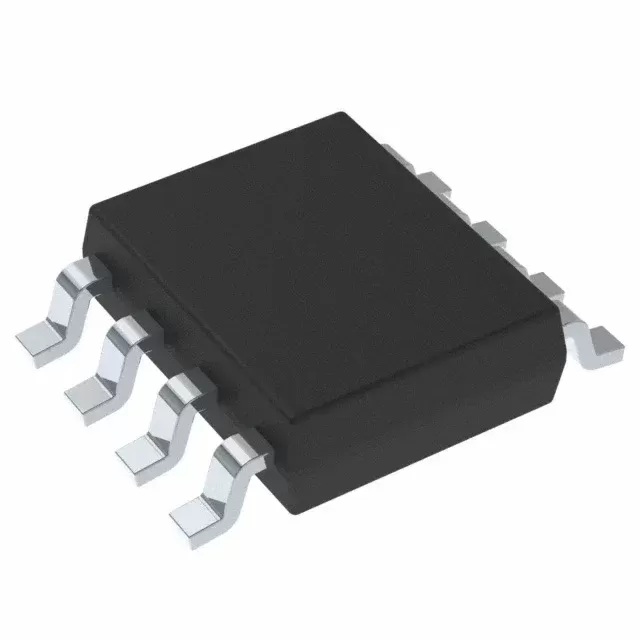

CD4029BM
Brand: Texas Instruments
Texas Instruments CD4029BM is a power management component designed for Industrial Automation and related applications. In stock at Superb Automation — request a quote for competitive pricing and fast delivery.
Product Specifications
CD4029BM
Texas Instruments — Power Management & Signal Chain
Product Overview
The CD4029BM from Texas Instruments is a power management / signal chain IC delivering high efficiency, precision regulation, and robust protection. Texas Instruments (TI) is a global leader in analog ICs, power management solutions, and embedded processors.
Superb Automation partners with leading brands including Qorvo, TI, ADI, XILINX, NVIDIA, Intel, ST, MACOM, Renesas, and Coilcraft to provide complete BOM and supply-chain solutions.
Key Features
- High-efficiency power conversion with low quiescent current
- Wide input voltage range with precision output regulation
- Integrated over-current, over-temperature, and short-circuit protection
- Small footprint packaging for space-constrained designs
- AEC-Q100 qualified options available for automotive applications
- Flexible sequencing and soft-start control
Key Specifications
| Input Voltage | V |
| Output Voltage | V |
| Output Current | A |
| Switching Frequency | kHz |
| Efficiency | % |
| Quiescent Current | µA |
| Topology | — |
| Package | — |
| Operating Temp | °C |
| Protection | — |
Applications
Industrial Automation
Automotive Electronics
Telecom Infrastructure
Server & Data Center Power
Medical Devices
Consumer Electronics
Request Quote — In Stock, 100% New & Original, Full Warranty
CD4029BM: a presettable up and down counter whose tube row is now obsolete
CD4029BM is a CD4029B presettable up and down counter in the 16-lead SOIC body, and the first thing to say about this exact string is that the vendor addendum lists it as Obsolete, with a blank quantity and a Call TI instruction. The active SOIC row for the same die is CD4029BM96, 2500 pieces on a large reel, and the active through-hole row is CD4029BE at 25 pieces in a tube. A purchase order written against the BM string therefore has no vendor row behind it, and the practical route is to move to the 96 reel or to the DIP.
The function is worth stating because it is the reason the part is still in catalogues. The vendor descriptor reads CMOS Presettable Up/Down Counter, the document is the CD4029B data sheet revision C, and the feature line gives an 8 MHz typical counting rate at 10 V, binary or decade counting selected by a pin, synchronous or ripple clocking, a preset capability and a carry out. The parametric table adds presettable operation, balanced outputs and a positive input clamp diode.
The CD4029BM row against the rows the addendum prints
| Part class | Presettable up and down counter, binary or decade |
| Vendor descriptor | CMOS Presettable Up/Down Counter |
| Vendor document | CD4029B data sheet revision C |
| Counting rate, vendor feature line | 8 MHz typical at 10 V |
| Counting modes | Binary or decade, selected by a control pin |
| Direction | Up or down, selected by a control pin |
| Preset | Four preset data inputs with a preset enable |
| Clocking | Synchronous parallel clocking or ripple clocking |
| Outputs | Four count outputs plus a carry out |
| Output drive, parametric table | 1.5 mA sink and source |
| Supply range | 3 V to 18 V |
| Package for this string | SOIC (D), 16 leads |
| Status of this string | Obsolete, quantity blank, Call TI |
| Active SOIC row of the same die | CD4029BM96, 2500 pieces on a large reel |
| Active DIP row | CD4029BE, 25 piece tube |
| SOP row | CD4029BNSR, 2000 piece reel |
| Ceramic rows | CD4029BF and CD4029BF3A, 25 piece tube, marking 8101602EA |
| Operating range on every printed row | Minus 55 to plus 125 degrees |
| Moisture level on the reel rows | Level 1, 260 degrees peak, unlimited floor life |
Binary and decade in one package
The counter counts in binary from 0 to 15 or in decade from 0 to 9, and the mode is chosen by a control pin rather than by a different part number. For a display application the decade mode gives a clean carry at nine, and for an address counter the binary mode uses all four outputs. That flexibility is why the part appears in instruments that have to count events and also address a memory, with the same package doing both jobs at different times.
The preset inputs let the count start from a value rather than from zero, which is how a timer is loaded with its initial count and how a counter is made to wrap at a number other than its natural maximum. The preset enable is asynchronous, so the preset value has to be stable before the enable pulse and through it, exactly as with any parallel load.
Synchronous against ripple clocking
The vendor feature line makes a point of offering both clocking modes. In synchronous mode all four outputs change together on the clock edge, which gives a clean transition but loads the clock line with the internal gates of every stage. In ripple mode the first stage clocks the second, which allows a slower or noisier clock input at the cost of a settling time during which the outputs pass through intermediate states. A counter that drives a decoder takes the synchronous mode, because the intermediate states produce false decoded outputs; a counter that only feeds another counter can take the ripple mode and the slower clock.
The trade is also about the clock source. A mechanical switch or a slow optical sensor has a rise time long enough that a synchronous clock input sees multiple edges, and the ripple mode with a Schmitt shaped input handles it better. A clean logic clock can drive either mode, and the synchronous mode is then the simpler choice.
Replacing an obsolete tube code without requalification
The arithmetic of a last time buy on a part like this is simple enough to do before the window closes. A board that consumes 200 pieces a year and has five years of production left needs 1000 pieces, which is less than half a reel, so a single reel of the active row covers the remaining life of the product and removes the obsolescence question altogether. A board that consumes 2000 pieces a year should be looking at the successor part rather than at stock, because the reel is a year of material and the second source question will come back.
The BM string and the BM96 string are the same die in the same 16-lead SOIC body, so the electrical behaviour does not change when a bill of materials moves from one to the other. What changes is the packing, 2500 pieces on a reel instead of a tube, and the line setup that goes with it. For a build that already runs reflow the change is administrative; for a build that hand loads the SOIC the reel has to be cut down or the DIP row used instead.
The obsolete status also affects the second source question. A broker offering CD4029BM is offering stock that the vendor no longer supports, and the date code on that stock is the only guide to its age. A board in long term service is better served by qualifying the BM96 reel now, while the vendor still lists it as active, than by chasing tube stock later.
Where the 4029 sits against the 4017 and the 4026
The CD4017B is a decade counter with ten decoded outputs and no preset or direction control. The CD4026B is a decade counter with a seven segment decoder and no direction control. The CD4029B is the only one of the three that counts both ways and presets, which makes it the part for a position counter, a timer load or a wrap at an arbitrary number. Its outputs are four binary lines rather than a decoded pattern, so a display needs an external decoder.
A board that needs a display and a fixed decade count takes the 4026, a board that needs ten discrete steps takes the 4017, and a board that needs to count down, preset or wrap takes the 4029. The 4029 is the most flexible of the three and also the one that needs the most external logic to drive a display.
Incoming checks when the correct row is in doubt
The first check is documentary: confirm the exact string on the purchase order against the addendum, because this family has an obsolete tube row and an active reel row with almost the same name. The second is functional: count up, count down, preset to a value, and confirm the carry out. The third is the mode pin, because a part that counts in binary when the board expects decade looks like a wiring error and is often a control pin left floating.
The reference pages are the obsolete part cross reference hub for the replacement route, the incoming inspection plan for the test sequence, and last time buy and LTB planning when a board in service depends on the obsolete row.
Questions that come up on the 4029
Whether the obsolete row can be substituted by the BM96 reel. It can, because the die and the body are identical, and only the packing changes.
Whether the counter can be preset while it is running. It can, because the preset enable is asynchronous, and the count resumes from the preset value on the next clock.
Whether the part can drive a seven segment display. It cannot, because four binary outputs need a decoder, and the segment current is beyond the 1.5 mA drive in any case.
Whether the carry out can clock another package directly. It can, and the ripple mode exists exactly for that chain, with the settling time to be allowed for in the next stage.