


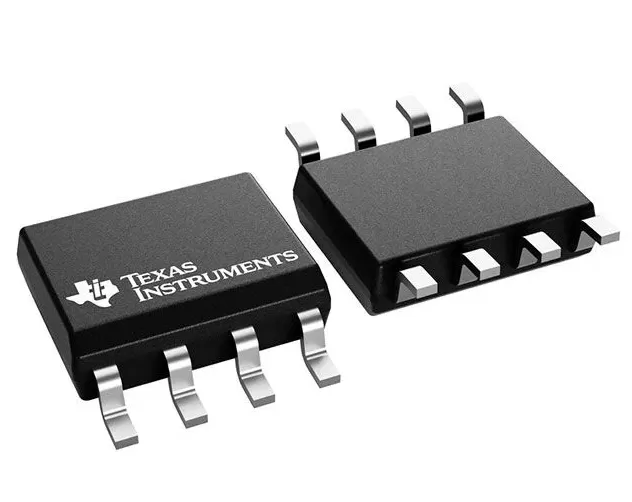

LM239AD
Brand: Texas Instruments
Texas Instruments LM239AD is a power management component designed for Industrial Automation and related applications. In stock at Superb Automation — request a quote for competitive pricing and fast delivery.
Product Specifications
LM239AD
Texas Instruments — Power Management & Signal Chain
Product Overview
The LM239AD from Texas Instruments is a power management / signal chain IC delivering high efficiency, precision regulation, and robust protection. Texas Instruments (TI) is a global leader in analog ICs, power management solutions, and embedded processors.
Superb Automation partners with leading brands including Qorvo, TI, ADI, XILINX, NVIDIA, Intel, ST, MACOM, Renesas, and Coilcraft to provide complete BOM and supply-chain solutions.
Key Features
- High-efficiency power conversion with low quiescent current
- Wide input voltage range with precision output regulation
- Integrated over-current, over-temperature, and short-circuit protection
- Small footprint packaging for space-constrained designs
- AEC-Q100 qualified options available for automotive applications
- Flexible sequencing and soft-start control
Key Specifications
| Input Voltage | V |
| Output Voltage | V |
| Output Current | A |
| Switching Frequency | kHz |
| Efficiency | % |
| Quiescent Current | µA |
| Topology | — |
| Package | — |
| Operating Temp | °C |
| Protection | — |
Applications
Industrial Automation
Automotive Electronics
Telecom Infrastructure
Server & Data Center Power
Medical Devices
Consumer Electronics
Request Quote — In Stock, 100% New & Original, Full Warranty
LM239AD: the A grade quad comparator, three millivolts at room on a fourteen pin body
LM239AD is the A grade of the quad differential comparator in the fourteen pin SOIC body, guaranteed from minus 25 to plus 85 degrees. The family has two offset sorts, and the A grade is the tighter one: 3 millivolts maximum at 25 degrees and 4 millivolts over the full window, against 5 and 9 millivolts on the plain LM239.
The two millivolts that the A grade removes are worth paying for in a particular case. When four thresholds sit on the same board and a single calibration table has to cover all four, the worst case error is set by the widest part in the set, and a batch of plain parts can drift 9 millivolts while the A grade holds 4. On a 12 bit measurement that is 20 codes instead of 9, and on a battery stack it is the difference between a warning at the right cell voltage and a warning that fires early.
This page covers the electrical rows, the two offset sorts side by side, the input range that reaches ground, and where four comparators in one package beat four singles.
LM239AD as the vendor document publishes it
Figures are from revision Z dated May 2025, at a 5 volt supply unless the row says otherwise, for the A grade over minus 25 to plus 85 degrees.
| Channels | 4, independent |
| Supply voltage | 2 to 36 volts, split rails to plus or minus 18 volts |
| Input offset voltage | 1 millivolt typical, 3 maximum at 25 degrees |
| Input offset voltage over temperature | 4 millivolts maximum |
| Input offset current | 5 nanoamps typical, 50 maximum |
| Input offset current over temperature | 150 nanoamps maximum |
| Input bias current | 25 nanoamps typical, 250 maximum |
| Input bias current over temperature | 400 nanoamps maximum |
| Common mode range | 0 to supply minus 1.5 volts at 25 degrees |
| Common mode range over temperature | 0 to supply minus 2 volts |
| Differential input voltage | plus or minus 36 volts |
| Large signal gain | 50 volts per millivolt minimum, 200 typical |
| Output low voltage | 150 millivolts typical, 400 maximum at 4 milliamps |
| Output low voltage over temperature | 700 millivolts maximum |
| Output sink current | 6 milliamps minimum at 1.5 volts |
| Output leakage | 0.1 nanoamps at 5 volts, 1 microamp at 30 volts over temperature |
| Supply current, four comparators | 0.8 milliamps typical, 2 maximum |
| Response time | 1.3 microseconds with 5 millivolts of overdrive |
| Response time, logic step | 0.3 microseconds |
| Operating temperature | minus 25 to plus 85 degrees |
| Package | 14 pins, SOIC body D |
| Carrier | tube, quantity on the addendum |
Three millivolts against five, and where the difference pays
The A grade sorts at 3 millivolts maximum at 25 degrees and 4 millivolts over temperature. The plain grade sorts at 5 and 9. Both come off the same die and the sort happens at wafer probe and final test, which is why the A grade costs more and why it is not always available in every carrier.
On a four cell battery stack the four thresholds come from one resistor ladder, and each comparator adds its own offset to its own cell. With a plain part the worst channel can be 9 millivolts out at the ends of the window, which on a 3.2 volt cell is 0.28 per cent, and on a 2.5 volt alarm threshold is 0.36 per cent. That sounds small until the same board has to declare a cell over voltage at 3.65 volts and the alarm fires at 3.62 on a cold morning.
The A grade halves the worst case. It does not remove the need for a calibration, because the offset is still a per part error, but it makes an uncalibrated board usable in the cases where the ladder tolerance has already eaten half the budget. A board that calibrates anyway should use the plain grade and spend the difference on a better resistor ladder.
An input range from ground to two volts below the supply
The common mode range runs from zero to the supply minus 1.5 volts at 25 degrees, and to the supply minus 2 volts over the full window. That is what makes the quad usable on a single supply with low side shunts, and it is the same row that limits a high side sense without a divider.
Over minus 25 to plus 85 the window loses only half a volt at the top, because the temperature span is narrower than the military part. A 5 volt rail therefore keeps a usable window to 3 volts at 85 degrees, and a 3.3 volt rail keeps it to 1.3 volts, which is tight enough that a rail to rail part is usually the better choice on a 3.3 volt only board.
Either input can be taken to 36 volts, or 0.3 volts below ground, without damage. On a 24 volt industrial board that row removes the clamp diodes that a smaller comparator would need, and it survives a reversed divider during a hot plug event.
Output: open collector, six milliamps guaranteed sink
The output sinks 6 milliamps minimum and 16 milliamps typical at 1.5 volts of saturation, with 400 millivolts maximum at 4 milliamps and 700 millivolts over temperature. The open collector means four outputs can be wired or tied into one node with a single pull up, which is how a four channel alarm becomes one interrupt line without a gate.
The leakage side is as important as the sink side on a wired bus. At 0.1 nanoamps at 5 volts and 1 microamp at 30 volts over temperature, four outputs in parallel leak 4 microamps worst case into the pull up. On a 10 kilo ohm pull up that is 40 millivolts, which no logic family will misread, and on a 1 megaohm pull up it is 4 volts, which every logic family will misread.
The response time of 1.3 microseconds with a 5 millivolt overdrive and 0.3 microseconds on a logic step is set by the same output stage, so a heavy pull up slows the edge and a light one lets the comparator figure dominate.
Where the A grade quad belongs
Four comparators in one body belong where the thresholds are related and the board is tight: a four cell stack with one window per cell, a four channel alarm card, a quad level translator, a four point temperature interlock. The A grade belongs in that set when the thresholds are within a few per cent of each other and the board is not calibrated.
The plain grade belongs where the board is calibrated or the window is wide, and the military grade belongs where the ambient goes below minus 25. The three codes share the body and the pinout, so a board can move between them without a board change, and the decision is a purchasing one rather than an engineering one once the temperature window is fixed.
For the sourcing side, our pin to pin cross reference page lists the parts that share the fourteen pin outline, and the power management cross reference page covers the codes within this family and what changes when one of them stops being printed.
Carrier and the addendum rows
The tape and reel table prints LM239ADR at 2500 pieces on a 330 millimetre reel with a 16.4 millimetre tape width, a 6.5 millimetre pocket and 2.1 millimetres of depth. The plain LM239AD is the tube carrier, and the tube quantity is not printed in the same table, so it should be read off the addendum at order time rather than assumed from another code.
| LM239AD | SOIC D, 14 pins | tube | A grade, minus 25 to plus 85 |
| LM239ADR | SOIC D, 14 pins | 2500 pieces, 330 millimetre reel | the same grade on the reel |
| LM239D | SOIC D, 14 pins | tube | plain grade, 5 millivolts at room |
| LM239PW | TSSOP PW, 14 pins | tube | the same die in the smaller body |
Buying questions that come with this code
Is LM239AD the same die as LM239D? Yes, and the A is a tighter offset sort plus a full range test, not a different circuit.
Does the A grade matter if the board is calibrated? Only for the drift term, which is 4 millivolts against 9 over the window, so a calibrated board can use the plain grade if the calibration covers temperature.
Can the part run from a single 5 volt supply? Yes, from 2 to 36 volts, and the input range still reaches ground, which is the row that makes it usable with a low side shunt.