


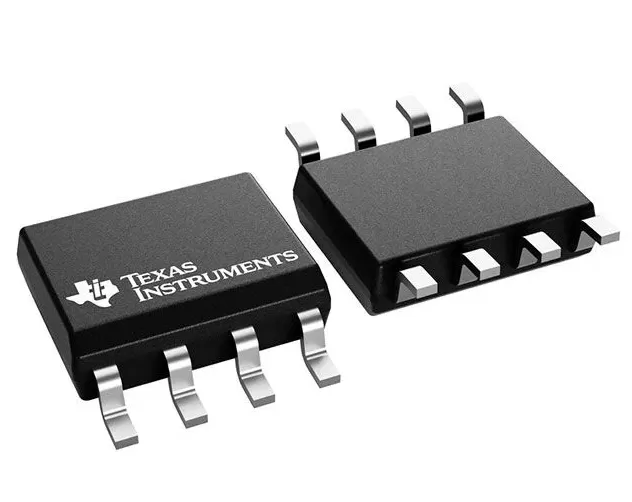

INA821ID
Brand: Texas Instruments
Texas Instruments INA821ID is a power management component designed for Industrial Automation and related applications. In stock at Superb Automation — request a quote for competitive pricing and fast delivery.
Product Specifications
INA821ID
Texas Instruments — Power Management & Signal Chain
Product Overview
The INA821ID from Texas Instruments is a power management / signal chain IC delivering high efficiency, precision regulation, and robust protection. Texas Instruments (TI) is a global leader in analog ICs, power management solutions, and embedded processors.
Superb Automation partners with leading brands including Qorvo, TI, ADI, XILINX, NVIDIA, Intel, ST, MACOM, Renesas, and Coilcraft to provide complete BOM and supply-chain solutions.
Key Features
- High-efficiency power conversion with low quiescent current
- Wide input voltage range with precision output regulation
- Integrated over-current, over-temperature, and short-circuit protection
- Small footprint packaging for space-constrained designs
- AEC-Q100 qualified options available for automotive applications
- Flexible sequencing and soft-start control
Key Specifications
| Input Voltage | V |
| Output Voltage | V |
| Output Current | A |
| Switching Frequency | kHz |
| Efficiency | % |
| Quiescent Current | µA |
| Topology | — |
| Package | — |
| Operating Temp | °C |
| Protection | — |
Applications
Industrial Automation
Automotive Electronics
Telecom Infrastructure
Server & Data Center Power
Medical Devices
Consumer Electronics
Request Quote — In Stock, 100% New & Original, Full Warranty
INA821ID: 4.7 MHz 7 nanovolt instrumentation amplifier in a 8-pin SOIC
INA821ID is a wideband precision instrumentation amplifier in a SOIC body of 8 pins. Seven nanovolts per root hertz, 4.7 MHz at unity gain and 290 kHz at gain 100 make this the fastest low noise member of the 50 kiloohm family before the current feedback part takes over. Offset is 10 microvolts typical, the inputs take 40 volts beyond the rails, and one resistor sets the gain with the 1 plus 49.4 kiloohm over RG relation.
Order code and package
| Order code | INA821ID |
| Function | wideband precision instrumentation amplifier |
| Gain | 1 to 1000, set by one external resistor |
| Gain equation | G equals 1 plus 49.4 kiloohms divided by RG |
| Package | SOIC, 8 pins |
| Other bodies | 8 pin VSSOP and 8 pin WSON |
| Supply | 4.5 V to 36 V single, plus and minus 2.25 to 18 V |
| Input protection | plus or minus 40 V beyond the rails |
| Noise | 7 nanovolts per root hertz |
| Bandwidth | 4.7 MHz at gain 1, 290 kHz at gain 100 |
| Datasheet | SBOS907 revision A |
Electrical parameters that decide the application
| Offset voltage | 10 microvolts typical, 35 microvolts maximum |
| Gain drift | 5 ppm per C at gain 1, 35 ppm per C above gain 1 |
| Common mode rejection | 112 dB minimum at gain 10 |
| Power supply rejection | 110 dB minimum |
| Load stability | 1 nanofarad without a series resistor |
| Temperature range | minus 40 to plus 125 C |
| Output | rail to rail with a reference pin |
| Noise at gain 100 | 7 nanovolts per root hertz input referred, which is below a 16 bit converter floor |
| Slew | set by the 4.7 MHz product rather than by a separate slew specification |
| Family position | widest bandwidth of the 8 nanovolt class parts |
Points to check before this part goes on a BOM
The 4.7 MHz figure is at unity gain, and it falls to 290 kHz at gain 100. A vibration front end that needs 100 kilohertz of bandwidth at gain 100 has room, one that needs 500 kilohertz does not.
Seven nanovolts per root hertz against eight in the sibling parts is a real difference at low gain. At gain 1 the amplifier noise and the source resistance are comparable, so the two nanovolts decide whether a 1 kiloohm source is the dominant term.
Protection drops from 60 volts in the INA818 line to 40 volts here. The wider bandwidth input stage cannot take the same overdrive, so a 24 V loop miswired onto this part is at the edge of the limit rather than inside it.
The gain equation uses 49.4 kiloohms rather than 50, and the difference is not a printing slip. The internal pair is trimmed so the standard resistor value gives the marked gain, which means a substitution between this part and a 50 kiloohm sibling changes the gain by about one percent.
Stability into 1 nanofarad is a converter interface advantage. A switched capacitor input presents a capacitive step at every conversion, and an amplifier that rings on it turns the ringing into a settled error at the sampling instant.
A 4.5 V supply minimum keeps this part off a 3.3 V rail. Where the analogue section is 3.3 V, a boosted rail or a different family is needed, and the current sense parts cover that rail with a narrower input range.
Where this order code fits
Vibration and acoustic front ends, fast bridge sampling and any board that needs both low noise and bandwidth from one amplifier are the users of this order code. Boards comparing it with a neighbouring part start from our Amplifier Cross Reference page, and boards replacing a part that has gone end of life start from the One Stop BOM Sourcing page.
Questions buyers ask
Why 49.4 kiloohms and not 50? The internal resistors are trimmed so that standard resistor values give the marked gain with the printed equation; using the 50 kiloohm equation with this part shifts the gain by about one percent.
Can it drive a 1 megahertz converter directly? It can drive the load, and the bandwidth limit appears first at high gain: at gain 100 the closed loop bandwidth is 290 kHz, well below a 1 megahertz sampling rate.
SUPERB holds and sources this Texas Instruments line for production and repair demand, quoted against the exact ordering string with date codes, packing and country of origin stated on the offer. When a line is moving, the Supplier Quality Audit page sets out the checks that keep a substitute from failing on the bench.