


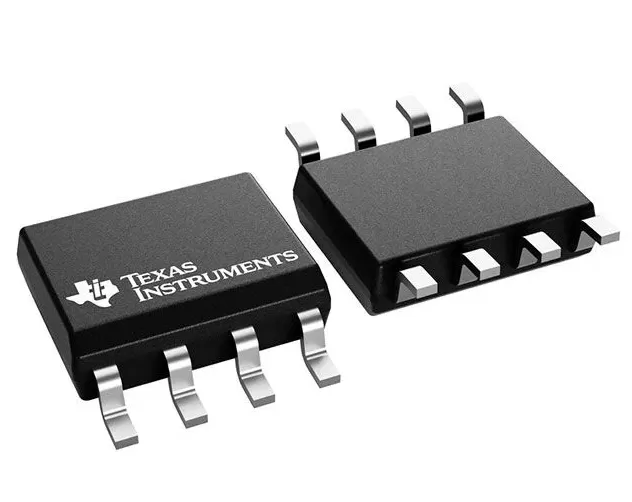

INA163UA2K5
Brand: Texas Instruments
Texas Instruments INA163UA2K5 is a power management component designed for Industrial Automation and related applications. In stock at Superb Automation — request a quote for competitive pricing and fast delivery.
Product Specifications
INA163UA2K5
Texas Instruments — Power Management & Signal Chain
Product Overview
The INA163UA2K5 from Texas Instruments is a power management / signal chain IC delivering high efficiency, precision regulation, and robust protection. Texas Instruments (TI) is a global leader in analog ICs, power management solutions, and embedded processors.
Superb Automation partners with leading brands including Qorvo, TI, ADI, XILINX, NVIDIA, Intel, ST, MACOM, Renesas, and Coilcraft to provide complete BOM and supply-chain solutions.
Key Features
- High-efficiency power conversion with low quiescent current
- Wide input voltage range with precision output regulation
- Integrated over-current, over-temperature, and short-circuit protection
- Small footprint packaging for space-constrained designs
- AEC-Q100 qualified options available for automotive applications
- Flexible sequencing and soft-start control
Key Specifications
| Input Voltage | V |
| Output Voltage | V |
| Output Current | A |
| Switching Frequency | kHz |
| Efficiency | % |
| Quiescent Current | µA |
| Topology | — |
| Package | — |
| Operating Temp | °C |
| Protection | — |
Applications
Industrial Automation
Automotive Electronics
Telecom Infrastructure
Server & Data Center Power
Medical Devices
Consumer Electronics
Request Quote — In Stock, 100% New & Original, Full Warranty
INA163UA2K5: the same amplifier on a 2500 piece reel
INA163UA2K5 is the fourteen pin SOIC on a 2500 piece large reel, with the marking INA163UA and a moisture level of 3 with a 168 hour floor life. The electrical rows are the tube rows: 1 nanovolt per root hertz, 0.002 per cent of distortion at a gain of 100, 800 kHz at that gain, 15 volts per microsecond and a gain law of 1 plus 6 kohm over RG.
A reel of a specialist audio amplifier is a statement about volume. Two thousand five hundred pieces at one or two per channel is a product line rather than a prototype, and at that point the offset row written as a function of gain starts to matter for the test fixture: 300 microvolts maximum at a gain of 100 means the fixture can trim once rather than twice, and 1.2 microvolts per degree means the trim holds.
INA163UA2K5 as the vendor document publishes it
| Gain range | 1 to 10000 V/V |
| Gain law | 1 plus 6 kohm divided by RG |
| Gain error, G = 1 | 0.1 per cent typical, 0.25 maximum |
| Gain error, G = 100 | 0.2 per cent maximum |
| Gain drift, G = 1 | 1 ppm per degree typical, 10 maximum |
| Gain drift, G above 10 | 25 ppm per degree typical, 100 maximum |
| Nonlinearity, G = 1 | 0.0003 per cent of full scale |
| Offset | 50 plus 2000 over G microvolts typical, 250 plus 5000 over G maximum |
| Offset drift | 1 plus 20 over G microvolts per degree |
| Supply rejection | 1 plus 50 over G microvolts per volt typical |
| Common mode rejection, G = 1 | 70 dB minimum, 80 typical |
| Common mode rejection, G = 100 | 100 dB minimum, 116 typical |
| Input bias current | 2 microamps typical, 12 maximum |
| Input impedance | 60 megohms in parallel with 2 picofarads |
| Voltage noise at 1 kHz | 1 nanovolt per root hertz |
| Distortion at 1 kHz, G = 100 | 0.002 per cent total harmonic plus noise |
| Bandwidth, G = 1 | 3.4 MHz |
| Bandwidth, G = 100 | 800 kHz |
| Slew rate | 15 volts per microsecond |
| Settling to 0.01 per cent, G = 100 | 3.5 microseconds on a 10 V step |
| Output swing | within 2 volts of each rail into 2 kohm |
| Quiescent current | 10 milliamps typical, 12 maximum |
| Supply range | plus or minus 4.5 to plus or minus 18 volts |
| Body | fourteen pin SOIC, marking INA163UA |
| Temperature range | minus 40 to plus 85 degrees specified |
| Catalogue code | INA163UA2K5 |
| Vendor string | INA163UA/2K5 |
| Carrier | 2500 piece large reel |
| Moisture level | level 3, 260 degrees, 168 hour floor life |
A gain of 1 to 10000 from one resistor
Gain on INA163UA2K5 is set by a single external resistor and the law is 1 plus 6 kohm divided by RG, so a 6 kohm resistor gives 2, a 600 ohm gives 11, a 60 ohm gives 101 and a 6 ohm gives 1001. The range is quoted as 1 to 10000 V/V and the vendor's gain accuracy note is explicit that the number depends on the external resistor: the internal network is trimmed to 0.1 per cent at a gain of 1, but the resistor's tolerance, its drift and its parasitic inductance all enter at every other gain.
What the current feedback topology changes is the bandwidth. A voltage feedback instrumentation amplifier loses bandwidth in proportion to gain; this one holds 800 kHz at a gain of 100 and 3.4 MHz at unity, a ratio of four for a gain ratio of a hundred, and the vendor's gain against frequency curves show the same shallow slope at every step. That is what makes a gain of 1000 at audio frequencies practical, and it is also why the part does not need a compensation capacitor at any gain.
Offset written as a function of gain
The offset row on INA163UA2K5 is written as 50 plus 2000 divided by G microvolts typical and 250 plus 5000 divided by G maximum, which at a gain of 1 is 2.05 and 5.25 millivolts, at a gain of 100 is 70 and 300 microvolts, and at a gain of 1000 is 52 and 255 microvolts. Drift follows the same shape, 1 plus 20 over G microvolts per degree typical. The reason is that the input stage's offset is referred to the input while the output stage's offset is divided by the gain, so the first term dominates at high gain and the second at low gain.
Reading the row correctly changes what a gain of 1 channel can be used for. At unity the part has 5.25 millivolts of maximum offset and a drift of 21 microvolts per degree, which is a monitoring grade front end and not a precision one, however good the noise is. At a gain of 100 the same part has 300 microvolts of offset and 1.2 microvolts per degree, which is a measurement grade channel. The part is not better at high gain by accident; the topology refers the output stage error back through the gain.
One nanovolt per root hertz and 0.002 per cent of distortion
INA163UA2K5 is a current feedback instrumentation amplifier built for one job: amplifying a very small signal without adding noise or distortion. Voltage noise is 1 nanovolt per root hertz at 1 kHz, 1.2 at 100 Hz and 2 at 10 Hz referred to the input, current noise is 0.8 picoamps per root hertz, and the output stage contributes 60 nanovolts per root hertz. Total harmonic distortion plus noise is 0.002 per cent at 1 kHz and a gain of 100.
Against a 200 ohm source, which is what a moving coil cartridge or a low impedance microphone presents, the voltage noise and the thermal noise of the source are within a factor of two of each other, and the vendor says so: the part delivers near theoretical noise performance for that source. On a 10 kohm source the source noise dominates and the 1 nanovolt is wasted. That is why the family lists microphone preamps and moving coil transducers first and why the bias current, not the noise, is what limits it on a high impedance sensor.
Eight hundred kilohertz at a gain of 100
Slew rate on INA163UA2K5 is 15 volts per microsecond, settling to 0.1 per cent on a 10 volt step at a gain of 100 is 2 microseconds and to 0.01 per cent 3.5 microseconds, overload recovery from a 50 per cent overdrive is 1 microsecond, and the output is stable into 1000 picofarads. The 800 kHz at a gain of 100 is the row that matters for audio: it keeps the closed loop flat to well past 20 kHz at a gain that a microphone preamp actually uses, and it keeps the distortion mechanism, which is a slew rate effect at high frequency, out of the audio band.
The output swing is within 2 volts of each rail minimum and 1.8 typical into a 2 kohm load, so on plus or minus 15 volts the usable output is about plus or minus 13 volts, which is 26 volts peak to peak or 9.2 volts RMS. For a professional audio chain running plus or minus 15 volt rails that is the standard headroom, and the part's 60 milliamp short circuit current is what allows it to drive a 600 ohm load without an external buffer.
Plus or minus 4.5 to 18 volts and the fourteen pin body
INA163UA2K5 runs from a supply between plus or minus 4.5 and plus or minus 18 volts, rated at plus or minus 15, and draws 10 milliamps typical and 12 maximum quiescent. That is a high current for a front end amplifier and it is what the 1 nanovolt input stage and the 800 kHz bandwidth at a gain of 100 cost. The body is the fourteen pin SOIC, specified from minus 40 to plus 85 degrees with operation to plus 125, at 100 degrees per watt junction to ambient, so 12 milliamps at 30 volts total is 360 milliwatts and a 36 degree rise.
The single body and the single grade are worth knowing before a second source is discussed. The catalogue carries INA163UA2K5 in a tube and on a 2500 piece reel, both with the marking INA163UA and a moisture level of 3 with a 168 hour floor life. There is no automotive row and no dual member of the family, so a channel that needs two of these needs two packages, and a board that has to fit a smaller body is looking at a different family rather than at a variant of this one.
Two microamps of bias current is the price of the noise
Bias current on INA163UA2K5 is 2 microamps typical and 12 maximum, with 10 nanoamps per degree of drift, an offset current of 0.1 microamps typical and 1 maximum, and an input impedance of 60 megohms in parallel with 2 picofarads. Those are bipolar input numbers and they are the direct consequence of a 1 nanovolt input stage: a low voltage noise bipolar pair carries a high base current, and no amount of trimming removes it.
The arithmetic is unforgiving on a high impedance source. Twelve microamps into 1 kohm is 12 millivolts of error, two thousand times the maximum offset at the same gain, and into 10 kohm it is 120 millivolts, which saturates the output at any useful gain. On a 200 ohm source, which is the case the part was built for, the same current is 2.4 millivolts. That is why the family's application list starts with microphones and moving coil transducers and mentions bridges second: a 350 ohm bridge is inside the window, a 10 kohm one is not.
The reel is the carrier a line needs and the moisture level of 3 is what the storage plan has to allow for. Our date code management page covers the floor life clock, and the traceability report page covers what travels with the reel through the build.
Does the reel change the marking? No. The body marking is INA163UA on both the tube and the reel.
Is there a dual version of this part? No. Two channels need two packages, and the fourteen pin body is the only one in the family.