


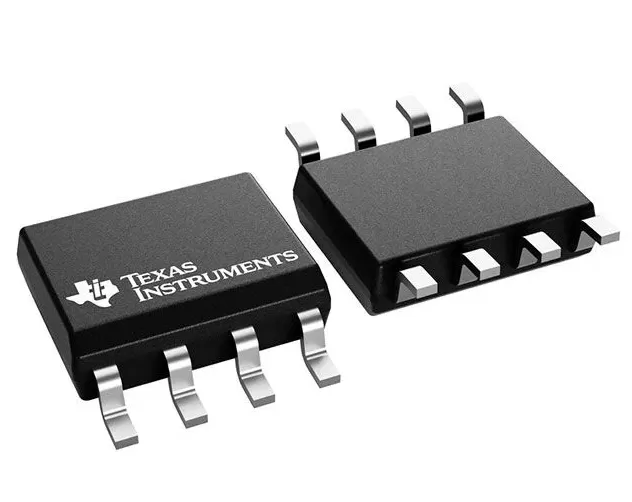

INA154U2K5
Brand: Texas Instruments
Texas Instruments INA154U2K5 is a power management component designed for Industrial Automation and related applications. In stock at Superb Automation — request a quote for competitive pricing and fast delivery.
Product Specifications
INA154U2K5
Texas Instruments — Power Management & Signal Chain
Product Overview
The INA154U2K5 from Texas Instruments is a power management / signal chain IC delivering high efficiency, precision regulation, and robust protection. Texas Instruments (TI) is a global leader in analog ICs, power management solutions, and embedded processors.
Superb Automation partners with leading brands including Qorvo, TI, ADI, XILINX, NVIDIA, Intel, ST, MACOM, Renesas, and Coilcraft to provide complete BOM and supply-chain solutions.
Key Features
- High-efficiency power conversion with low quiescent current
- Wide input voltage range with precision output regulation
- Integrated over-current, over-temperature, and short-circuit protection
- Small footprint packaging for space-constrained designs
- AEC-Q100 qualified options available for automotive applications
- Flexible sequencing and soft-start control
Key Specifications
| Input Voltage | V |
| Output Voltage | V |
| Output Current | A |
| Switching Frequency | kHz |
| Efficiency | % |
| Quiescent Current | µA |
| Topology | — |
| Package | — |
| Operating Temp | °C |
| Protection | — |
Applications
Industrial Automation
Automotive Electronics
Telecom Infrastructure
Server & Data Center Power
Medical Devices
Consumer Electronics
Request Quote — In Stock, 100% New & Original, Full Warranty
INA154U2K5: a 2500 piece reel of the unity gain difference amplifier
INA154U2K5 is the U grade of the INA154 on a 2500 piece reel. The code decodes into three facts: U is the tighter offset bin at 750 microvolts maximum, 2K5 is the reel quantity, and the missing suffix is the gain, because the 25 kohm network fixes it at 1 V/V and nothing external changes it.
Two thousand five hundred pieces at 3.1 MHz is a lot of channels for a part that is usually used one or two per board. The reason to buy the reel anyway is that a cut length is not a stock position: a reel can be drawn down over years, it is the carrier the feeder expects, and the vendor's shelf life clock is on the moisture label rather than on the parts. The page keeps the carrier and the electrical window on the same sheet so the order line and the channel budget are decided together.
INA154U2K5 as the vendor document publishes it
| Gain | 1 V/V fixed |
| Gain error | 0.02 per cent typical, 0.05 maximum |
| Gain drift | 1 ppm per degree typical, 10 maximum |
| Nonlinearity | 0.0001 per cent typical, 0.001 maximum of full scale |
| Offset | 100 microvolts typical, 750 maximum |
| Offset drift | 2 microvolts per degree typical, 20 maximum |
| Supply rejection | 5 microvolts per volt typical, 60 maximum |
| Input impedance | 50 kohm differential, 50 kohm common mode |
| Common mode rejection | 80 dB minimum, 90 typical |
| Voltage noise | 2.6 microvolts peak to peak, 52 nanovolts per root hertz at 1 kHz |
| Bandwidth | 3.1 MHz small signal |
| Slew rate | 14 volts per microsecond |
| Settling to 0.01 per cent | 3 microseconds on a 10 V step |
| Overload recovery | 3 microseconds from a 50 per cent overdrive |
| Output swing | within 1.8 volts of the positive rail into 10 kohm |
| Quiescent current | 2.4 milliamps typical, 2.9 maximum |
| Supply range | plus or minus 4 to plus or minus 18 volts |
| Current limit | 60 milliamps continuous |
| Stable load capacitance | 500 picofarads |
| Body | eight pin SOIC |
| Temperature range | minus 40 to plus 85 degrees |
| Catalogue code | INA154U2K5 |
| Vendor string | INA154U/2K5 |
| Carrier | 2500 piece reel |
| Grade | U, 750 microvolts maximum offset |
Unity gain from a 25 kohm network
INA154U2K5 is a unity gain difference amplifier built from a precision op amp and a pair of 25 kohm resistors on each input, trimmed as a ratio to a gain of 1 V/V with 0.02 per cent typical and 0.05 per cent maximum gain error on the U grade, 0.1 on the UA. Nonlinearity is 0.0001 per cent typical and 0.001 maximum, and the ratio holds over temperature at 1 ppm per degree typical and 10 maximum.
The network is not adjustable and the gain is not meant to be changed, which simplifies everything downstream: the input impedance is fixed at 50 kohm, the bandwidth is fixed at 3.1 MHz and the common mode range is a known function of the supply. On a differential line receiver or a current shunt monitor that is exactly the right trade, because the alternative is four resistors whose ratio has to be trusted and whose tracking over temperature has to be measured.
750 microvolts on the U grade and 1500 on the UA
Offset on INA154U2K5 is 100 microvolts typical and 750 maximum on the U grade referred to the output, with 2 microvolts per degree of drift; the UA grade is 1500 microvolts maximum with a drift the vendor leaves to the typical curve. Supply rejection is 5 microvolts per volt typical and 60 maximum over plus or minus 4 to plus or minus 18 volts, and the noise is 2.6 microvolts peak to peak from 0.1 to 10 Hz and 52 nanovolts per root hertz at 1 kHz.
At unity gain the offset is the same number at the input and at the output, which makes the budget simple: 750 microvolts on a plus or minus 10 volt span is 0.0075 per cent of full scale and a sixteenth of what a 16 bit converter resolves. The drift is the term that matters on a channel calibrated once, 2 microvolts per degree or 90 microvolts over 45 degrees, an eighth of the initial offset. That is why the U grade exists and why the UA grade is specified with a typical drift curve rather than a limit.
3.1 MHz and 14 volts per microsecond
INA154U2K5 carries 3.1 MHz of small signal bandwidth and a 14 volt per microsecond slew rate, with a settling time of 2 microseconds to 0.1 per cent and 3 to 0.01 on a 10 V step into a 100 pF load, and overload recovery of 3 microseconds from a 50 per cent overdrive. That combination is fast for a difference amplifier and is the reason the family lists synchronous demodulation among its applications.
The scan arithmetic is generous: sixteen channels at 3 microseconds is 48 microseconds, so the amplifier is not the limit in any multiplexed system built around it. The slew rate sets the large signal behaviour, and a 10 V step at 14 volts per microsecond is 0.7 microseconds of ramp, which is consistent with the 2 microsecond settling figure. What the part will not do is drive a heavy load at that speed: the output current limit is 60 milliamps and the stable load capacitance is 500 picofarads.
50 kohms on both inputs, and the imbalance it punishes
The input impedance of INA154U2K5 is 50 kohm differential and 50 kohm common mode, which is symmetric and high enough that a 1 kohm source loses 2 per cent of the signal and a 100 ohm source 0.2 per cent. Common mode range extends beyond both rails, to twice the positive rail minus 4 volts and twice the negative rail plus 2 volts with the output at zero.
Symmetric does not mean insensitive. Two per cent of signal loss from a 1 kohm source is forty times the 0.05 per cent gain error, so a source resistance belongs in the calibration, and any difference between the two source resistances converts common mode into a differential error at the rate of the mismatch. A protection resistor added to one input for a cable fault has to be matched on the other, and a filter capacitor on one input has to be matched on the other for the same reason at frequencies above a few hundred kilohertz.
2.4 milliamps and plus or minus 4 to 18 volts
INA154U2K5 draws 2.4 milliamps typical and 2.9 maximum, from a supply between plus or minus 4 and plus or minus 18 volts, and the output reaches to within 1.8 volts of the positive rail and 1.6 of the negative into a 10 kohm load. Current limit is 60 milliamps continuous into the common point and the part is stable into 500 picofarads.
The 2.4 milliamps is high next to the 570 microamps of the INA145 and that is the cost of 3 MHz and 14 volts per microsecond in the same body. In a mains powered instrument it is irrelevant. In a battery instrument it rules the part out unless the measurement is fast and intermittent, in which case the 4 volt floor of the supply window is the second constraint: a 3.3 V rail is below the minimum, so the part needs a boosted rail or a different family.
What a unity gain difference amplifier is for, and where it stops
INA154U2K5 earns its place as an instrumentation building block: a differential line receiver on a long cable, a current shunt monitor on a high side rail within its common mode window, a summing amplifier, a synchronous demodulator front end, or the input stage of a discrete instrumentation amplifier where the gain is set by a following stage. In each case the value is the trimmed 25 kohm ratio, which no four resistor build matches without a matched network.
It stops at three things. A source impedance above a few kilohertz of impedance times capacitance, where the 50 kohm input and the 3 MHz bandwidth together produce a phase shift that erodes the rejection. A common mode beyond twice the supply, which is generous but finite. And a supply below 4 volts, because the window starts there. A channel that needs any of those is a different part, and the family that covers it is the programmable gain one rather than this fixed unity gain member.
A reel is a stock decision and this one is easy to justify because the part has no shelf life limit beyond its moisture level. Our date code management page covers how that stock is aged and labelled, and the BOM shortage recovery page covers the route when the reel is not on the shelf and a build is already released.
Is INA154U2K5 the same part as INA154U/2K5? Yes. The slash is dropped in catalogue renderings and kept in the vendor addendum, and the grade, the body and the reel do not change with the spelling.
Can the gain be trimmed to something other than 1? Not with this part. The 25 kohm network is on the die and the ratio is fixed; a channel that needs gain needs a second stage, and the INA145 or INA163 is the family that carries a gain resistor.