


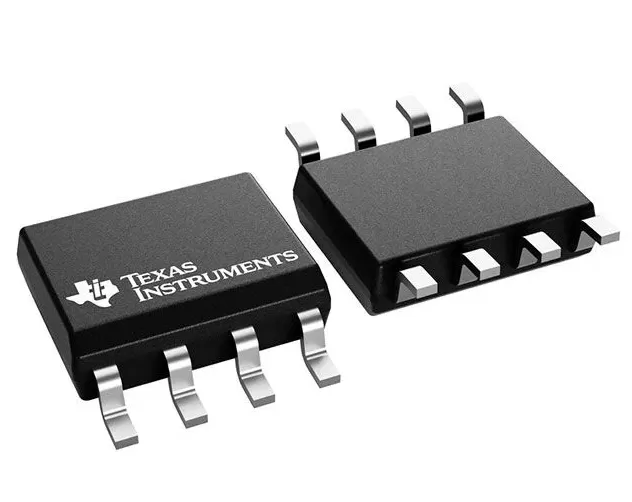

INA122UA
Brand: Texas Instruments
Texas Instruments INA122UA is a power management component designed for Industrial Automation and related applications. In stock at Superb Automation — request a quote for competitive pricing and fast delivery.
Product Specifications
INA122UA
Texas Instruments — Power Management & Signal Chain
Product Overview
The INA122UA from Texas Instruments is a power management / signal chain IC delivering high efficiency, precision regulation, and robust protection. Texas Instruments (TI) is a global leader in analog ICs, power management solutions, and embedded processors.
Superb Automation partners with leading brands including Qorvo, TI, ADI, XILINX, NVIDIA, Intel, ST, MACOM, Renesas, and Coilcraft to provide complete BOM and supply-chain solutions.
Key Features
- High-efficiency power conversion with low quiescent current
- Wide input voltage range with precision output regulation
- Integrated over-current, over-temperature, and short-circuit protection
- Small footprint packaging for space-constrained designs
- AEC-Q100 qualified options available for automotive applications
- Flexible sequencing and soft-start control
Key Specifications
| Input Voltage | V |
| Output Voltage | V |
| Output Current | A |
| Switching Frequency | kHz |
| Efficiency | % |
| Quiescent Current | µA |
| Topology | — |
| Package | — |
| Operating Temp | °C |
| Protection | — |
Applications
Industrial Automation
Automotive Electronics
Telecom Infrastructure
Server & Data Center Power
Medical Devices
Consumer Electronics
Request Quote — In Stock, 100% New & Original, Full Warranty
INA122UA: the A grade of the micropower amplifier in the SO-8 body
The INA122UA is the tighter trimmed bin of the surface mount member: same die, same two op amp topology, same 60 µA, same rail to rail output, same 4.9 by 6 mm body as the plain U row, and a graded offset rather than a graded package. It is the part to choose when the channel has no trim and the offset has to hold at the factory value over temperature.
On a portable instrument that is calibrated once by the sensor rather than by the electronics, the amplifier offset is a fixed error that shows up as a zero error. A tighter bin reduces that error and costs a few cents, which on a product built in thousands is cheaper than a calibration step.
The INA122UA rows as the addendum publishes them
| Part class | Single supply micropower instrumentation amplifier |
| Vendor status | ACTIVE, production data |
| Data sheet | SBOS069B |
| Grade | A suffix, tighter trimmed bin |
| Supply range | 2.2 V to 36 V single or dual |
| Quiescent current | 60 µA |
| Output swing | Rail to rail |
| Gain equation | G = 5 + 200 kΩ divided by RG |
| Input offset voltage | 250 µV maximum, family row |
| Offset drift | 3 µV per degree maximum |
| Input bias current | 25 nA maximum |
| Body | SOIC, D outline, 8 pins |
| Carrier | Tube row for this string |
| Reel sibling | INA122UA/2K5, 2500 pieces |
| Plain bin sibling | INA122U, same body and carrier |
| Moisture level | Level 3, 260 degrees, 168 hour floor life |
| Temperature range | Minus 40 to plus 85 degrees |
The carrier row is the one a small build gets wrong. A tube of surface mount parts is not a production carrier, and a build of 200 boards needs four tubes opened, four moisture exposures and four label records, against one reel. The reel is the better carrier above a hundred pieces, and the tube exists for the prototype.
Grading, drift and the difference that is not published
The addendum lists the plain and the A rows separately, and the datasheet publishes the electrical table for the family. That means the A bin is a test limit rather than a separate table, and a customer who wants the tighter limit in writing has to ask for the grade on the order and accept the family table as the specification. This is normal for Burr-Brown parts of this generation, and it is a point that a purchasing department unfamiliar with the family will question.
What no grade changes is the drift. Three microvolts per degree is a family row, and a 40 degree excursion moves the offset by 120 µV regardless of bin. A channel that is specified to hold 100 µV over temperature cannot be built with this part at any grade, and the correct answer is a different family rather than a tighter bin.
The two op amp stage in a compact assembly
A 4.9 by 6 mm body leaves little room for the surrounding parts, and the gain resistor is the one that has to be close. At a gain of 100 the resistor is about 1.9 kΩ; at a gain of 500 it is about 400 Ω. A 0402 part placed within 2 mm of the RG pins keeps the loop small and the stray capacitance low, and the trace should not pass near the input pins because the gain node is a high impedance point at high gain.
The reference divider is the other nearby part. On a single supply a divider sets the output zero, and its noise appears directly at the output. A 100 nF across the lower resistor is the usual fix, and it costs a component that is often left out of the bill of materials because it does not appear in the application circuit.
Applications where the A bin earns its keep
A handheld pressure calibrator is a good example: a bridge sensor, a 3 V supply, a display, and no calibration step for the electronics because the unit is calibrated against a reference pressure at the factory. The zero error of the channel is set by the amplifier offset, and a tighter bin is a direct improvement in the product's accuracy specification at the low end of its range.
A battery powered temperature transmitter is the second example. A thermocouple or an RTD front end with a gain of 100 and a 10 mV full scale is limited by offset and drift rather than by noise, and the A bin reduces the offset term without touching the power budget. The drift term remains, and at 3 µV per degree a 50 degree ambient swing is 150 µV, which on a 10 mV scale is 1.5 per cent: the transmitter either compensates the ambient or specifies a narrower range.
Buying INA122UA
The tube and the reel are both active, and the grade is the A bin. A purchase order should name the grade and the carrier, because three strings share the body and only two of them are the A bin. A receiving check that reads the label is enough, provided the label is read against the order rather than against the previous order.
For a long programme, the micropower single supply category has more substitutes than the precision bipolar one, so the obsolescence risk is lower and the substitution risk is higher. Our drop in replacement verification page covers the checks we run before proposing a substitute, and the amplifier cross reference page lists the families we compare against.
Calibrating the channel without a trim network
A channel with no trim is calibrated in software, and the calibration is only as good as the stability of the offset it removes. If the offset at the calibration temperature is removed by a stored constant, the residual is the drift times the excursion, which is 3 µV per degree on this family. A 30 degree excursion leaves 90 µV, and on a 10 mV full scale that is 0.9 per cent, which is the number that has to fit in the specification rather than the room temperature offset.
The A bin helps at the point of calibration rather than after it. A part with a wider offset may sit at the edge of the software's correction range, and a calibration routine with a fixed range will fail on those units rather than correct them. Widening the correction range costs nothing in hardware and is the pragmatic answer when the grade cannot be tightened.
A second calibration point at a higher temperature is the only way to remove the drift term, and it doubles the test time. A programme that cannot afford it should specify the channel accuracy over a narrower temperature range rather than claim a figure that only holds at room temperature.
The pressure test that catches the offset problem is a simple one: short both inputs and read the output at the lowest gain in use. A channel that reads a large offset at a shorted input has an offset problem rather than a sensor problem, and the reading is taken in a second rather than after an hour of fault finding. It belongs in the first article check rather than in the production flow, because it is the amplifier that changes and not the sensor.
Questions that arrive with this part number
Whether the A bin is worth the premium is the first question, and the answer depends on whether the channel has a trim. With a trim the bin is irrelevant at room temperature and the drift dominates; without a trim the bin is the zero error. Whether the part can be used below 2.2 V is the second, and it cannot: the supply floor is a hard limit, and a 1.8 V rail needs a different family.
The third question is the minimum gain of 5, which is set by the topology. A channel that needs unity gain cannot use this part, and an engineer who tries will find the resistor equation gives a negative value rather than a warning.