


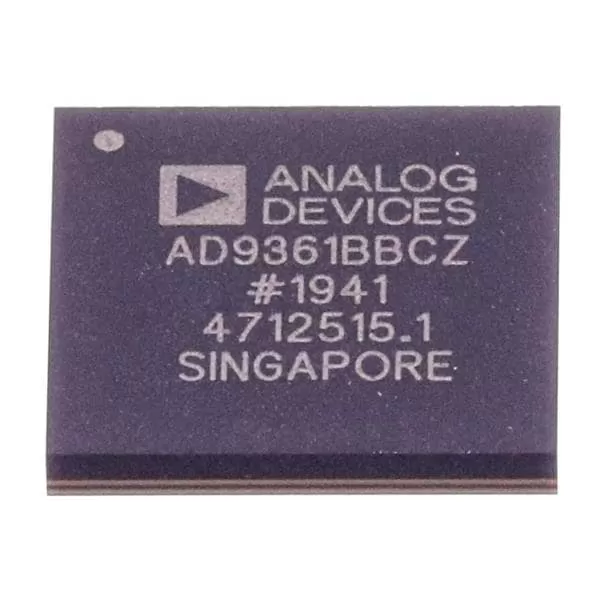

LTC2484IDD#TRPBF
Brand: Analog Devices
Analog Devices LTC2484IDD#TRPBF is a analog & mixed-signal component designed for Precision Instrumentation and related applications. In stock at Superb Automation — request a quote for competitive pricing and fast delivery.
Product Specifications
LTC2484IDD#TRPBF
Analog Devices — Analog & Mixed-Signal ICs
Product Overview
The LTC2484IDD#TRPBF from Analog Devices is a high-performance analog / mixed-signal IC providing precision signal acquisition, conversion, and conditioning. Analog Devices (ADI) is a world leader in high-performance analog, mixed-signal, and DSP ICs for instrumentation, healthcare, automotive, and communications.
Superb Automation partners with leading brands including Qorvo, TI, ADI, XILINX, NVIDIA, Intel, ST, MACOM, Renesas, and Coilcraft to provide complete BOM and supply-chain solutions.
Key Features
- High-resolution data conversion with excellent SNR and THD
- Wide dynamic range and high linearity across operating conditions
- Integrated voltage reference with low temperature drift
- Flexible digital interface — SPI, I2C, or parallel options
- Industrial/automotive temperature range with guaranteed specs
- Low power consumption with power-down modes
Key Specifications
| Resolution | bits |
| Channels | — |
| Sample Rate | kSPS |
| Interface | — |
| Supply Voltage | V |
| Operating Temp | °C |
| Package | — |
| INL | LSB |
| SNR | dB |
| THD | dB |
Applications
Precision Instrumentation
Industrial Process Control
Medical Imaging & Diagnostics
Automotive Sensor Interfaces
Communications Infrastructure
Test & Measurement
LTC2484IDD#TRPBF: 24 Bits of Output, 20 Bits of Noise, 16 Bits of Accuracy
The LTC2484IDD#TRPBF is a 24-bit delta sigma converter with a patented input sampling scheme the vendor calls Easy Drive. It digitises high impedance sensors directly, with no differential input current and no external buffer, accepts a common mode range from ground to the supply regardless of the reference, and takes a reference anywhere from 100 mV to the supply rail. Integral nonlinearity is 2 ppm, there are no missing codes, offset error is 1 ppm, total unadjusted error is 15 ppm, noise is 600 nV rms, the line frequency rejection is selectable as 50 Hz, 60 Hz or both at once, a 2x speed mode doubles the rate to 15 Hz on the internal oscillator, and the digital filter settles in a single cycle so every reading is valid after an input step. It runs from 2.7 V to 5.5 V, needs no external crystal, and comes in a 3 mm by 3 mm 10-lead DFN.
Easy Drive is the reason this converter is used with bridges, thermistors and strain gauges rather than behind an instrumentation amplifier. A classic switched capacitor input draws a charge packet from the source at every conversion, so a 10 kohm bridge produces an error that grows with the source resistance. Here the differential input current is cancelled at the input, so the source resistance stops being an error term and the sensor can connect directly.
Three numbers, three different jobs
Twenty-four bits is the word length. At a 5 V full scale one code is 298 nV. The noise floor is 600 nV rms, which is 2.01 codes, and with a crest factor of 6.6 the peak to peak noise is 3.96 uV, so the noise free resolution is 20.3 bits. The total unadjusted error of 15 ppm is 75 uV at 5 V, which is 252 codes or 16.0 bits of absolute accuracy. So a customer who asks for 24 bits receives 20 bits of noise free resolution and 16 bits of absolute accuracy in the same package, and the number that matters depends on whether the measurement is a change or an absolute value.
The 2 ppm integral nonlinearity is 10 uV at 5 V, 33.6 codes, which sits below the total unadjusted error and is not the limit. The offset of 1 ppm is 5 uV, 16.8 codes. Combining those terms is what produces the 15 ppm figure, so quoting the linearity alone describes the converter better than it describes the measurement.
Lowering the reference raises the code count and lowers the usable bits
The reference may go as low as 100 mV, which makes one code 5.96 nV and looks like a 24-bit converter with an enormous resolution. The noise floor does not scale with the reference, so 600 nV rms against a 100 mV full scale is 1.5e-5 of full scale, or 17.3 bits of noise free resolution. A ratiometric bridge measurement on a 100 mV reference is a legitimate use, but it buys span, not resolution, and the arithmetic has to be done on the noise in volts rather than on the code count.
The conversion rate sets the other end. The 2x mode gives 15 Hz on the internal oscillator, so the normal rate is 7.5 Hz, which is 133 ms per reading with simultaneous 50 Hz and 60 Hz rejection. That is a scale or a temperature channel, not a control loop. A multiplexed front end benefits from the single cycle settling: the reading after a channel change is valid, so four sensors at 7.5 Hz each need no settling interval and the scan rate stays at 7.5 Hz per channel only if the multiplexer keeps up.
| Word length | 24 bit, one code is 298 nV at a 5 V full scale |
| Noise | 600 nV rms, 2.01 codes, 20.3 bits noise free at a crest factor of 6.6 |
| Accuracy | 15 ppm total unadjusted error, 75 uV at 5 V, 16.0 bits absolute |
| Linearity | 2 ppm INL, 10 uV at 5 V, no missing codes |
| Offset | 1 ppm, 5 uV at 5 V |
| Input | Rail to rail, zero differential input current, direct sensor connection |
| Reference | 100 mV to the supply rail, common mode independent of the reference |
| Rejection | 50 Hz, 60 Hz or both, selectable |
| Rate | 7.5 Hz normal, 15 Hz in 2x mode, single cycle settling |
| Supply and package | 2.7 V to 5.5 V, internal oscillator, 10-lead DFN 3 mm by 3 mm |
Two questions buyers ask
Can a 10 kohm bridge connect without an amplifier?
Yes, and that is the point of the input stage. The differential input current is cancelled, so the source resistance does not produce the gain error a switched capacitor input would. The remaining error terms are the reference and the bridge excitation, both of which are ratios in a ratiometric measurement and therefore cancel.
Is 600 nV rms the same as 24 bits?
No. Twenty-four bits is the word length and sets the smallest code, 298 nV at 5 V. The 600 nV rms noise bounds the resolution at about 20 bits. The 15 ppm total unadjusted error bounds the absolute accuracy at 16 bits. A specification that quotes only the word length is quoting the interface, not the measurement.
Ordering and supply
The IDD suffix is the 10-lead DFN on the industrial temperature grade. The same family contains parts with different input structures, so a line item that names only 24 bits and a DFN body can deliver a converter whose input current depends on the source impedance. With this part the input structure is the whole reason for the order, so it belongs in the description next to the part number.
We source this family for production and for repair lots. Start at the analog mixed signal ICs family page, compare a candidate against the ADC and DAC cross reference, and where a converter has to go into an instrument that is already qualified, the checks in how to verify a drop in replacement cover the input current and the reference range before the first board is built.
Request Quote — In Stock, 100% New & Original, Full Warranty