
ISOM8111DFGRQ1
Brand: Texas Instruments
Texas Instruments ISOM8111DFGRQ1 is a power management component designed for AI Servers & Low-Altitude Economy (Drone and UAV) and related applications. In stock at Superb Automation — request a quote for competitive pricing and fast delivery.
Product Specifications
ISOM8111DFGRQ1
Texas Instruments — Power Management & Signal Chain
Product Overview
The ISOM8111DFGRQ1 from Texas Instruments is a power management / signal chain IC delivering high efficiency, precision regulation, and robust protection. Texas Instruments (TI) is a global leader in analog ICs, power management solutions, and embedded processors.
Superb Automation partners with leading brands including Qorvo, TI, ADI, XILINX, NVIDIA, Intel, ST, MACOM, Renesas, and Coilcraft to provide complete BOM and supply-chain solutions.
Key Features
- High-efficiency power conversion with low quiescent current
- Wide input voltage range with precision output regulation
- Integrated over-current, over-temperature, and short-circuit protection
- Small footprint packaging for space-constrained designs
- AEC-Q100 qualified options available for automotive applications
- Flexible sequencing and soft-start control
Key Specifications
| Input Voltage | V |
| Output Voltage | V |
| Output Current | A |
| Switching Frequency | kHz |
| Efficiency | % |
| Quiescent Current | µA |
| Topology | — |
| Package | — |
| Operating Temp | °C |
| Protection | — |
Applications
Industrial Automation
Automotive Electronics
Telecom Infrastructure
Server & Data Center Power
Medical Devices
Consumer Electronics
Request Quote — In Stock, 100% New & Original, Full Warranty
ISOM8111DFGRQ1: an optocoupler footprint with a silicon barrier behind it
The ISOM8111DFGRQ1 is a single channel opto-emulator in a four pin SOIC body. On the input side it emulates an LED and draws current like one. On the output side it drives a phototransistor-like stage with a current transfer ratio of 150 to 230 per cent at 5 mA of input current and 5 V of collector voltage. The point of the part is the footprint: it drops into a circuit built for an industry standard phototransistor optocoupler, and it replaces the LED and the light path with a silicon dioxide barrier.
What changes is drift. An optocoupler loses transfer ratio as the LED ages, and the circuit around it is usually built with margin for that decay. A capacitive barrier does not age the same way, so the transfer ratio stays flat over temperature and over life, and the margin that was spent on LED decay can be spent on something else or removed. The device is rated with a collector emitter voltage of 80 V maximum and an input forward current of 50 mA maximum, so the surrounding circuit does not have to change its limits.
Isolation depends on the body option. The family reaches 3750 VRMS and 5000 VRMS depending on the package, with a working voltage of 500 VRMS to 750 VRMS and a repetitive peak of 1061 VPK. Turn on time for this transfer ratio class is 4.5 microseconds typical at 10 V of collector supply, 2 mA of collector current and a 100 ohm load.
Key data for the ISOM8111DFGRQ1
| Function | Single channel opto-emulator with LED-emulator input and analog transistor output |
| Transfer ratio | 150 per cent to 230 per cent at 5 mA input and 5 V collector, the 8111 grade of the family |
| Voltage limits | Collector emitter 80 V maximum, input forward current 50 mA maximum |
| Isolation | 3750 VRMS or 5000 VRMS depending on the package, working voltage 500 VRMS to 750 VRMS, 1061 VPK repetitive peak |
| Speed | Turn on 4.5 microseconds typical at 10 V supply, 2 mA collector current and 100 ohm load |
| Certification | DIN EN IEC 60747-17 and UL 1577 recognition on the family |
Body, packing and order code data
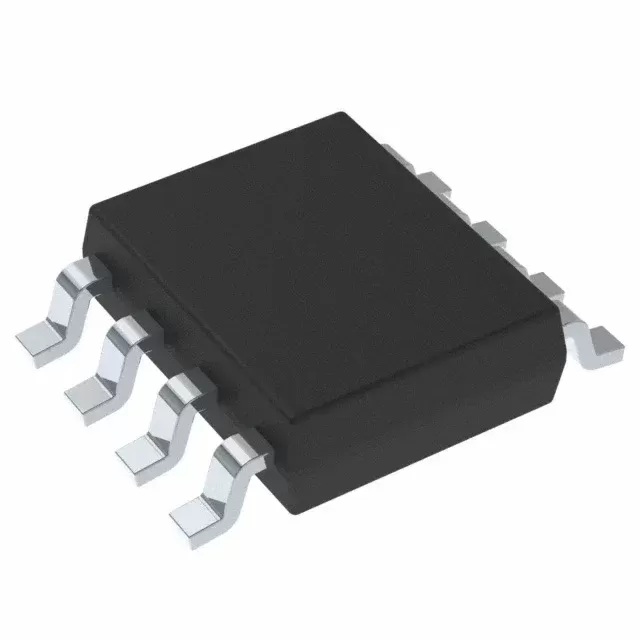
| Body | SOIC DFG, 4 pins, the small outline that matches a phototransistor optocoupler land pattern |
| Packing | 2000 pieces on a large reel |
| Finish | NIPDAU, moisture level 2, 260 C peak, one year floor life |
| Temperature | Minus 55 C to plus 125 C |
| Q1 string | The addendum prints the DFG, DFH and DFS industrial rows, not the Q1 row, so the qualified release has to be confirmed from the automotive document |
A drop in replacement that is not quite a drop in
The pin map matches, the footprint matches and the current transfer ratio falls inside the range the original part offered. What does not match is the input current at the low end and the turn off behaviour. An optocoupler turns off slowly because the stored charge in the base region has to clear. An emulator turns off faster and more predictably, which changes the edge that a downstream comparator or a gate driver sees.
That is good news in most circuits and a trap in a few. A circuit that relies on the slow turn off of an optocoupler to stretch a pulse will see a shorter pulse. Our how to verify a drop in replacement page sets out the bench checks for that case, and the component obsolescence management page is where the decision to move off an aging optocoupler belongs.
Where an opto-emulator replaces an LED part
Isolated feedback in a power supply, isolated fault signalling, interface sensing in a motor drive and patient connected sensing in a medical monitor are the four uses that come up most often. In each case the circuit was built around a phototransistor, and the emulator is dropped in to remove the aging term from the reliability calculation.
The 80 V collector rating covers a 48 V rail with margin, and the 50 mA input limit covers a drive current that many circuits set at 10 to 20 mA. Where the original circuit ran the LED at 5 mA for a low power budget, the 150 to 230 per cent transfer ratio still delivers enough collector current to pull a logic input low through a few kilo ohms.
Questions we get on this code
Buyers ask whether the part is a true second source for a named optocoupler. It is a functional replacement, not a licensed second source, and the CTR grade has to be matched by letter: the 8110 grade covers 100 to 155 per cent, the 8111 grade 150 to 230 per cent, the 8112 grade 255 to 380 per cent and the 8113 grade 375 to 560 per cent. Picking the wrong letter changes the output current at a given input.
The second question is about the Q1 string. The industrial addendum prints DFG, DFH and DFS rows at 2000 pieces and does not print the Q1 row, so the automotive release has to come with its own evidence. Treat the string as unconfirmed until a document or a ship record arrives, and do not let a distributor search field settle the question.