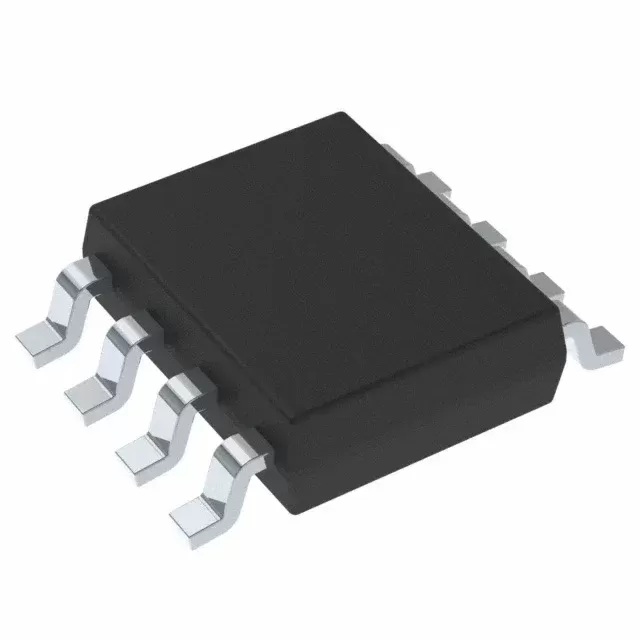
ISO721MDR
Brand: Texas Instruments
Texas Instruments ISO721MDR is a power management component designed for AI Servers & Low-Altitude Economy (Drone and UAV) and related applications. In stock at Superb Automation — request a quote for competitive pricing and fast delivery.
Product Specifications
ISO721MDR
Texas Instruments — Power Management & Signal Chain
Product Overview
The ISO721MDR from Texas Instruments is a power management / signal chain IC delivering high efficiency, precision regulation, and robust protection. Texas Instruments (TI) is a global leader in analog ICs, power management solutions, and embedded processors.
Superb Automation partners with leading brands including Qorvo, TI, ADI, XILINX, NVIDIA, Intel, ST, MACOM, Renesas, and Coilcraft to provide complete BOM and supply-chain solutions.
Key Features
- High-efficiency power conversion with low quiescent current
- Wide input voltage range with precision output regulation
- Integrated over-current, over-temperature, and short-circuit protection
- Small footprint packaging for space-constrained designs
- AEC-Q100 qualified options available for automotive applications
- Flexible sequencing and soft-start control
Key Specifications
| Input Voltage | V |
| Output Voltage | V |
| Output Current | A |
| Switching Frequency | kHz |
| Efficiency | % |
| Quiescent Current | µA |
| Topology | — |
| Package | — |
| Operating Temp | °C |
| Protection | — |
Applications
Industrial Automation
Automotive Electronics
Telecom Infrastructure
Server & Data Center Power
Medical Devices
Consumer Electronics
Request Quote — In Stock, 100% New & Original, Full Warranty
ISO721MDR: The 150 Mbps Single Channel Isolator With CMOS Thresholds and No Input Filter
ISO721MDR is a single channel high speed digital isolator in a SOIC (D-8) body of 8 pins. It carries one line at 150 Mbps with a 12 ns typical delay and 0.5 ns of pulse skew, uses CMOS thresholds at half the rail, and drops the input noise filter of the plain ISO721 in exchange for lower jitter.
Order code and package
| Ordering string | ISO721MDR |
| Status in the addendum | Printed as Obsolete, with the .A string carrying the active row |
| Active string | ISO721MDR.A, 2500 pieces on a large reel, NIPDAU, -40 to plus 125 degrees |
| Package | SOIC, 8 pins, D body |
| Carrier on the active row | 2500 pieces on a large reel |
| Tube sibling | ISO721MD, printed without status detail in the same table |
| Temperature range | Minus 40 to plus 125 degrees Celsius |
| Part marking | IS721M, which is not the ordering string |
| Input threshold | CMOS, at half the rail |
| Input noise filter | None, which is the difference from ISO721 |
Electrical parameters that decide the application
| Signaling rate | 150 Mbps |
| Propagation delay | 12 ns typical |
| Pulse skew | 0.5 ns typical |
| Isolation rating | 2500 VRMS for one minute per UL 1577, tested at 1.2 times for one second on every unit |
| Maximum repetitive peak voltage | 560 VPK |
| Maximum transient voltage | 4000 VPK per VDE 0884-17 |
| External clearance | 4 mm in the D package |
| External creepage | 4 mm in the D package |
| Distance through insulation | 0.008 mm |
| Tracking index | At least 400 V, material group II |
| Rated mains voltage | Up to 150 VRMS at overvoltage category I to IV, up to 300 VRMS at I to III |
| Barrier capacitance | About 1 pF from input to output |
| Barrier life | About 28 years at the rated working voltage |
| Supply range | 3.3 V or 5 V, or any combination of the two |
| Input tolerance | 5 V tolerant when the part runs from a 3.3 V rail |
| Output drive | 4 mA CMOS |
| Fail-safe state | Output driven high when no refresh pulse arrives for more than 4 microseconds |
| Output enable | None on this member, the enable belongs to ISO722 |
| Climatic category | 40/125/21, pollution degree 2 |
Family variants and how they differ
| ISO721MDR.A | The active string, same die, same reel quantity, with the finish and moisture columns filled in |
| ISO721DR | The 100 Mbps member with TTL thresholds and an input noise filter |
| ISO722DR | The 100 Mbps member with CMOS thresholds and an output enable |
| ISO722MDR | The 150 Mbps member with an output enable, for a shared line |
| ISO6720FBDR | A dual at 50 Mbps when a second channel is needed and 150 Mbps is not |
| ISO7641FMDWR | A quad at 150 Mbps when more than one line has to cross at this rate |
Points to check before this part goes on a BOM
The plain ISO721MDR string reads Obsolete in the addendum while ISO721MDR.A reads Active with a full reel row. Buyers comparing a distributor line against the datasheet see the obsolete status and assume the part is gone, when the active string is the same die with the finish paperwork filled in.
The part marking is IS721M, not ISO721M. A receiving inspection that matches marking to ordering string will reject a correct part, which is the kind of mismatch that stops a line for a day.
There is no input noise filter on this member. The plain ISO721 filters pulses of up to 2 ns and adds a small delay for it, and the M member removes that filter to reduce jitter. On a noisy bus the filter is worth more than the jitter, and on a clean high speed link the reverse is true.
2500 VRMS and a 4 mm clearance place this part in the basic class. It is not a substitute for a reinforced barrier even though the 4000 VPK transient number looks large, because the continuous rating and the physical distance are the numbers a safety review reads.
The fail-safe circuit drives the output high if the periodic refresh pulse stops for more than 4 microseconds. That is a deliberate high, so a receiving device that treats a high as an active command needs the logic inverted somewhere in the path.
A single channel part leaves six pins unused in the eight pin body, and the family still uses the full body because the barrier distance is a package property. That is why the single and the dual share a footprint family rather than shrinking further.
Where a single channel at 150 Mbps is the whole requirement
Clock distribution across a barrier, a single serial data line into an isolated converter, or one enable line that has to be faster than the rest of the interface are the usual cases. When only one line crosses, a single channel part is smaller and cheaper than any dual, and the eight pin body is the same footprint across the whole family.
Because the family shares the body, a board that later needs a second channel can often take a dual in the same footprint, but the pin functions differ between the single and the dual, so the change is a board revision rather than a substitution.
The obsolete flag and what to do about it
A status column that reads Obsolete on one string and Active on its .A sibling is common in the TI addendum and it does not mean the silicon has stopped. It means that particular ordering string is no longer bookable through the standard channel, and the .A or the G4 string is the one to quote.
For a production line the practical step is to quote the active string, keep the marking mismatch on the incoming inspection sheet, and treat any stock of the obsolete string as a last time buy rather than as a regular line. Both strings are the same die, so a mixed delivery is not a quality risk, but it is a paperwork risk.
The refresh pulse and the four microsecond window
The channel does not pass a DC level directly. It sends a periodic refresh pulse across the barrier, and if that pulse stops for more than 4 microseconds the fail-safe circuit takes over and drives the output high. That is how a stopped clock or a dead input side becomes a defined state instead of a floating line.
A data stream with long idle periods still produces refresh pulses, so an idle line is not a fault. What triggers the fail-safe state is the loss of the input side, not the loss of edges, which is the distinction that keeps a slow bus from being read as a failure.
Where 2500 VRMS is the right barrier
Inside equipment that runs from a 48 V or a 24 V supply, 2500 VRMS with 4 mm of clearance is comfortably above the stress and the part competes on speed and cost. Across a mains boundary the same part cannot be used regardless of its transient rating.
That is a question about the equipment class rather than about the component, and it is normally settled before the bill of material is frozen. Once it is settled the family choice follows, because the wide body parts carry the reinforced class and the eight pin parts do not.
Where this order code fits
It is chosen where exactly one digital line has to cross a barrier at high rate and the jitter matters more than immunity to short noise pulses, most often on a clock or a serial link into an isolated section. Teams comparing it with a neighbouring part start from our Component Obsolescence Management page, and teams replacing a part that has gone end of life start from the Last-Time-Buy and LTB Planning page.
Questions buyers ask
Is the part really obsolete? The plain ISO721MDR row is printed Obsolete and ISO721MDR.A is printed Active at 2500 pieces on a large reel. The die is the same, so the practical answer is to quote the .A string.
Why does the marking not match the part number? The addendum prints IS721M as the marking for this family. It is a short code that fits the eight pin body, and it is the same on the plain and the .A strings.
What is the difference from ISO721DR? Rate, threshold and filter. ISO721 runs at 100 Mbps with TTL thresholds and a 2 ns input noise filter, and this member runs at 150 Mbps with CMOS thresholds and no filter.
SUPERB holds and sources this line for production and repair demand, quoted against the exact ordering string with date codes, packing and country of origin stated on the offer. When a part is moving, the Incoming Inspection Plan page sets out the checks that keep a substitute from failing on the bench.