


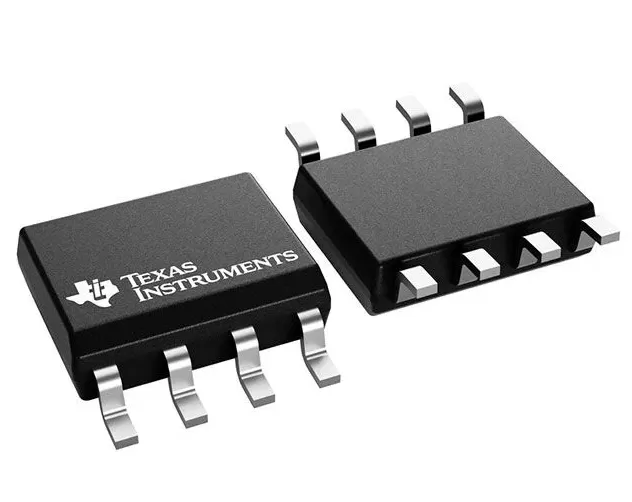

INA121U2K5
Brand: Texas Instruments
Texas Instruments INA121U2K5 is a power management component designed for Industrial Automation and related applications. In stock at Superb Automation — request a quote for competitive pricing and fast delivery.
Product Specifications
INA121U2K5
Texas Instruments — Power Management & Signal Chain
Product Overview
The INA121U2K5 from Texas Instruments is a power management / signal chain IC delivering high efficiency, precision regulation, and robust protection. Texas Instruments (TI) is a global leader in analog ICs, power management solutions, and embedded processors.
Superb Automation partners with leading brands including Qorvo, TI, ADI, XILINX, NVIDIA, Intel, ST, MACOM, Renesas, and Coilcraft to provide complete BOM and supply-chain solutions.
Key Features
- High-efficiency power conversion with low quiescent current
- Wide input voltage range with precision output regulation
- Integrated over-current, over-temperature, and short-circuit protection
- Small footprint packaging for space-constrained designs
- AEC-Q100 qualified options available for automotive applications
- Flexible sequencing and soft-start control
Key Specifications
| Input Voltage | V |
| Output Voltage | V |
| Output Current | A |
| Switching Frequency | kHz |
| Efficiency | % |
| Quiescent Current | µA |
| Topology | — |
| Package | — |
| Operating Temp | °C |
| Protection | — |
Applications
Industrial Automation
Automotive Electronics
Telecom Infrastructure
Server & Data Center Power
Medical Devices
Consumer Electronics
Request Quote — In Stock, 100% New & Original, Full Warranty
INA121U/2K5: 2500 pieces of the FET input amplifier on a large reel
The INA121U/2K5 is the production carrier of this family: the same SO-8 body and the same die as INA121U, supplied on a large reel of 2500 pieces. The string keeps the slash in the vendor addendum and the catalogue drops it, which is the only difference between the two records. For a line that runs more than a few hundred boards a year this is the carrier to specify, because a tube of 75 is a prototype carrier packaged in a surface mount body.
The electrical rows are the family rows: 4 pA bias current, 450 µA quiescent, 200 µV offset, 2 µV per degree drift, 106 dB common mode rejection, 40 V input protection, gain from 1 to 10,000 with one resistor. The reel changes the logistics, not the performance.
The INA121U/2K5 rows as the addendum publishes them
| Part class | FET input instrumentation amplifier, current feedback |
| Vendor status | ACTIVE, production data |
| Data sheet | SBOS078 |
| Catalogue string | INA121U/2K5 with the slash, INA121U2K5 without |
| Gain equation | G = 1 + 50 kΩ divided by RG |
| Input offset voltage | Plus or minus 200 µV |
| Offset drift | Plus or minus 2 µV per degree |
| Input bias current | Plus or minus 4 pA |
| Quiescent current | 450 µA |
| Body | SOIC, D outline, 8 pins |
| Carrier | 2500 pieces on a large reel |
| Tube sibling | INA121U, 75 pieces per tube |
| Grade sibling | INA121UA/2K5, tighter offset bin, same reel |
| Moisture level | Level 3, 260 degrees, 168 hour floor life |
| Temperature range | Minus 40 to plus 85 degrees |
| Lead finish | Published as call TI |
| RoHS | Yes on the addendum row |
A reel of 2500 at level 3 is a storage commitment. The reel is 330 mm across, it does not fit in a small dry cabinet, and once opened it has a 168 hour floor life. A programme that uses 200 pieces a month will open and reseal the same reel for a year, and each opening is a moisture exposure event. The two honest options are a desiccant cabinet large enough for the reel or buying the tube for the small monthly quantity and accepting the feeder change.
Reel handling and the failure modes that are not electrical
The first failure mode on a large reel is the leader tape. A reel that has been partially consumed and rewound can have a splice that a feeder rejects, and the symptom is a line stop at the placement head rather than a bad board. The second is the pocket orientation: the parts are in the pockets the vendor taped them into, and a reel that has been decanted and re-taped by a distributor is no longer the vendor's carrier. The third is the label: a reel of 2500 with a label that names a different grade is the one mixed shipment that a photograph at receiving catches and a count does not.
None of these are the amplifier's fault, and all of them show up as amplifier failures on a test bench. The rule that follows is that the receipt record should carry the reel label and the date code, and that a partial reel should be resealed with the desiccant that came with it rather than with the bag the parts arrived in.
Bandwidth, gain and the reel does not change either
A current feedback instrumentation amplifier holds its bandwidth better than a voltage feedback part as the gain rises, and this family is specified for a 1000 gain range that most parts of its age cannot reach. At a gain of 1000 the gain resistor is about 50 Ω, the parasitic inductance of the package and the board trace is a measurable part of the impedance, and the AC gain is higher than the equation predicts. A production build that runs the same gain on every board should verify the step response on the first article rather than assume the equation.
At a gain of 10 the resistor is about 5.5 kΩ, and the same part has a much flatter response. The gain choice therefore interacts with the compensation: a board that has to work at both ends of the range may need to test both ends, because a value chosen for stability at a gain of 10 is not the value that gives the best response at a gain of 1000.
Reference and supply in a reflowed assembly
The part needs a reference node to define the output zero, and on a bipolar supply that node is ground. On a single supply it is a mid rail, and a divider that is not buffered will move with the load current. A 10 kΩ divider across 5 V draws 250 µA, which is more than half the amplifier's own supply current, and the divider's tolerance becomes a gain error. The practical answer is a low power shunt reference or a buffered divider, chosen before the board rather than after.
Supply decoupling is the other assembly level detail. At 450 µA the part draws little, but a switching regulator on the same rail will inject noise into the input through the supply pins, and the 106 dB of common mode rejection does not help because the noise arrives as a supply variation rather than as a common mode signal. A 100 nF at each supply pin and a 10 µF bulk capacitor near the connector is the usual arrangement, and the placement matters more than the values.
Buying INA121U/2K5
The reel is active and the tube is active, so the choice is a schedule decision. A reel of 2500 at a build rate of 500 boards a year is five years of stock, and five years is longer than the shelf life of the solderability of the finish. A reel bought for a two year programme is a sound purchase; a reel bought for a ten year programme is a stock rotation problem that will be solved by scrapping the tail.
The grade decision is the same as for the tube row: the plain bin and the tighter bin share the body and the reel, and the price difference is smaller than the cost of a failing channel at incoming test. Our safety stock planning page covers how we size a reel against a build schedule, and the amplifier cross reference page lists the alternatives when a specific grade is not on the shelf.
Building the same board on two lines
A programme that splits production between two assembly houses needs the same carrier at both, and a reel is the carrier that survives the split, because two tubes of 75 and a reel of 2500 are not interchangeable for scheduling. The reel also makes the split auditable: the label, the date code and the count travel with one object, so a board built at either site can be traced to a single lot rather than to a tube that was divided by eye.
The qualification argument is the same in reverse. A part that has been qualified in the tube has been qualified in the same die and the same body, so moving to the reel does not require a requalification; moving to a different grade or a different body does. Keeping the grade and changing only the carrier is the cheap way to move a build between sites.
Questions that arrive with this part number
Whether the slash matters is the first question, and it does not: the vendor prints INA121U/2K5 and the catalogue prints INA121U2K5, and both refer to the same reel. Whether the reel is sealed with desiccant is the second, and the answer is that the vendor ships it that way and a distributor that decants it does not have to. The third question is whether a partial reel can be returned to stock, and it can if it is resealed with desiccant and the humidity indicator is still in the dry range.
The fourth question is whether the same die is available in a smaller carrier for a small build. It is, as the 75 piece tube, and taking the tube for a small quantity avoids opening a reel that will then sit for years.