


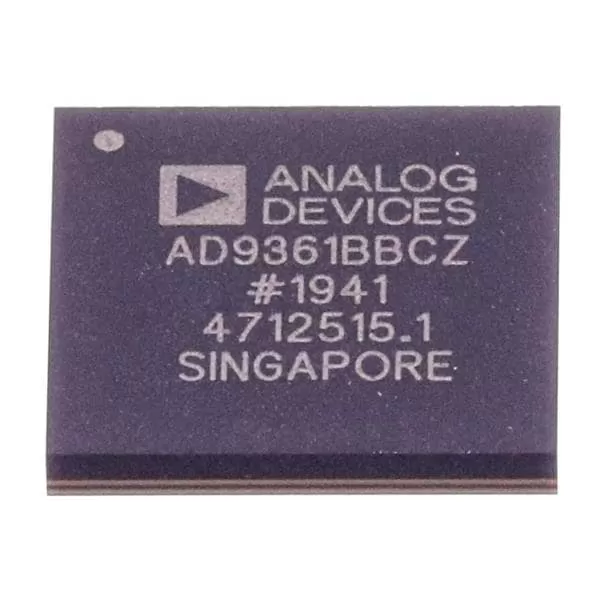

ADXL372BCCZ-RL7
Brand: Analog Devices
Analog Devices ADXL372BCCZ-RL7 is a analog & mixed-signal component designed for Precision Instrumentation and related applications. In stock at Superb Automation — request a quote for competitive pricing and fast delivery.
Product Specifications
ADXL372BCCZ-RL7
Analog Devices — Analog & Mixed-Signal ICs
Product Overview
The ADXL372BCCZ-RL7 from Analog Devices is a high-performance analog / mixed-signal IC providing precision signal acquisition, conversion, and conditioning. Analog Devices (ADI) is a world leader in high-performance analog, mixed-signal, and DSP ICs for instrumentation, healthcare, automotive, and communications.
Superb Automation partners with leading brands including Qorvo, TI, ADI, XILINX, NVIDIA, Intel, ST, MACOM, Renesas, and Coilcraft to provide complete BOM and supply-chain solutions.
Key Features
- High-resolution data conversion with excellent SNR and THD
- Wide dynamic range and high linearity across operating conditions
- Integrated voltage reference with low temperature drift
- Flexible digital interface — SPI, I2C, or parallel options
- Industrial/automotive temperature range with guaranteed specs
- Low power consumption with power-down modes
Key Specifications
| Resolution | bits |
| Channels | — |
| Sample Rate | kSPS |
| Interface | — |
| Supply Voltage | V |
| Operating Temp | °C |
| Package | — |
| INL | LSB |
| SNR | dB |
| THD | dB |
Applications
Precision Instrumentation
Industrial Process Control
Medical Imaging & Diagnostics
Automotive Sensor Interfaces
Communications Infrastructure
Test & Measurement
ADXL372BCCZ-RL7: Plus or Minus 200 g, 22 uA, and the Bandwidth That Decides Whether an Impact Is Seen
The ADXL372BCCZ-RL7 is a three axis MEMS accelerometer with a plus or minus 200 g range, a 12-bit output at 100 mg per LSB, and a user selectable bandwidth from 200 Hz to 3200 Hz behind a four pole anti-aliasing filter. At a 3200 Hz output data rate it draws 22 uA from a 2.5 V supply, in wake-up mode it draws a few microamps while watching for activity, in instant-on mode it draws 1.4 uA while continuously monitoring for an impact, and in standby it draws under 0.1 uA. The part runs from 1.6 V to 3.5 V, is specified from minus 40 C to 105 C, comes in a 3 mm by 3.25 mm by 1.06 mm package, and supports SPI plus a limited I2C format.
The feature that makes it useful is not the current, it is the on-chip event handling: a deep multi-mode FIFO, activity and inactivity detection with adjustable thresholds, and a peak capture mode that stores only the highest acceleration of an event above threshold. A host processor that would otherwise have to poll at 3200 Hz can sleep, wake on an interrupt, and read one event with its peak value already recorded.
Twelve bits at 100 mg is 2000 codes, so eleven bits are used
Plus or minus 200 g at 100 mg per LSB spans 4,000 codes, and 12 bits gives 4,096, so the part uses 11 bits of its 12 and the remaining codes are headroom. A 100 mg step on a 200 g range is 0.05 percent of full scale, which is a resolution suited to detecting that an impact happened and not to characterising its waveform. A shock of 50 g is 500 codes, plenty to distinguish a drop from a knock; a vibration of 2 g is 20 codes, which is one part in ten of the range and far too coarse for condition monitoring of a bearing.
The four pole anti-aliasing filter is what makes the 3200 Hz rate honest. At 3200 Hz the Nyquist frequency is 1600 Hz, and an impact has energy well above that; without the filter, energy above Nyquist folds down and appears as a lower frequency event with the wrong amplitude. The filter attenuates that out-of-band content before it is sampled, which is why the part can run at a modest rate on a high g signal without lying about it. The high pass filter removes the slow terms, the initial offset and the thermal drift, so a mounted part does not report a constant acceleration as an event.
| Range | Plus or minus 200 g, three axes |
| Resolution | 12 bits at 100 mg per LSB, 2,000 codes for the full range |
| Bandwidth | 200 Hz to 3,200 Hz selectable, four pole anti-aliasing filter |
| Current | 22 uA at 3,200 Hz on 2.5 V, 193 mAh over a year |
| Low power modes | 1.4 uA instant-on with adjustable threshold, under 0.1 uA standby |
| Supply | 1.6 V to 3.5 V |
| Interface | SPI, limited I2C format support, external trigger for sample synchronisation |
| Event handling | Deep FIFO, activity and inactivity detection, peak value capture |
| Package | 3 mm by 3.25 mm by 1.06 mm |
Twenty two microamps is still a coin cell in a year
Twenty two microamps over a year is 193 mAh, which is most of a 225 mAh CR2032, so a product that runs this part continuously at 3200 Hz from a coin cell lasts about 1.17 years before the accelerometer alone has taken the whole budget. The instant-on mode at 1.4 uA is 12.26 mAh over a year, which is a fifth of the cell, and that is the mode a shipping or asset tracker should be in most of the time. The choice is therefore not which accelerometer but which mode the product spends its life in.
The wake-up path needs the same care. Instant-on at 1.4 uA can only compare against a threshold; when it trips, the part switches to normal mode fast enough to capture the event, and the event is stored in the FIFO with its peak. If the host takes 10 ms to read it, the FIFO holds the data and nothing is lost, provided the FIFO was configured before the event. A system that configures the FIFO after the interrupt has already lost the beginning of the impact, which is usually the part that matters.
Two questions buyers ask
Is plus or minus 200 g enough for a drop test?
For a package dropped from a metre onto a hard floor, the peak is usually between 500 g and 2000 g depending on the mounting and the cushioning, so no: this part saturates. It suits a product where the impact path is cushioned, a helmet, a shipment inside packaging, or a machine where the event of interest is a few tens of g. A 2000 g part is the other end of the family and the two are not interchangeable for a drop specification.
Can it be used for condition monitoring of a motor?
Not for bearing frequencies. The 100 mg per LSB step is too coarse for the small vibrations that indicate wear, and the 3200 Hz bandwidth is too narrow for the higher order bearing tones. A lower g, wider bandwidth part is the correct choice there. This part is an event detector, and a good one, which is a different job.
Ordering and supply
The BCCZ suffix is the 3 mm by 3.25 mm LGA package in tape and reel. Substitution traps are the range, the bandwidth and the low power modes. A part with the same 12 bits and a plus or minus 16 g range cannot see an impact at all without saturating, and a part without the FIFO forces the host to poll, which removes the current advantage entirely.
We hold and source this family for production and for repair. Start from the analog mixed signal ICs family page, compare a candidate against the medical device components page where the impact sensing family is listed by range, and where a substitute has to be qualified on an existing board, use the sequence in how to verify a drop in replacement.
Request Quote — In Stock, 100% New & Original, Full Warranty