


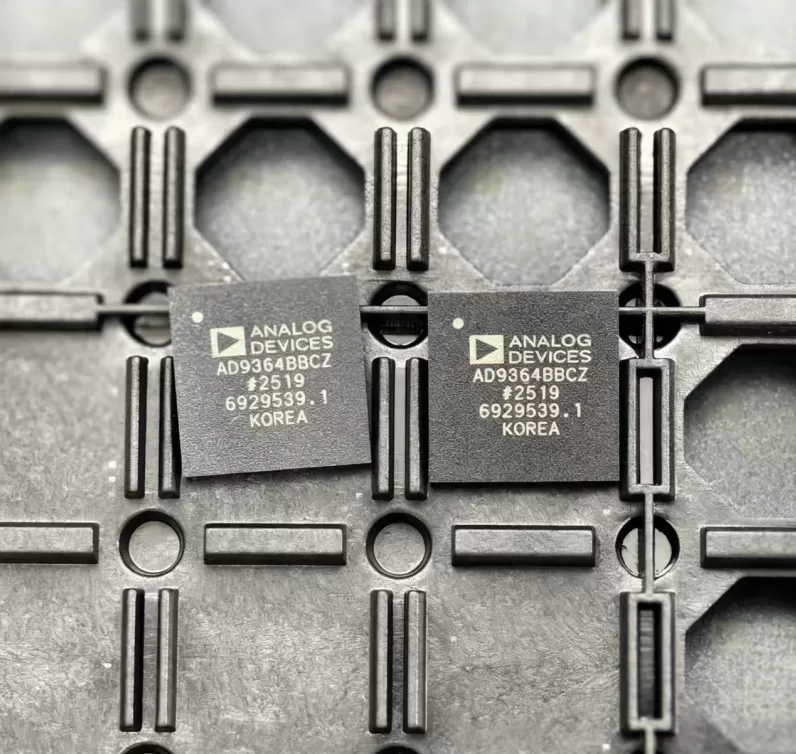

AD5645RBRUZ-REEL7
Brand: Analog Devices
Analog Devices AD5645RBRUZ-REEL7 is a analog & mixed-signal component designed for Precision Instrumentation and related applications. In stock at Superb Automation — request a quote for competitive pricing and fast delivery.
Product Specifications
AD5645RBRUZ-REEL7
Analog Devices — Analog & Mixed-Signal ICs
Product Overview
The AD5645RBRUZ-REEL7 from Analog Devices is a high-performance analog / mixed-signal IC providing precision signal acquisition, conversion, and conditioning. Analog Devices (ADI) is a world leader in high-performance analog, mixed-signal, and DSP ICs for instrumentation, healthcare, automotive, and communications.
Superb Automation partners with leading brands including Qorvo, TI, ADI, XILINX, NVIDIA, Intel, ST, MACOM, Renesas, and Coilcraft to provide complete BOM and supply-chain solutions.
Key Features
- High-resolution data conversion with excellent SNR and THD
- Wide dynamic range and high linearity across operating conditions
- Integrated voltage reference with low temperature drift
- Flexible digital interface — SPI, I2C, or parallel options
- Industrial/automotive temperature range with guaranteed specs
- Low power consumption with power-down modes
Key Specifications
| Resolution | bits |
| Channels | — |
| Sample Rate | kSPS |
| Interface | — |
| Supply Voltage | V |
| Operating Temp | °C |
| Package | — |
| INL | LSB |
| SNR | dB |
| THD | dB |
Applications
Precision Instrumentation
Industrial Process Control
Medical Imaging & Diagnostics
Automotive Sensor Interfaces
Communications Infrastructure
Test & Measurement
AD5645RBRUZ-REEL7: Four 14 Bit Channels and a Reference That Drifts 5 ppm
What this part is
The AD5645R is a quad channel, 14 bit voltage output converter with an on chip reference. Each channel has its own output amplifier, and the four channels share a two wire interface that runs at standard, fast and high speed rates up to 3.4 MHz. Hardware load and clear pins are brought out, so the outputs can be updated together from a register rather than one at a time, and each channel can be powered down on its own when a function is not in use.
The reference is the part of this device that carries the accuracy story. In the TSSOP body it is a 2.5 V source with 5 ppm per degree C drift; the same family in the LFCSP body carries a 10 ppm per degree C source, and one LFCSP option uses a 1.25 V source instead. The B in this order code and the RUZ package code place it in the TSSOP body, which is the 5 ppm version. That difference between bodies is not a packaging detail, it changes the error budget.
Published figures that matter to a buyer
| Resolution | 14 bit per channel |
| Channels | 4 voltage output |
| On chip reference | 2.5 V, 5 ppm per degree C in TSSOP |
| Alternative reference | 10 ppm per degree C in LFCSP, or 1.25 V option |
| Supply | 2.7 V to 5.5 V |
| Interface | I2C at 100 kHz, 400 kHz and 3.4 MHz |
| Monotonicity | guaranteed |
| Power on reset | to zero scale or midscale by order code |
| Power down | per channel |
| Control pins | hardware load and clear |
| Bodies | 14 lead TSSOP, 10 lead LFCSP, 12 ball WLCSP |
Where the headline numbers stop
Fourteen bits on a 2.5 V span puts one count at 152.6 uV. The reference drift of 5 ppm per degree C over a 100 degree swing is 500 ppm, which is 1.25 mV, or 8.2 counts. That means the reference, not the converter, sets what the output does over temperature: the part is monotonic and linear to a fraction of a count, and then the reference moves eight counts across the industrial range. Anyone who needs the drift to stay inside one count has to look at the 1.25 V reference option or at an external reference, not at a higher resolution converter.
The interface sets the update rate. One channel update is a three byte frame on the bus, so with address and acknowledge bits it is about thirty bit times: 75 us at 400 kHz and 8.8 us at 3.4 MHz. All four channels in sequence at 400 kHz therefore take about 300 us, which is the number to use when a loop needs all four outputs refreshed together. The hardware load pin can hold the outputs static until all four registers are written, so the four outputs change at the same instant rather than in sequence, and that is what a calibration routine needs.
Applications where it fits
- Process control loops where four setpoints or bias points have to move together.
- Programmable gain and offset adjustment in instrumentation channels.
- Portable battery instruments that need four outputs from a single 3 V rail.
- Test equipment where a midscale power up state is safer than zero for the device under test.
Two questions buyers ask
Does the part wake up at zero or at midscale? It depends on the order code. Both power on reset options exist in the family, and the difference is not cosmetic: a midscale start puts half of full scale on a control line before the first write, which may be the safe state for one load and a fault for another. The reset state has to be read from the code before a cross reference is offered.
Can the internal reference be turned off? Yes, and on this family the external reference is the default at power up, with the internal source enabled by a write. That ordering matters during a host boot: until the write arrives, an external reference has to be present on the pin. A board that relies on the internal reference without driving the pin will sit at an undefined output during the interval between power up and the first command.
Sourcing notes and next step
AD5645RBRUZ-REEL7 is the TSSOP body on tape and reel, which is the 5 ppm reference version and the tighter of the two reference grades in this family. The 12 bit and 16 bit members share the pinout, so a replacement question is about resolution and reference grade together. The analog and mixed signal IC family page lists the converter line, the ADC and DAC cross reference page sets out how a converter substitute is checked, and the component cost reduction page covers what can be changed without moving the error budget.
Request Quote — In Stock, 100% New & Original, Full Warranty