
STM32F107VBT6
Brand: ST
ST STM32F107VBT6 is a mcu & embedded component designed for general electronics and related applications. In stock at Superb Automation — request a quote for competitive pricing and fast delivery.
Product Specifications
STM32F107VBT6
ST — MCU & Embedded Processors
Product Overview
The STM32F107VBT6 from ST is a microcontroller / embedded processor engineered for real-time control, signal processing, and connectivity. STMicroelectronics is a European semiconductor leader with a strong portfolio in MCUs, power management, sensors, and analog ICs.
Superb Automation partners with leading brands including Qorvo, TI, ADI, XILINX, NVIDIA, Intel, ST, MACOM, Renesas, and Coilcraft to provide complete BOM and supply-chain solutions.
Key Features
- ARM Cortex / RISC-V / proprietary core with high-performance real-time processing
- Integrated flash memory and SRAM for efficient code execution
- Rich peripheral set: UART, SPI, I2C, ADC, timers, PWM
- Low-power modes for battery-operated and energy-sensitive applications
- Hardware security features: secure boot, crypto accelerator, TRNG
- Extensive development ecosystem with IDE, HAL, and RTOS support
Key Specifications
| Core | — |
| Max Frequency | MHz |
| Flash | KB |
| SRAM | KB |
| GPIO | — |
| ADC | bits |
| Interfaces | — |
| Supply Voltage | V |
| Operating Temp | °C |
| Package | — |
Applications
Industrial Motor Control
IoT Edge Nodes
Consumer Electronics
Automotive Body Control
Smart Home & Appliances
Medical Portable Devices
Request Quote — In Stock, 100% New & Original, Full Warranty
STM32F107VBT6: Ethernet, Two CAN Buses and USB OTG on One Device
STM32F107VBT6 adds a 10/100 Ethernet MAC with its own DMA and 4 Kbytes of dedicated SRAM to the connectivity line, with hardware IEEE 1588 timestamp support and both MII and RMII interfaces available on every package. Flash is 128 Kbytes, SRAM is 64 Kbytes, the core runs at 72 MHz, and the 100 pin LQFP body brings out 80 I/Os. For a device that has to bridge a field bus, a USB port and an office network, this is the smallest single chip arrangement in the family.
Why the MAC has its own memory
The Ethernet engine keeps its descriptor rings and buffers in 4 Kbytes of dedicated SRAM, separate from the 64 Kbytes the application uses. That separation is what keeps a large TCP window from being starved by a display refresh or a flash write, and it is the reason the connectivity line performs better as a network node than a general purpose part with a software stack on shared memory. The MAC needs an external PHY and a 25 MHz reference, which the wider oscillator range accepts directly.
Values at a glance
| Parameter | Value | Note |
|---|---|---|
| Core and clock | Cortex-M3, 72 MHz | 1.25 DMIPS/MHz, trace macrocell, 12 channel DMA |
| Flash, SRAM | 128 Kbytes, 64 Kbytes | 256 Kbyte VC code in the same package |
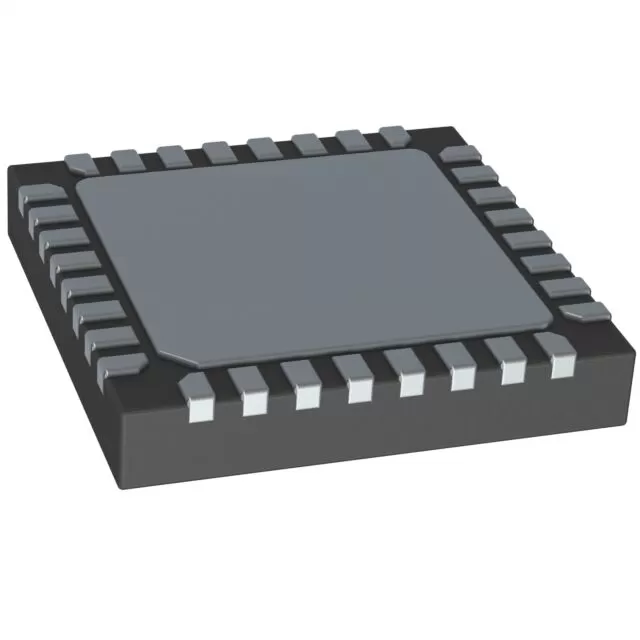
| Package | LQFP100, 14 by 14 mm | LFBGA100 body also offered |
| I/O | 80 pins | Almost all 5 V tolerant |
| Ethernet | 10/100 MAC with dedicated DMA | IEEE 1588 hardware support, 4 Kbytes dedicated SRAM |
| CAN | 2 controllers, 2.0B active | 512 bytes of dedicated SRAM |
| USB | 2.0 full speed device, host, OTG | On chip PHY, 1.25 Kbytes dedicated SRAM |
| Analog | 2 ADC 12 bit 16 channels; 2 DAC | 2 MSPS interleaved, 0 to 3.6 V conversion range |
RMII saves eleven pins
The MII interface needs 16 signals plus the management pair, while RMII needs nine signals for the same 100 Mbit link by running a single 50 MHz reference. On a 100 pin body that difference decides whether the SDIO card, the second CAN bus and the I2S codec all fit. RMII does move the clock accuracy requirement to the PHY reference, so the crystal and its load capacitors become part of the link budget rather than a detail of the microcontroller.
Buying a networking microcontroller with a long life
The F107 range has been in production for a long time and remains in demand for industrial gateways, which means stock exists but is uneven between densities and bodies. The 256 Kbyte VC code is the natural upgrade path when the network stack and the application outgrow 128 Kbytes. Where the code is fixed and the supply is not, the usual combination is a microcontroller cross reference covering VB and VC, an one stop BOM that includes the PHY and the magnetics as one item, and a drop in verification record for any substitute that claims the same footprint.
Common questions
Does the MAC include the PHY? No. The device provides the MAC and the MII or RMII interface; the PHY, the magnetics and the RJ45 connector are separate parts, and their supply arrangement is what determines the isolation rating of the port.
Can Ethernet and both CAN buses run at once? Yes, they are independent peripherals with their own buffer memory, and the shared resources are the DMA channels and the clock tree rather than the interfaces themselves.
Is IEEE 1588 usable without extra hardware? The timestamp unit is in the MAC, so the accuracy depends on the PHY delay being known and stable. A PHY without disclosed latency limits the achievable synchronisation regardless of the MAC.