



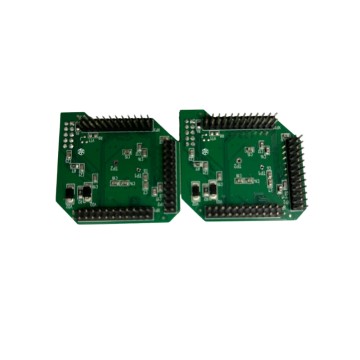
STM32F103C8T6
Brand: ST
The STM32F103C8T6 belongs to ST's STM32F1 Performance Line — the series that defined the "Blue Pill" development board and became the most widely cloned ARM MCU in the maker, hobbyist, and drone communities. Its combination of 72 MHz Cortex-M3 processing, rich communication peripherals, hardware PWM for motor control, and compact 48-pin footprint makes it the natural choice for entry-level to mid-range multirotor flight controllers.
In the drone ecosystem, the STM32F103C8T6 is famous for running Betaflight — the dominant open-source flight controller firmware — on boards such as the Omnibus F3, SP Racing F3, Matek F405, and countless clone designs. The chip's dual 12-bit ADC enables simultaneous gyroscope and accelerometer sampling via SPI-attached IMUs (MPU6000/MPU6050/ICM-20602), while the advanced-control timer generates up to 6 channels of hardware PWM for BLHeli_S / BLHeli_32 ESCs. USB 2.0 Full Speed provides a direct PC connection for configuration via Betaflight Configurator without an external USB-UART bridge.
Product Specifications
STM32F103C8T6 — ARM Cortex-M3 MCU for Drone Flight Controllers by STMicroelectronics
The STM32F103C8T6 is STMicroelectronics' mainstream 32-bit ARM Cortex-M3 microcontroller, running at 72 MHz with 64 KB Flash and 20 KB SRAM. Packaged in a compact LQFP-48 (7×7 mm), it has been the backbone of the open-source drone flight controller ecosystem — powering Betaflight, Cleanflight, iNav, and ArduPilot firmware across countless FC board designs. With 2× 12-bit ADCs, 7-channel DMA, up to 9 communication interfaces (USART, SPI, I²C), and industrial temperature range (−40°C to +85°C), it remains one of the most sourced MCUs for drone, robotics, and general embedded control applications worldwide.
Part Number Decoded — Field by Field
| Field | Value | Meaning |
|---|---|---|
| STM32 | Product Family | STMicroelectronics 32-bit ARM-based MCU |
| F | Core Type | Foundation — general-purpose mainstream series (ARM Cortex-M3) |
| 103 | Sub-Family | Performance Line — 72 MHz, motor control capable, USB & CAN available |
| C | Pin Count | 48 pins (LQFP-48) |
| 8 | Flash Size | 64 KB |
| T | Package | LQFP (Low-profile Quad Flat Package) |
| 6 | Temperature Range | −40°C to +85°C (industrial) |
Quick Specifications
| Parameter | Value |
|---|---|
| Manufacturer | STMicroelectronics |
| Part Number | STM32F103C8T6 |
| Core | ARM Cortex-M3 |
| Max Clock | 72 MHz |
| Flash | 64 KB |
| SRAM | 20 KB |
| Package | LQFP-48 (7×7 mm, 0.5 mm pitch) |
| Supply Voltage | 2.0V – 3.6V |
| Operating Temperature | −40°C to +85°C |
| GPIO | 37 |
| ADC | 2× 12-bit (10 channels) |
| Timers | 3× 16-bit general-purpose, 1× 16-bit advanced (PWM), 2× watchdog, 1× SysTick |
| Communication | 3× USART, 2× SPI (18 Mbit/s), 2× I²C, 1× CAN 2.0B, 1× USB 2.0 Full Speed |
| DMA | 7-channel |
| Debug | SWD + JTAG |
Product Overview
The STM32F103C8T6 belongs to ST's STM32F1 Performance Line — the series that defined the "Blue Pill" development board and became the most widely cloned ARM MCU in the maker, hobbyist, and drone communities. Its combination of 72 MHz Cortex-M3 processing, rich communication peripherals, hardware PWM for motor control, and compact 48-pin footprint makes it the natural choice for entry-level to mid-range multirotor flight controllers.
In the drone ecosystem, the STM32F103C8T6 is famous for running Betaflight — the dominant open-source flight controller firmware — on boards such as the Omnibus F3, SP Racing F3, Matek F405, and countless clone designs. The chip's dual 12-bit ADC enables simultaneous gyroscope and accelerometer sampling via SPI-attached IMUs (MPU6000/MPU6050/ICM-20602), while the advanced-control timer generates up to 6 channels of hardware PWM for BLHeli_S / BLHeli_32 ESCs. USB 2.0 Full Speed provides a direct PC connection for configuration via Betaflight Configurator without an external USB-UART bridge.
Key Features & Benefits
72 MHz ARM Cortex-M3 — Enough Headroom for 4 kHz Gyro Loops
At 72 MHz with single-cycle multiply and hardware divide, the Cortex-M3 core can sustain a 4 kHz gyroscope update rate with PID control loops running on all 4–6 motor axes simultaneously — the practical performance ceiling for analog/SPI gyro-based flight controllers without overclocking to unreliable F4 territory.
64 KB Flash + 20 KB SRAM — Fits Betaflight, iNav, and ArduPilot
64 KB of embedded Flash comfortably accommodates Betaflight (~150–250 KB for F3 builds when optimized), Cleanflight, and lightweight iNav configurations. For ArduPilot, the 20 KB SRAM requires careful feature selection, but with optimized builds the F103 targets remain viable for basic fixed-wing and copter platforms.
Industrial Temperature −40°C to +85°C — Outdoor-Ready
The "-6" temperature suffix guarantees operation from −40°C to +85°C — essential for drones flying in cold high-altitude environments, agricultural UAVs operating in extreme heat, and industrial inspection platforms where reliability across thermal cycles is non-negotiable.
7-Channel DMA — Offloads IMU and Serial Transfers
The 7-channel DMA controller offloads SPI gyro/accelerometer reads, USART telemetry streaming (CRSF, SmartPort, MSP), and I²C barometer/magnetometer polling from the CPU — freeing core cycles for the PID control loop and enabling lower-latency flight characteristics.
Advanced Timer with 6 Hardware PWM Channels — Quadcopter to Hexacopter
One 16-bit advanced-control timer with complementary outputs and dead-time insertion drives up to 6 independent PWM channels — directly supporting quadcopter (4 motors), hexacopter (6 motors), and servo-driven tricopter configurations using protocols from standard PWM through Oneshot125, Multishot, and DShot (bit-banged).
USB 2.0 Full Speed + CAN 2.0B — One Cable for Config, One Bus for Expansion
The on-chip USB 2.0 Full Speed peripheral eliminates external USB-UART ICs (e.g., CP2102, CH340G), reducing BOM cost and board complexity. The CAN 2.0B interface enables integration with UAVCAN/DroneCAN peripherals (GPS, airspeed sensors, ESC telemetry nodes) for modular drone architectures.
Target Applications
Entry-Level Drone Flight Controllers
The undisputed king of Betaflight and Cleanflight FCs. Powers the Omnibus F3, SP Racing F3, Matek F405-OSD (F1-era), and countless "STM32F103" boards from the open-source drone ecosystem. Ideal for 3″–7″ miniquads, cinewhoops, and FPV racing drones where cost-per-BOM is critical and processing needs are bounded by SPI gyro loop rates ≤ 4 kHz.
ArduPilot Lightweight Platforms
With optimized builds (ChibiOS + minimal feature set), the STM32F103 can run ArduPilot on fixed-wing and basic copter platforms. Common in low-cost agricultural drone GPS boards, long-endurance mapping UAVs, and university competition aircraft where the Cortex-M3's deterministic real-time behavior outranks raw MHz.
Sensor Hub & Companion Processors
As a dedicated sensor-fusion processor, the F103 offloads IMU, barometer (BMP280/MS5611), magnetometer (HMC5883L/QMC5883L), and GPS (UBlox NEO-M8) processing from a host application processor (Raspberry Pi, Jetson, or STM32H7). Communicates sensor state via USART or SPI to the main flight computer.
Robotics Motor Controllers
The advanced PWM timer and CAN interface make it a natural fit for distributed motor-control nodes in ground robots, robotic arms, and automated guided vehicles (AGVs). The 7-channel DMA handles encoder quadrature decoding and current-sense ADC reads without CPU intervention.
Educational & Maker Platforms
The STM32F103C8T6 is the heart of the "Blue Pill" development board — one of the world's most widely used ARM learning platforms. Supported by Arduino (STM32duino), PlatformIO, STM32CubeIDE, and MicroPython, it's the go-to chip for university embedded systems courses, hackathon projects, and open-source IoT prototypes.
Industrial Sensor & Actuator Nodes
In industrial environments, the F103 serves as a low-cost Modbus RTU (RS-485) or CANopen slave node, bridging analog sensors (4–20 mA, 0–10V) and digital actuators to PLCs and SCADA systems. The −40°C to +85°C range and 2.0V–3.6V supply suit unregulated industrial power rails.
F103 Series Variant Comparison
| Feature | STM32F103C8T6 | STM32F103CBT6 | STM32F103RCT6 | STM32F103VCT6 |
|---|---|---|---|---|
| Package | LQFP-48 | LQFP-48 | LQFP-64 | LQFP-100 |
| Flash | 64 KB | 128 KB | 256 KB | 256 KB |
| SRAM | 20 KB | 20 KB | 48 KB | 48 KB |
| GPIO | 37 | 37 | 51 | 80 |
| USART | 3 | 3 | 5 | 5 |
| SPI | 2 | 2 | 3 | 3 |
| FPU | No (Cortex-M3 — no hardware FPU) | |||
| Best For | Betaflight 4 kHz, Blue Pill | Betaflight, more Flash headroom | ArduPilot fixed-wing, iNav | Complex drone & industrial |
STM32F103 vs Competing Entry-Level Flight Controller MCUs
| Feature | STM32F103C8T6 (ST) | GD32F103C8T6 (GigaDevice) | AT32F403AC8T6 (Artery) | APM32F103C8T6 (Geehy) |
|---|---|---|---|---|
| Core | ARM Cortex-M3 @ 72 MHz | ARM Cortex-M3 @ 108 MHz | ARM Cortex-M4F @ 240 MHz | ARM Cortex-M3 @ 96 MHz |
| Flash / SRAM | 64 KB / 20 KB | 64 KB / 20 KB | 64 KB / 96 KB | 64 KB / 20 KB |
| Package | LQFP-48 | LQFP-48 (pin-compatible) | LQFP-48 (pin-compatible) | LQFP-48 (pin-compatible) |
| FPU | No | No | Yes (single-precision) | No |
| Betaflight Support | F3 target (legacy) | Unofficial (F3 port) | No (M4F arch diff) | No |
| Availability (Q3 2026) | Stable, 8–12 week lead | Good (domestic China) | Good | Good |
Frequently Asked Questions
What is the difference between STM32F103C8T6 and STM32F103CBT6?
The C8 variant has 64 KB Flash. The CB variant has 128 KB Flash. SRAM (20 KB), pinout, and peripherals are identical. Both use LQFP-48. If your Betaflight/ArduPilot build needs more code space (e.g., logging, OSD, additional features), choose the CB. Otherwise the C8 is sufficient for standard builds.
Can the STM32F103C8T6 run Betaflight 4.4+?
No. Betaflight dropped official F3 target support after BF 4.0.x. The STM32F103 (Cortex-M3) is classified as an F3 target. For Betaflight 4.4+, you need an STM32F405/F411/F722/F745/H743 (F4 or F7 target). The F103 remains viable for legacy Betaflight 3.x/4.0.x builds and for Cleanflight/iNav F3 targets (with feature limitations).
Is the STM32F103C8T6 affected by the 2026 MCU shortage?
As of mid-2026, STM32F103 supply has normalized significantly compared to the 2021–2023 shortage. Lead times are 8–12 weeks, and spot-market availability through Asia-based distributors is good. However, volume pricing has remained elevated above pre-shortage levels. SUPERB Automation maintains relationships with multiple trusted and independent channels to secure competitive pricing and consistent delivery.
How do I flash Betaflight to an STM32F103-based flight controller?
Flash via Betaflight Configurator over USB DFU mode: (1) Short the BOOT0 pin to 3.3V (or press the BOOT button if present). (2) Connect USB — the MCU enters the ROM bootloader. (3) In Betaflight Configurator, select "STM32F103" as the target, choose the .hex firmware, and click "Flash Firmware." After flashing, remove the BOOT0 jumper and reconnect USB normally for COM-port configuration.
Can I use the GD32F103C8T6 as a drop-in replacement for STM32F103C8T6?
Pin-compatible, but not a drop-in firmware replacement. The GD32F103 uses a different flash-controller architecture (GigaDevice proprietary vs ST's), and its core runs faster at 108 MHz when configured for zero-wait-state operation. Betaflight F3 firmware compiled for STM32F103 will not boot on the GD32F103 without recompilation with GD32-specific startup code and clock configuration. Contact SUPERB for supply advice if you're considering a migration.
What is the minimum order quantity (MOQ)?
Contact SUPERB Automation for a tailored quote. We support quantities from prototype tray (1–10 pcs) to full production volumes. Send your target quantity and delivery timeline — we'll provide competitive pricing with full traceability.
Ordering Information
| Orderable Part Number | Package | Packaging | Temperature |
|---|---|---|---|
| STM32F103C8T6 | LQFP-48 (7×7 mm) | Tray (250 pcs/tray) | −40°C to +85°C |
| STM32F103C8T6TR | LQFP-48 (7×7 mm) | Tape & Reel (2,400 pcs/reel) | −40°C to +85°C |
Design Resources
Datasheet: STM32F103x8/STM32F103xB — Complete datasheet with pin definitions, electrical characteristics (I/O DC/AC parameters, current consumption, timing), and package mechanical drawings.
Reference Manual (RM0008): STM32F1xx advanced ARM-based 32-bit MCUs — Full register-level documentation covering all peripherals (GPIO, timers, ADC, USART, SPI, I²C, CAN, USB, DMA, RCC, PWR).
Betaflight GitHub:
betaflight/betaflight— Open-source flight controller firmware with STM32F103 (F3) target support (up to BF 4.0.x).STM32CubeIDE: Free ST development environment with STM32CubeMX graphical pinout/clock configurator and built-in GCC toolchain.
Blue Pill Schematic: Open-source reference design — minimum-viable STM32F103C8T6 breakout board with 8 MHz HSE crystal, 32.768 kHz LSE crystal, USB, reset button, and BOOT0 jumper.
Request a Quote
SUPERB Automation supplies genuine STMicroelectronics STM32F103C8T6 MCUs with full traceability and batch-level QA documentation. Whether you need a single tray for prototype drone FC builds or pallet-level volumes for production, we source through verified channels with competitive lead times. Contact us with your target quantity, delivery date, and any special packaging or marking requirements — we'll respond with a detailed quotation within 24 hours.