


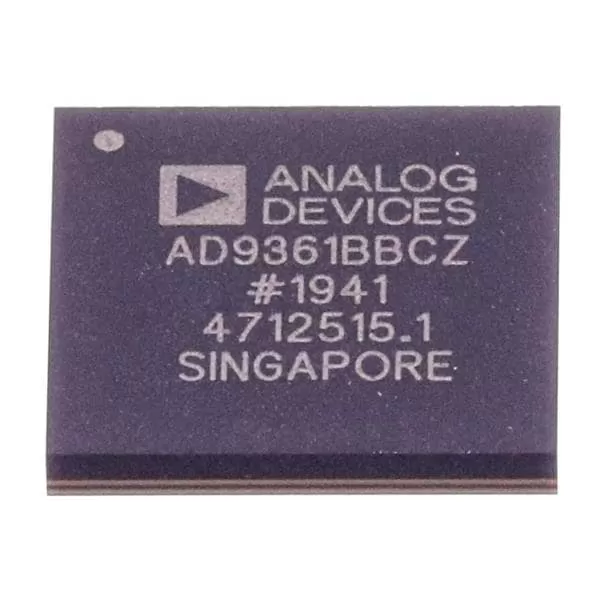

MAX9814ETD+T
Brand: Analog Devices
Analog Devices MAX9814ETD+T is a analog & mixed-signal component designed for Precision Instrumentation and related applications. In stock at Superb Automation — request a quote for competitive pricing and fast delivery.
Product Specifications
MAX9814ETD+T
Analog Devices — Analog & Mixed-Signal ICs
Product Overview
The MAX9814ETD+T from Analog Devices is a high-performance analog / mixed-signal IC providing precision signal acquisition, conversion, and conditioning. Analog Devices (ADI) is a world leader in high-performance analog, mixed-signal, and DSP ICs for instrumentation, healthcare, automotive, and communications.
Superb Automation partners with leading brands including Qorvo, TI, ADI, XILINX, NVIDIA, Intel, ST, MACOM, Renesas, and Coilcraft to provide complete BOM and supply-chain solutions.
Key Features
- High-resolution data conversion with excellent SNR and THD
- Wide dynamic range and high linearity across operating conditions
- Integrated voltage reference with low temperature drift
- Flexible digital interface — SPI, I2C, or parallel options
- Industrial/automotive temperature range with guaranteed specs
- Low power consumption with power-down modes
Key Specifications
| Resolution | bits |
| Channels | — |
| Sample Rate | kSPS |
| Interface | — |
| Supply Voltage | V |
| Operating Temp | °C |
| Package | — |
| INL | LSB |
| SNR | dB |
| THD | dB |
Applications
Precision Instrumentation
Industrial Process Control
Medical Imaging & Diagnostics
Automotive Sensor Interfaces
Communications Infrastructure
Test & Measurement
MAX9814ETD+T: 20 dB of Automatic Range Behind a 40, 50 or 60 dB Gain
The MAX9814ETD+T is a microphone amplifier with automatic gain control and a low noise microphone bias from Analog Devices, in the 14-pin TDFN measuring 3 mm by 3 mm, tape and reel. The published summary gives three total gain settings of 40, 50 and 60 dB, a programmable attack time, a programmable attack to release ratio, 2.7 V to 5.5 V supply, 30 nV per root Hz of input referred noise density, 0.04 percent typical total harmonic distortion, a low power shutdown mode, a 2 V internal microphone bias, and an operating range of -40 C to +85 C.
Where the 20 dB of automatic range sits inside the 60 dB
The chain is documented as three stages: a fixed 12 dB preamplifier, a variable gain amplifier that moves from 20 dB down to 0 dB, and an output stage with selectable gains of 8, 18 or 28 dB. Add the fixed and selectable stages and the result is the 40, 50 or 60 dB headline. The automatic part is only the 20 dB of the variable stage, so the device holds the output within a 20 dB window while the input moves over a much wider range, and the AGC threshold is set by an external resistive divider rather than by a register.
That matters when a specification says the part handles a wide dynamic range. It handles 20 dB automatically, and the rest of the range is handled by the gain setting chosen at the pin. The hold time is fixed at 30 ms, which is inside a spoken syllable, so the gain recovers between syllables rather than between words.
Signal to noise at a real microphone sensitivity
30 nV per root Hz over the 20 kHz audio band is 4.24 uV rms of input referred noise. An electret microphone with -38 dBV per Pa sensitivity delivers 12.6 mV at 94 dB SPL, which is 69.5 dB of signal to noise at that level, and 1.26 mV at 74 dB SPL, which is 49.5 dB. Those two numbers are the reason the AGC exists: a talker at arm's length and a talker across a room differ by the amount the 20 dB stage can absorb.
At the output side, 60 dB of gain turns the same 4.24 uV into 4.24 mV of noise while full scale arrives at 1.0 mV of input, which shows the gain setting has to follow the expected acoustic level rather than the maximum one.
The bias resistor is the current budget
The 2 V bias generator can supply most electret microphones directly, and the standing current is set by the resistor that feeds the capsule rather than by the amplifier. A 2.2 kohm resistor draws 0.91 mA continuously, and a 1 kohm resistor draws 2.0 mA, so a battery powered product that budgets microamps for the amplifier will spend its current in the bias network. Calculating that resistor against the capsule's own current requirement is the step that decides whether the product meets its standby figure.
| Parameter | Published value | What it decides |
|---|---|---|
| Total gain | 40, 50 or 60 dB | Set by a trilevel input at the output stage |
| Automatic range | 20 dB variable stage, 20 dB to 0 dB | Handles level change, not the whole dynamic range |
| Stage split | 12 dB fixed preamp, 8, 18 or 28 dB output | Explains the three headline gains |
| Input referred noise | 30 nV per root Hz | 69.5 dB signal to noise at 94 dB SPL |
| Distortion | 0.04 percent typical | Below the capsule's own distortion in most builds |
| Supply | 2.7 V to 5.5 V | Runs from a single lithium cell without a rail |
| Microphone bias | 2 V internal, low noise | Capsule current set by the external resistor |
| Hold time | 30 ms fixed | Gain recovers between syllables |
| Package and range | 14-pin TDFN 3 mm by 3 mm, -40 C to +85 C | Fits under a microphone port opening |
Questions from buyers and from the line
Can the AGC be turned off? The compression behaviour is part of the device, and the ratio of attack to release is what the second trilevel input programs. A product that needs a fixed gain path without compression should use the fixed gain stage of the chain rather than expect the AGC to be disabled by a register.
Why does the noise figure move when I change the gain pin? Input referred noise is constant at 30 nV per root Hz, and output noise scales with the gain setting, so the apparent noise at the converter changes by 20 dB between the 40 and 60 dB settings. That is expected behaviour and it is the reason the gain pin has to be tied to the acoustic level of the product.
The device is listed under the analog and mixed-signal IC category. Products that carry it are usually bought alongside medical device components, and the second source question is handled on amplifier cross reference.
Request Quote — In Stock, 100% New & Original, Full Warranty