
STM32F103VEH6
Brand: ST
ST STM32F103VEH6 is a mcu & embedded component designed for general electronics and related applications. In stock at Superb Automation — request a quote for competitive pricing and fast delivery.
Product Specifications
STM32F103VEH6
ST — MCU & Embedded Processors
Product Overview
The STM32F103VEH6 from ST is a microcontroller / embedded processor engineered for real-time control, signal processing, and connectivity. STMicroelectronics is a European semiconductor leader with a strong portfolio in MCUs, power management, sensors, and analog ICs.
Superb Automation partners with leading brands including Qorvo, TI, ADI, XILINX, NVIDIA, Intel, ST, MACOM, Renesas, and Coilcraft to provide complete BOM and supply-chain solutions.
Key Features
- ARM Cortex / RISC-V / proprietary core with high-performance real-time processing
- Integrated flash memory and SRAM for efficient code execution
- Rich peripheral set: UART, SPI, I2C, ADC, timers, PWM
- Low-power modes for battery-operated and energy-sensitive applications
- Hardware security features: secure boot, crypto accelerator, TRNG
- Extensive development ecosystem with IDE, HAL, and RTOS support
Key Specifications
| Core | — |
| Max Frequency | MHz |
| Flash | KB |
| SRAM | KB |
| GPIO | — |
| ADC | bits |
| Interfaces | — |
| Supply Voltage | V |
| Operating Temp | °C |
| Package | — |
Applications
Industrial Motor Control
IoT Edge Nodes
Consumer Electronics
Automotive Body Control
Smart Home & Appliances
Medical Portable Devices
Request Quote — In Stock, 100% New & Original, Full Warranty
STM32F103VEH6: 512 Kbytes and 80 I/Os in a 10 mm Ball Grid Body
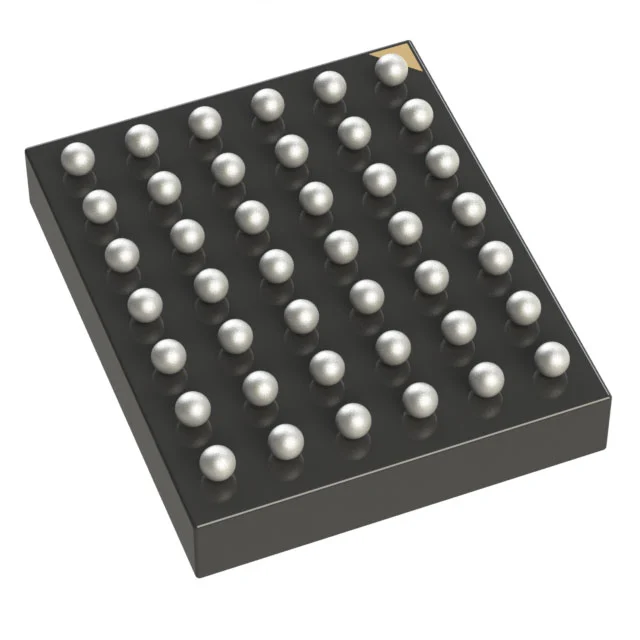
STM32F103VEH6 is the 512 Kbyte top density of the STM32F103 high density line, in the LFBGA100 body rather than the LQFP100 one. The H in the order code is the ball grid package, so the same silicon that is sold as a 14 by 14 mm quad flat part here occupies 10 by 10 mm with 100 balls on a 0.8 mm pitch. SRAM is 64 Kbytes, the core runs at 72 MHz, the flexible static memory controller and the three 12 bit converters are present, and the temperature code 6 means minus 40 to plus 85 C.
When the ball grid body is the right choice
Two things drive the choice. One is area: on a dense board where the 100 pin quad flat part would force a larger board, the 10 by 10 mm body saves about a third of the footprint. The other is electrical: shorter ball connections and a ground ball array under the die give a quieter supply and a better return path for the ADC reference, which matters when three converters run interleaved at 1 microsecond each. Against that, the ball grid body cannot be inspected by eye and needs X-ray or boundary scan, so a low volume product often stays on the quad flat version for serviceability alone.
Values at a glance
| Parameter | Value | Note |
|---|---|---|
| Core and clock | Cortex-M3, 72 MHz | Two APB buses, hardware divide, single cycle multiply |
| Flash, SRAM | 512 Kbytes, 64 Kbytes | 256 and 384 Kbyte codes share the die and the body |
| Package | LFBGA100, 10 by 10 mm | 0.8 mm ball pitch, H suffix in the code |
| I/O | 80 pins | Almost all 5 V tolerant, 16 external interrupt lines |
| ADC, DAC | 3 converters, 12 bit, 16 channels; 2 DAC channels | Dual sample and hold, temperature sensor on chip |
| External memory | FSMC with four chip selects | NOR, PSRAM, NAND, Compact Flash style interfaces |
| Communication | 3 SPI, 2 I2S, 2 I2C, 5 USART, SDIO, USB, CAN | SDIO supports the high capacity card interface |
| Temperature | Minus 40 to plus 85 C | Junction limit 125 C, code 7 raises ambient to 105 C |
Decoupling is the hidden cost of the smaller body
A 100 ball device has far less room for the supply network than a 14 mm quad flat part. The vendor recommends a 10 nF capacitor per supply pair and a bulk capacitor close to the ball array, and on a 0.8 mm pitch body those parts have to sit on the opposite side of the board through vias placed inside the array. A board that copies the decoupling arrangement from a quad flat board and keeps the same values usually measures more supply noise on the converters, and the first visible symptom is a few counts of jitter on the analog readings rather than a functional failure.
Buying the 512 Kbyte code in the ball grid body
Fewer suppliers stock the ball grid version of any given density, and the STM32F103VEH6 is no exception: reels tend to sit with the quad flat codes because those are the ones on the largest number of bills of material. Where the exact body is required, the build usually needs a longer commitment, and a microcontroller cross reference that records package and density separately is what stops a quad flat part being quoted as an equivalent. The other two documents that matter here are a lead time review for the committed quantity and an incoming inspection plan that covers ball coplanarity and moisture level for a part that cannot be inspected visually.
Common questions
Is the ball grid part a straight swap for the quad flat one? Electrically the die and pin functions are the same, but the footprint is different and the ball assignment has to be checked pin by pin against the quad flat table before a board revision is committed.
Does the 512 Kbyte part have more SRAM than the 384 Kbyte one? No. Both carry 64 Kbytes. Only the 256 Kbyte version drops to 48 Kbytes, which surprises teams that expect memory to scale with flash.
How is the part programmed in production? Through the serial wire debug port, or through the system memory bootloader on USART1, CAN2 or USB depending on the boot strap. A ball grid body with no test points needs the programming header built in deliberately.