


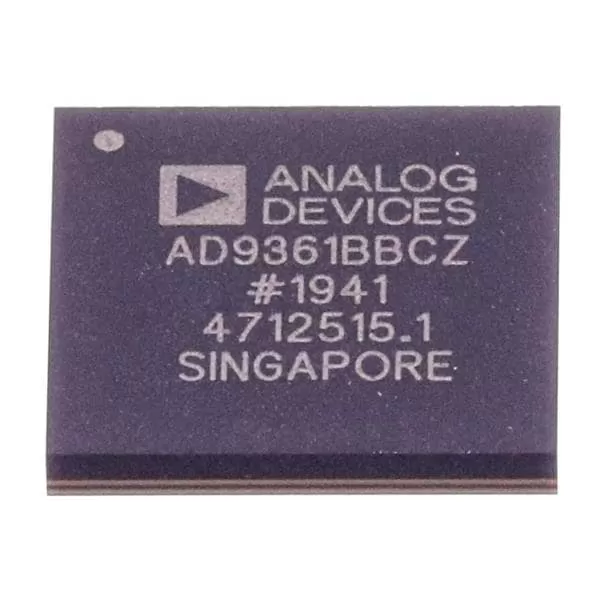

ADUM1401WSRWZ
Brand: Analog Devices
Analog Devices ADUM1401WSRWZ is a analog & mixed-signal component designed for Instrumentation and related applications. In stock at Superb Automation — request a quote for competitive pricing and fast delivery.
Product Specifications
ADUM1401WSRWZ
Analog Devices — Analog & Mixed-Signal ICs
Product Overview
The ADUM1401WSRWZ from Analog Devices is a high-performance analog / mixed-signal IC providing precision signal acquisition, conversion, and conditioning. Analog Devices (ADI) is a world leader in high-performance analog, mixed-signal, and DSP ICs for instrumentation, healthcare, automotive, and communications.
Superb Automation partners with leading brands including Qorvo, TI, ADI, XILINX, NVIDIA, Intel, ST, MACOM, Renesas, and Coilcraft to provide complete BOM and supply-chain solutions.
Key Features
- High-resolution data conversion with excellent SNR and THD
- Wide dynamic range and high linearity across operating conditions
- Integrated voltage reference with low temperature drift
- Flexible digital interface — SPI, I2C, or parallel options
- Industrial/automotive temperature range with guaranteed specs
- Low power consumption with power-down modes
Key Specifications
| Resolution | bits |
| Channels | — |
| Sample Rate | kSPS |
| Interface | — |
| Supply Voltage | V |
| Operating Temp | °C |
| Package | — |
| INL | LSB |
| SNR | dB |
| THD | dB |
Applications
Precision Instrumentation
Industrial Process Control
Medical Imaging & Diagnostics
Automotive Sensor Interfaces
Communications Infrastructure
Test & Measurement
Request Quote — In Stock, 100% New & Original, Full Warranty
ADuM1401WSRWZ: the automotive 125 C quad isolator at 1 Mbps
The ADuM1401WSRWZ is the automotive grade of the quad channel ADuM1401, three inputs on side 1 and one on side 2, in the 16-lead wide body SOIC, rated from -40 C to +125 C. The S letter sets the data rate at 1 Mbps with a 100 ns delay, which surprises buyers who assume an automotive part is the fast one: in this family the 125 C codes are the slow ones.
Published values
| Parameter | Value |
|---|---|
| Channels | Four, three inputs on side 1 and one on side 2 |
| Data rate, this code | 1 Mbps |
| Propagation delay, this code | 100 ns maximum at 5 V |
| Pulse width distortion, this code | 40 ns maximum |
| The T version | 10 Mbps, 34 ns maximum delay, 3 ns distortion |
| Temperature range | -40 C to +125 C |
| Qualification | AEC-Q100 automotive |
| Isolation, UL 1577 | 2500 V rms for one minute |
| Working voltage, VDE 0884-17 | 560 V peak |
| Supply range | 2.7 V to 5.5 V on either side |
| Current at 5 V, S rate | 1.0 mA per channel maximum from 0 to 2 Mbps |
| Package | 16-lead wide body SOIC, option RW-16 |
The S letter is 1 Mbps, not a speed grade in the usual sense
Three letters set the rate in the automotive codes: S at 1 Mbps, T at 10 Mbps and U at 25 Mbps. This order code is S, so the part that survives 125 C is also the slowest member of the family, and a project that needs both temperature and rate has to move to the T code and accept a 34 ns delay.
That combination is a real constraint in an engine bay or a transmission controller, where the ambient is the hard requirement and the data rate is usually modest. Reading the rate letter as if it followed the commercial A, B, C pattern produces a part three times faster than the one that is stocked.
What the automotive qualification adds
AEC-Q100 qualification is a test and documentation regime rather than a different die, so the electrical behaviour is the family behaviour and the paperwork is what a tier one supplier needs. The +125 C rating is the part of it that reaches the board.
The body and the pinout are shared with the commercial parts, so a board can carry either. What cannot be assumed is that a commercial part may be substituted back in: the temperature rating is the reason the code exists.
Power and isolation at 125 C
Four channels at 1.0 mA on 5 V is 4 mA, 20 mW, which leaves derating room at 125 C. The isolation ratings do not change with temperature in the way a reader might expect: 2500 V rms is the one minute withstand and 560 V peak is the continuous working voltage, and both are quoted for the part rather than for the grade.
The output enable pins are present here as on the commercial parts, which matters in a vehicle because the isolated side can be unpowered during a start event while the controller side stays alive.
Where it is used
Hybrid and electric vehicle battery monitoring, motor drive interfaces, transmission controllers and any automotive sub assembly where four signals share one barrier.
Two pages worth reading before a purchase order goes out are defense grade components and the ADI second source page; the first lists what else fits the socket, the second is the test sequence for a drop in, and BOM shortage recovery covers the case where the shortage is already on the line.
Two questions buyers ask
Is the WSRWZ the fastest automotive part in this family? No. S is 1 Mbps, T is 10 Mbps and U is 25 Mbps. The WTRWZ is the 10 Mbps automotive code with a 34 ns delay.
Can a commercial 1401 be fitted instead? Electrically it may work on the bench, but it is rated to +105 C and it is not AEC-Q100 qualified. In an automotive build that substitution is not allowed.