
TPSM86838RCGR
Brand: Texas Instruments
Texas Instruments TPSM86838RCGR is a power management component designed for AI Servers & Low-Altitude Economy (Drone and UAV) and related applications. In stock at Superb Automation — request a quote for competitive pricing and fast delivery.
Product Specifications
TPSM86838RCGR
Texas Instruments — Power Management & Signal Chain
Product Overview
The TPSM86838RCGR from Texas Instruments is a power management / signal chain IC delivering high efficiency, precision regulation, and robust protection. Texas Instruments (TI) is a global leader in analog ICs, power management solutions, and embedded processors.
Superb Automation partners with leading brands including Qorvo, TI, ADI, XILINX, NVIDIA, Intel, ST, MACOM, Renesas, and Coilcraft to provide complete BOM and supply-chain solutions.
Key Features
- High-efficiency power conversion with low quiescent current
- Wide input voltage range with precision output regulation
- Integrated over-current, over-temperature, and short-circuit protection
- Small footprint packaging for space-constrained designs
- AEC-Q100 qualified options available for automotive applications
- Flexible sequencing and soft-start control
Key Specifications
| Input Voltage | V |
| Output Voltage | V |
| Output Current | A |
| Switching Frequency | kHz |
| Efficiency | % |
| Quiescent Current | µA |
| Topology | — |
| Package | — |
| Operating Temp | °C |
| Protection | — |
Applications
Industrial Automation
Automotive Electronics
Telecom Infrastructure
Server & Data Center Power
Medical Devices
Consumer Electronics
Request Quote — In Stock, 100% New & Original, Full Warranty
TPSM86838RCGR: the forced continuous 8 A member, for rails that cannot change ripple with load
The TPSM86838RCGR is the same 8 A, 4.5 V to 28 V module as the 837 with one behavioural difference: it runs forced continuous conduction, so the switching frequency holds at the selected 800 kHz or 1200 kHz from no load to full load and the output ripple stays a fixed function of the inductor and the output capacitor. On a rail that feeds a differential amplifier, a 16 bit converter or a radio synthesizer, that consistency is worth more than the standby current, because the filter can be tuned once and the emission scan does not change between the light load and the full load test points.
The cost is quiescent current. The 838 draws more than the 837 at no load because the inductor current reverses and the part circulates energy rather than skipping pulses. The headline 45 microamps in the electrical table applies to the Eco-mode member, and a standby budget that leans on that number should use the 837 instead. Everything else is common: 0.6 V reference at 1 percent, 98 percent maximum duty, the same 19 pin body, the same 1000 piece reel, and the same 150 C junction rating.
Key electrical data for the TPSM86838RCGR
| Input range | 4.5 V to 28 V, UVLO wake 4.2 V, hysteresis 550 mV, shutdown 3 microamps |
| Output | 0.6 V to 5.5 V, 0.6 V reference, 1 percent accuracy at 25 C |
| Current | 8 A continuous, 98 percent maximum duty |
| Switching | 800 kHz or 1200 kHz, fixed at the selected value in forced continuous mode |
| Loop | D-CAP3 control, no external compensation, MLCC output capacitors supported |
| Protection | Non-latching OV, UV, OC, OT, UVLO, power good, output discharge |
Package, marking and reel data
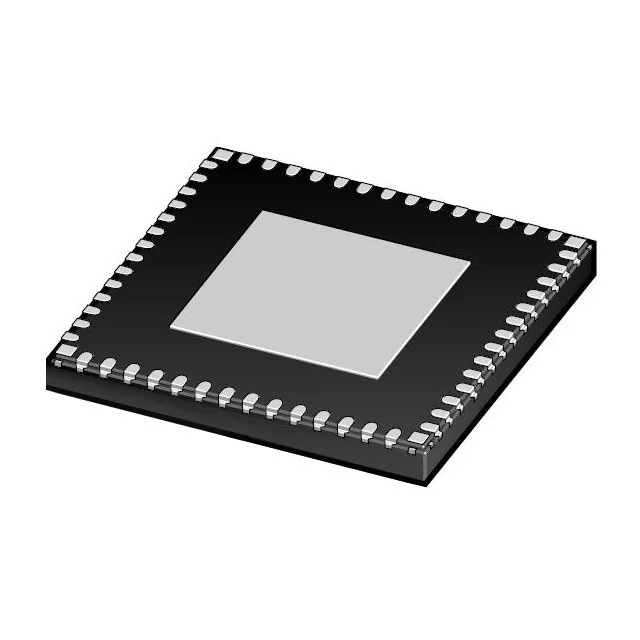
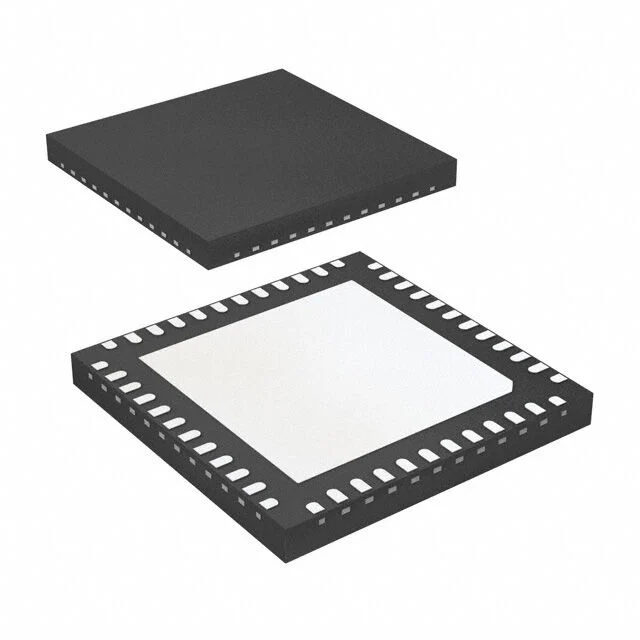
| Body | RCG, 19 pin B3QFN HotRod, 5.00 mm by 5.50 mm |
| Reel | 1000 pieces on a 330 mm reel, 16.4 mm carrier, Q1 orientation |
| Finish | NIPDAU, level 3 at 250 C with a 168 hour floor life |
| Grade | Junction -40 C to 150 C, thermal pad on the underside |
Choosing the output filter around a fixed ripple
With the frequency fixed, the ripple current is duty divided by frequency times inductance, and the output voltage ripple is that current times the capacitor ESR plus the capacitive term. At 24 V in, 5 V out, 1200 kHz and 1.5 microhenry, the ripple current is 1.05 A, so two 47 microfarad ceramics in parallel hold the ripple under 10 mV. The same rail at 800 kHz needs 1.5 A of ripple and the same capacitance to hold the same window, which is why the higher frequency usually wins when the board area is tight. The inductor value is the other half of the choice: 1.5 microhenry at 1200 kHz gives the same ripple as 2.2 microhenry at 800 kHz, so the two settings trade copper against switching loss rather than changing the output window.
The input side is the part that catches teams out. The module draws a pulsed current at the switching frequency, and the loop between the input capacitor and the VIN pin has to be short. Two 10 microfarad ceramics within 3 mm of the pin, plus a 100 nanofarad for the high frequency component, keep the conducted emission inside a CISPR 11 class B limit. A customer moving from a discrete buck to this module usually removes four components and a shielding can, which is the commercial reason to make the change. Our how to reduce component cost page sets out the count reduction we see on this class of board.
Buyer questions on the TPSM86838RCGR
Does the module need an external compensation network? No. D-CAP3 is internally compensated and is specified for low ESR ceramic output capacitors, so the external parts are the input capacitor, the output capacitor, the soft start capacitor and the feedback divider.
Is the switching frequency set by a resistor? No, it is selected by the mode pin state at start-up, so there are two choices and no analog setting. That also means the choice cannot be changed without a board change.
What is the difference from the 6 A family? The current rating and the output window. The 6 A family reaches 13 V out, this one stops at 5.5 V, and both share the same package family and the same 250 C reflow note.
Availability and cross reference
The 838 ships 1000 pieces per reel with a level 3 moisture class at 250 C. Because the body is the same as the 837, a customer can move between them without a stencil change, and the only document that has to change is the assembly note on the bake rule. We keep both in the same buffer and record the floor life on the kitting sheet, which is the control our kitting service page describes.