
TMP6431DYAR
Brand: Texas Instruments
Texas Instruments TMP6431DYAR is a power management component designed for AI Servers & Low-Altitude Economy (Drone and UAV) and related applications. In stock at Superb Automation — request a quote for competitive pricing and fast delivery.
Product Specifications
TMP6431DYAR
Texas Instruments — Power Management & Signal Chain
Product Overview
The TMP6431DYAR from Texas Instruments is a power management / signal chain IC delivering high efficiency, precision regulation, and robust protection. Texas Instruments (TI) is a global leader in analog ICs, power management solutions, and embedded processors.
Superb Automation partners with leading brands including Qorvo, TI, ADI, XILINX, NVIDIA, Intel, ST, MACOM, Renesas, and Coilcraft to provide complete BOM and supply-chain solutions.
Key Features
- High-efficiency power conversion with low quiescent current
- Wide input voltage range with precision output regulation
- Integrated over-current, over-temperature, and short-circuit protection
- Small footprint packaging for space-constrained designs
- AEC-Q100 qualified options available for automotive applications
- Flexible sequencing and soft-start control
Key Specifications
| Input Voltage | V |
| Output Voltage | V |
| Output Current | A |
| Switching Frequency | kHz |
| Efficiency | % |
| Quiescent Current | µA |
| Topology | — |
| Package | — |
| Operating Temp | °C |
| Protection | — |
Applications
Industrial Automation
Automotive Electronics
Telecom Infrastructure
Server & Data Center Power
Medical Devices
Consumer Electronics
Request Quote — In Stock, 100% New & Original, Full Warranty
TMP6431DYAR: the 47 k member of the linear thermistor family
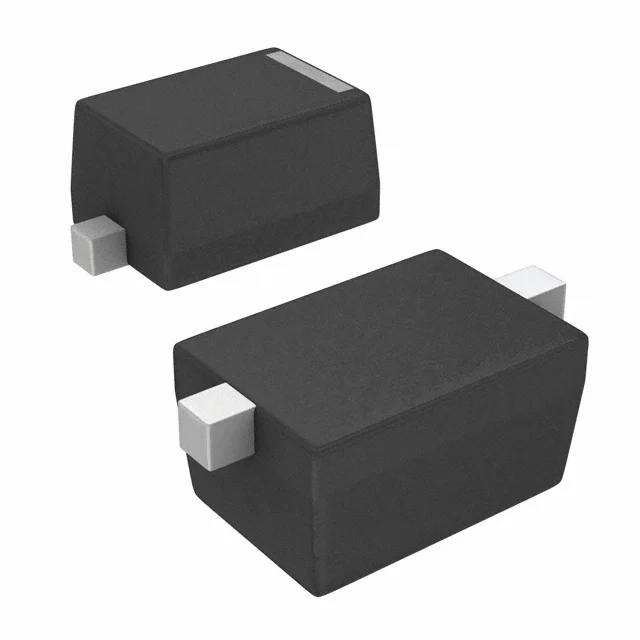
TMP6431DYAR is a silicon linear thermistor with a nominal 47 k resistance at 25 degrees, a positive coefficient of 6400 parts per million per degree, and a plus or minus 1 percent tolerance between 0 and 70 degrees. It is the 0603 body member of the TMP64 family, which is the same silicon idea as the 100 k part with a lower resistance, and the lower resistance is the whole reason to choose it.
The family position is what a buyer needs to understand before a substitution is discussed. The TMP61 is 10 k, the TMP64 is 47 k and the TMP63 is 100 k, all with the same coefficient and the same package options. A board that was built around one of them cannot take another without checking the divider, and a firmware that was written for one cannot read another without a change of constant.
The values below come from SNIS212C, revised September 2020, and from the orderable addendum. The two that decide most builds are the bias current window of 0 to 40 microamps and the 150 degree top of the 0603 body, because the resistance value sets how much voltage the part drops at a given bias.
What 47 k buys over 100 k
At 20 microamps the 47 k part drops 0.94 V where the 100 k part drops 2 V. On a 3.3 V rail that difference is the whole argument: the 47 k divider leaves 2.36 V of headroom for the series resistor and the converter, and it can sit at mid rail with a 47 k series resistor. On a 1.8 V rail the 47 k part is the only one of the two that works at all with a meaningful bias.
The cost is current. A matched 47 k divider on 3.3 V draws 35 microamps, against 16.5 microamps for a matched 100 k divider. In a mains powered instrument that is nothing. In a battery device that sleeps for a year it is the difference between a two year life and a five year life, and the 100 k part exists for that case.
| Function | silicon linear thermistor, positive temperature coefficient |
| Nominal resistance | 47 k at 25 degrees Celsius |
| Resistance tolerance | plus or minus 1 percent maximum from 0 to 70 degrees |
| Temperature coefficient | plus 6400 ppm per degree at 25 degrees |
| Coefficient tolerance | 0.2 percent typical across the range |
| Operating window | minus 40 to plus 150 degrees Celsius in the 0603 body |
| Bias current | 0 to 40 microamps recommended, 20 microamps in the electrical table |
| Voltage across the part | 0 to 5.5 V recommended, 6 V absolute maximum |
| Current limit | 450 microamps absolute maximum |
| Thermal response | 0.6 seconds to 63 percent in stirred liquid, 0402 body |
| Long term drift | 0.5 percent typical over 600 hours at 150 degrees |
| Fail-safe behaviour | resistance falls on a short circuit failure |
| Thermal resistance | 742.9 degrees per watt junction to ambient, 0603 body |
| ESD | plus or minus 2000 V human body, plus or minus 1000 V charged device |
| Package | SOT-5X3, DYA, 0603 footprint, two pins |
| Carrier | 3000 pieces on a large reel |
| Moisture level | level 1 at 260 degrees, unlimited floor life |
| Marking | 1HH |
The divider, worked through
With a matched 47 k series resistor and a 3.3 V rail the divider sits at 1.65 V at 25 degrees, draws 35 microamps, and moves about 5.28 mV per degree. That slope is identical to the 100 k version because the ratio of coefficient to resistance is the same, so the resolution per count is also identical at 0.153 degrees on a 12 bit converter. What changes is the current, not the sensitivity.
Where the resistance value does change the answer is in the bias arrangement. A part biased from a current source rather than a divider produces a voltage that is the current times the resistance, so a 47 k part at 20 microamps gives 0.94 V at 25 degrees and moves 0.1256 V per 100 degrees, while a 100 k part gives 2 V and moves 0.268 V. The lower resistance gives a smaller signal for the same current, and therefore needs more gain, which is why a current source bias suits the 100 k part and a divider suits the 47 k part.
There is a third arrangement worth knowing: the part in the feedback of an amplifier, so the output is proportional to the resistance ratio. That arrangement is immune to the absolute value of the bias and uses the tolerance of the sensor directly, and it is the one to choose when a product has to read within a quarter of a degree without an individual calibration.
Self heating and response
At 20 microamps the dissipation is 18.8 microwatts, so with 742.9 degrees per watt the die sits 0.014 degrees above the board. At the 40 microamp limit it is 75 microwatts and 0.056 degrees, still invisible. The part can therefore be biased for signal without a self heating correction, which is not true of a small NTC bead at the same current.
The response time of 0.6 seconds in the 0402 member is the figure the family quotes, and the 0603 body is slower in proportion to its mass. For a surface temperature measurement on a heat spreader that is fast enough to follow a thermal transient. For a fluid measurement the probe housing dominates and the sensor response is irrelevant.
Where the 47 k part is the right choice
Three cases come up in our builds. First, a 3.3 V or 1.8 V rail where a 100 k part cannot be biased properly. Second, a board that already has a 47 k divider from an earlier part and wants to keep the resistors. Third, a product that needs the same reading in two places, one with a current source bias and one with a divider, where the lower resistance keeps the voltage in range.
The family list names temperature monitoring in HVAC and thermostats, industrial control and appliances, thermal compensation for display backlights, building automation, threshold detection in motor control and chargers. The same list applies to this member, and the choice between the three resistance values is a bias question rather than an application question.
Telling the three family members apart on a reel
The order codes differ in the digits after TMP6, and the markings differ: this part is marked 1HH, the 100 k part is marked 1HG. A reel that is labelled correctly but marked with the wrong code is a mixed reel, and it is worth catching before assembly because a 100 k part in a 47 k divider reads about 30 degrees cold and looks like a calibration failure rather than a parts failure.
The pin to pin cross reference page sets out how we compare two thermistor strings before a substitution is approved, and the BOM scrubbing page covers the check that catches a resistance value typed into a BOM without a tolerance or a package.
Ordering and incoming checks
The orderable row prints TMP6431DYAR as active and in production, SOT-5X3 with two pins, 3000 pieces on a large reel, moisture level 1 at 260 degrees and marking 1HH. The DECT row is the same body in a tray and the DECR row is the 0402 body on a 10000 piece reel, so the footprint has to be specified on the purchase order rather than assumed from the family name.
Incoming inspection is a resistance check at 25 degrees on a sample of ten against the tolerance window, a marking check and a reel label check. Because the part is level 1, no bake is needed, and a build that is used to baking NTC reels can drop that step.
For a medical instrument that has to prove the sensor it used, the medical device component page collects the parts and the documentation we keep for that class of build.
Three questions buyers ask about this string
Is it a drop in replacement for the 100 k part? Mechanically yes, electrically no. The divider and the firmware constant both change, and a board that swaps the part without changing them reads about 30 degrees cold.
Does it work on a 1.8 V rail? Yes, at a bias of about 19 microamps with a matched divider, which sits inside the recommended window and leaves 0.9 V across the part.
Is there an automotive grade? The TMP64-Q1 family carries the automotive qualification and its own order codes. This string is the catalog grade, and a purchase order that names only the family can land on either.