
SN65HVD3082EDGKR
Brand: Texas Instruments
Texas Instruments SN65HVD3082EDGKR is a power management component designed for AI Servers & Low-Altitude Economy (Drone and UAV) and related applications. In stock at Superb Automation — request a quote for competitive pricing and fast delivery.
Product Specifications
SN65HVD3082EDGKR
Texas Instruments — Power Management & Signal Chain
Product Overview
The SN65HVD3082EDGKR from Texas Instruments is a power management / signal chain IC delivering high efficiency, precision regulation, and robust protection. Texas Instruments (TI) is a global leader in analog ICs, power management solutions, and embedded processors.
Superb Automation partners with leading brands including Qorvo, TI, ADI, XILINX, NVIDIA, Intel, ST, MACOM, Renesas, and Coilcraft to provide complete BOM and supply-chain solutions.
Key Features
- High-efficiency power conversion with low quiescent current
- Wide input voltage range with precision output regulation
- Integrated over-current, over-temperature, and short-circuit protection
- Small footprint packaging for space-constrained designs
- AEC-Q100 qualified options available for automotive applications
- Flexible sequencing and soft-start control
Key Specifications
| Input Voltage | V |
| Output Voltage | V |
| Output Current | A |
| Switching Frequency | kHz |
| Efficiency | % |
| Quiescent Current | µA |
| Topology | — |
| Package | — |
| Operating Temp | °C |
| Protection | — |
Applications
Industrial Automation
Automotive Electronics
Telecom Infrastructure
Server & Data Center Power
Medical Devices
Consumer Electronics
Request Quote — In Stock, 100% New & Original, Full Warranty
SN65HVD3082EDGKR: a 200 kbit/s RS-485 transceiver drawing 0.3 mA
The SN65HVD3082EDGKR is the low power member of the SNx5HVD308xE family: a 3.3 V half duplex RS-485 transceiver that carries 200 kbit/s, draws 0.3 mA typical in the active state and drops to about 1 nA in shutdown. That current profile is why it appears in energy meters, battery backed nodes and anything that has to listen on a bus for years without a mains supply.
It is a 1/8 unit load part, so 256 nodes can share one segment, and the bus pins survive 15 kV of human body discharge. The footprint is the industry standard SN75176 one, which means a board that already has that land pattern can take this part without a change. The D package is characterised from minus 40 C to 105 C, and the DGK and P packages from minus 40 C to 85 C.
Key data for the SN65HVD3082EDGKR
| Rate | 200 kbit/s on the 3082, against 1 Mbps on the 3085 and 20 Mbps on the 3088 in the same family |
| Current | 0.3 mA typical in active mode, about 1 nA in shutdown, which is the reason the part exists |
| Loading | 1/8 unit load, up to 256 nodes on a bus, TIA/EIA-485A compliant |
| Protection | Bus pin ESD up to 15 kV, thermal shutdown, glitch free power up and power down on the bus pins |
| Receiver | Fail safe on bus open, bus shorted and bus idle, so a quiet bus reads as a defined level |
| Footprint | Industry standard SN75176 pinout, power on reset holds the outputs high impedance until the rail is stable |
Body, marking and reel data
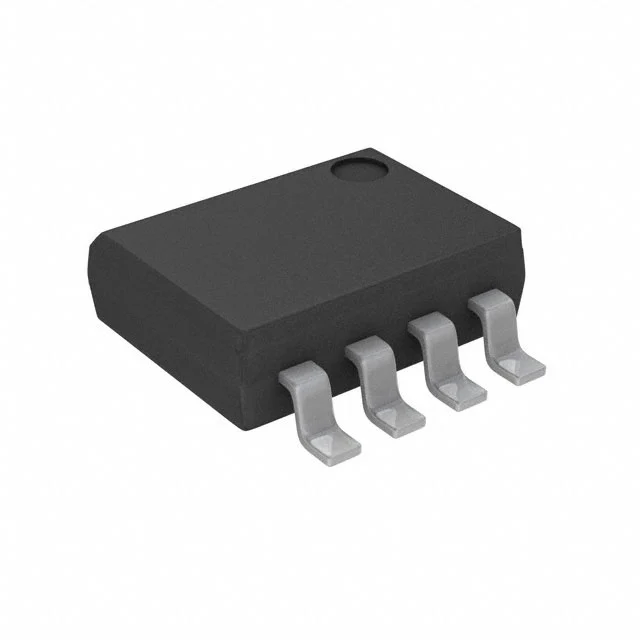
| Body | DGK, VSSOP 8 at 3.00 mm by 3.00 mm, with D SOIC 8 and P DIP 8 options in the family |
| Reel | 2500 pieces on a large reel, carrier tape 12.4 mm, 330 mm reel |
| Marking | NWN on both the plain and .A rows of this body |
| Finish and moisture | The plain row prints Call TI for both finish and moisture level, the .A row prints a tin finish with level 1 unlimited floor life |
| Temperature | Minus 40 C to 85 C on the DGK and P bodies, minus 40 C to 105 C on the D body of the 3082 member |
Where the low current part earns its place
A metering network has hundreds of nodes, each with a small supply and no fan. The transceiver is one of the few parts that is awake all the time, so its quiescent current sets the floor of the whole budget. At 0.3 mA a node can run from a supercapacitor through a short outage, and the shutdown state at 1 nA means a parked node draws nothing measurable while it waits to be polled.
The 200 kbit/s ceiling suits that application. Metering traffic is a poll and a response, not a stream, and a slower edge is more tolerant of a long unshielded pair inside a building. Where a site already has the SN75176 land pattern, the physical swap is a drop in, and the electrical difference is the current draw and the 3.3 V rail. Power on reset is the second difference: the outputs stay high impedance until the rail is stable, so a card inserted into a live bus does not drive it during the ramp. Builders who have been bitten by a transceiver that talks for a few milliseconds at power up tend to choose this family for that reason alone.
Questions we get when this code is on a BOM
The question that comes up most is about the supply. This is a 3.3 V part, and the SN75176 it replaces is a 5 V part. The bus levels are compatible, because RS-485 is defined by the differential voltage, but the logic side is not, and a 5 V controller will overdrive the inputs. Level shifting or a 5 V member of the family is the answer, and we ask for the controller rail before quoting.
The second question is about the finish column. The plain SN65HVD3082EDGKR row prints Call TI for the lead finish and the moisture level, while the .A row of the same body prints a tin finish and level 1. Both are active and both ship, so a build that needs a documented finish should order the row that publishes one, and we name the row on the offer.
How SUPERB supports this line item
We supply the SN65HVD3082EDGKR with the row, the finish and the moisture level stated, because the plain row leaves two of those open. Customers replacing an SN75176 can use our pin to pin cross reference page, which lists the rail and logic level checks that a pinout match alone does not cover.
For metering and remote node builds where the current budget is the constraint, the safety stock planning page describes how we hold the low power interface parts so a field rollout does not stall on a 2500 piece reel.