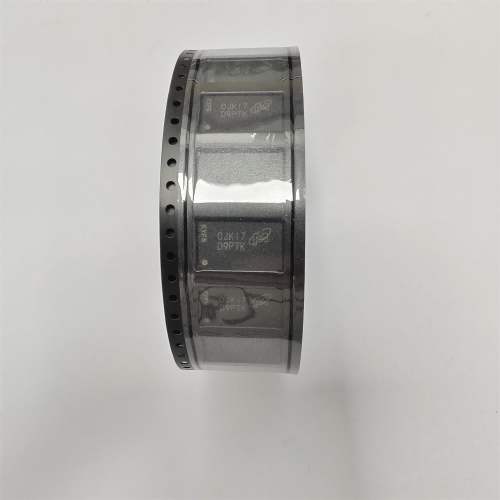


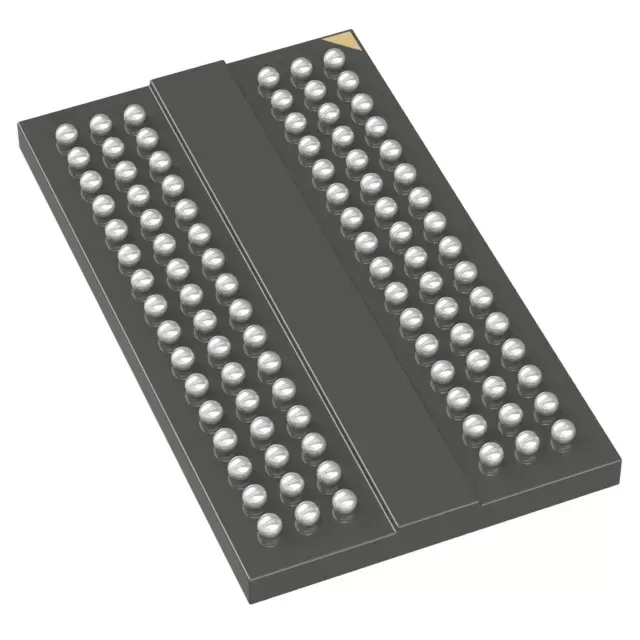
MT41K64M16TW-107:J
The MT41K64M16TW-107:J is a 1 Gb (128 MB) DDR3L SDRAM component from Micron Technology, organized as 64M × 16-bit and rated for DDR3L-1866 (1866 MT/s, PC3-14900). Operating at just 1.35V with full backward compatibility to standard 1.5V DDR3, it delivers up to 3.7 GB/s of peak bandwidth in a single x16 chip — making it the workhorse memory for FPGA configuration buffers, networking line cards, industrial single-board computers, and legacy platform maintenance where DDR3L remains the pragmatic choice.
Product Specifications
MT41K64M16TW-107:J — 1Gb DDR3L-1866 SDRAM by Micron Technology
The MT41K64M16TW-107:J is a 1 Gb (128 MB) DDR3L SDRAM component from Micron Technology, organized as 64M × 16-bit and rated for DDR3L-1866 (1866 MT/s, PC3-14900). Operating at just 1.35V with full backward compatibility to standard 1.5V DDR3, it delivers up to 3.7 GB/s of peak bandwidth in a single x16 chip — making it the workhorse memory for FPGA configuration buffers, networking line cards, industrial single-board computers, and legacy platform maintenance where DDR3L remains the pragmatic choice.
Part Number Decoded — Field by Field
| Field | Value | Meaning |
|---|---|---|
| MT41K | Product Prefix | Micron DDR3L SDRAM. "K" = DDR3L generation (1.35V optimized) |
| 64M | Row Address Space | 64 Mega-locations. Each location = 16 bits (×16). Total = 64M × 16 = 1,024 Mb = 1 Gb = 128 MB per chip |
| 16 | Data Bus Width | ×16 — 16 data lines (DQ0–DQ15), two data strobe pairs (UDQS, LDQS) |
| TW | Package Code | 96-Ball FBGA, 8 mm × 14 mm body, 0.8 mm ball pitch |
| -107 | Speed Grade | tCK = 1.07 ns (minimum clock period). Clock = 933 MHz → Data Rate = 1866 MT/s. DDR3L-1866 / PC3-14900 |
| :J | Temperature/Revision | Commercial temperature grade: 0°C to +95°C TC. ":" is Micron's field delimiter |
Quick Specifications
| Parameter | Value |
|---|---|
| Manufacturer | Micron Technology |
| Part Number | MT41K64M16TW-107:J |
| Mouser # | 340-263706-TRAY |
| Type | DDR3L SDRAM (Low-Voltage DDR3, JEDEC JESD79-3-1) |
| Density | 1 Gb = 128 MB per Chip |
| Organization | 64M × 16-bit |
| Speed Grade | DDR3L-1866 (PC3-14900) |
| Data Rate | 1866 MT/s |
| Clock Frequency | 933 MHz |
| tCK (Minimum) | 1.07 ns |
| CAS Latency (CL) | 13 (at DDR3L-1866) |
| tRCD / tRP | 13 cycles (~13.9 ns each at tCK=1.07ns) |
| Access Time (tAA) | 20 ns (from DigiKey — CAS + internal read latency) |
| Internal Banks | 8 Banks (Standard DDR3 Architecture) |
| Prefetch Architecture | 8n-Prefetch (DDR3 Standard) |
| Page Size | 2 KB per Page (per Bank) |
| Supply Voltage (VDD/VDDQ) | 1.35 V (DDR3L). Backward Compatible to 1.5 V (Standard DDR3 Mode) |
| VREF | VDD/2 Internal (DDR3L); External VREF Pin for 1.5V DDR3 Mode |
| Active Read Current (IDD4R) | ~150–200 mA per Chip (at DDR3L-1866) |
| Standby Current | ~20–30 mA (Typical, Self-Refresh Mode) |
| Refresh Cycle | 8,192 Cycles per tREF (64 ms at TC ≤ 85°C) |
| ODT (On-Die Termination) | Programmable: RTT_NOM (40/60/120 Ω), Dynamic ODT for Writes |
| ZQ Calibration | External 240 Ω (±1%) Resistor Required for Output Driver Calibration |
| Package | 96-Ball FBGA (8 × 14 mm, 0.8 mm Ball Pitch) |
| Temperature Grade | Commercial: 0°C to +95°C TC (Case Temperature) |
| Industrial Variant | MT41K64M16TW-107 IT:J (−40°C to +85°C) |
| Packaging | Tray (Standard, ":J" suffix); TR = Tape & Reel |
| RoHS | Compliant |
Product Overview
The MT41K64M16TW-107:J belongs to Micron's DDR3L SDRAM family — the low-voltage evolution of DDR3 that reduces IO power by approximately 15-20% compared to standard 1.5V DDR3 while maintaining full electrical and timing backward compatibility. For embedded system designers, this means a single PCB can support both DDR3L (1.35V) for power-sensitive deployments and standard DDR3 (1.5V) for legacy compatibility — using the same memory controller and the same PCB layout.
At 1 Gb (128 MB) per chip, the MT41K64M16TW-107:J sits in the density sweet spot for FPGA-based systems where a single DRAM chip provides sufficient frame-buffer or configuration memory. Two chips on a 32-bit bus deliver 256 MB — enough for a Linux kernel, a root filesystem, and application code in a headless embedded controller. Four chips on a 64-bit bus provide 512 MB — the practical upper limit of what a DDR3L memory controller typically supports in point-to-point topology without registered DIMMs.
DDR3L-1866 represents the highest standard JEDEC speed bin for DDR3L. The tCK = 1.07 ns timing pushes the memory bus to 933 MHz — requiring careful PCB layout (controlled-impedance traces, matched lengths, adequate decoupling) but delivering 3.7 GB/s peak bandwidth from a single x16 chip.
Key Features & Benefits
DDR3L 1.35V — 15-20% Lower Power Than Standard DDR3
The MT41K64M16TW-107:J operates at 1.35V VDD/VDDQ in DDR3L mode, reducing IO power consumption by 15-20% compared to standard 1.5V DDR3. This is critical for thermally constrained embedded designs — every watt saved in the DRAM subsystem is one less watt to dissipate through the enclosure:
Fanless industrial PCs: Lower DRAM power reduces junction temperature and extends MTBF
PoE-powered devices: 15.4W total budget per port — every 100mW on DRAM is 100mW less available for the application processor
Battery-backed systems: DDR3L in self-refresh mode consumes ~20–30mA at 1.35V (~30–40mW) — sustainable from a supercapacitor or small Li-Ion cell during power-loss events
Backward Compatible to 1.5V DDR3 — One PCB, Two Voltage Options
Unlike DDR4 which is electrically incompatible with DDR3 (different voltage, different pinout, different signaling), DDR3L is a superset of DDR3: the MT41K64M16TW-107:J operates reliably at both 1.35V and 1.5V. This enables:
Single PCB design supporting both low-power (1.35V DDR3L) and standard (1.5V DDR3) memory configurations by changing only the regulator output voltage — not the memory chip or PCB layout
Drop-in replacement for standard DDR3 in existing designs — swap the BOM line item from MT41J (DDR3) to MT41K (DDR3L), lower VDD from 1.5V to 1.35V, and achieve immediate power savings with no firmware or PCB changes
128 MB per Chip — FPGA-Optimized Density
At 128 MB per chip, the MT41K64M16TW-107:J is ideally sized for FPGA applications where external DRAM provides frame buffers, packet buffers, or configuration caches:
Single-chip 16-bit bus: 128 MB — Xilinx Spartan-6/Artix-7, Intel Cyclone IV/V, Lattice ECP5
Dual-chip 32-bit bus: 256 MB — Xilinx Zynq-7000 PS DDR, Altera SoC HPS DDR
For applications needing more than 256 MB, DDR4 (MT40A series) provides higher density at lower cost per bit — see the DDR3L vs DDR4 trade-offs section below.
DDR3L-1866: The Fastest Standard DDR3L Speed Bin
At tCK = 1.07 ns (933 MHz clock, 1866 MT/s data rate), DDR3L-1866 is the highest speed grade in the JEDEC DDR3L standard. Per-chip peak bandwidth is 1866 MT/s × 2 bytes = 3.73 GB/s. While DDR4-3200 (12.8 GB/s on a 32-bit bus) has long since overtaken this, DDR3L-1866 remains more than sufficient for the embedded workloads it typically serves: industrial Ethernet packet processing, HMI framebuffer updates, and PLC control-loop data logging.
DDR3L vs DDR4 — When to Stay, When to Migrate
| Consideration | Stay with DDR3L (MT41K) | Migrate to DDR4 (MT40A) |
|---|---|---|
| Existing Design | Maintaining a shipping product; BOM is qualified; replacing with DDR3L pin-compatible | Designing a new platform from scratch; no DDR3 legacy constraint |
| Memory Density | ≤ 512 MB per system (2-4 chips, 1Gb each) | Needs ≥ 1 GB — DDR4 4Gb/8Gb chips are cheaper per bit |
| Power Budget | 1.35V DDR3L is lowest-power DDR option; DDR4 requires VPP 2.5V rail | DDR4 1.2V IO power is lower, but VPP adds regulator cost |
| Processor Support | MCU/SoC with DDR3/DDR3L controller only (i.MX6, Zynq-7000, AM335x) | SoC with DDR4 controller (i.MX8M, Zynq MPSoC, AM62x) |
| PCB Complexity | DDR3 layout is simpler — 2-layer reference feasible below 800 MT/s | DDR4-3200 requires 4+ layers, tight length matching, VPP sequencing |
| Lead Time / Lifecycle | DDR3L is mature, stable supply, predictable long-term availability from Micron | DDR4 is current mainstream — better long-term roadmap |
Target Applications
FPGA Configuration & Frame Buffers
External DRAM for Xilinx Spartan-6/Artix-7/Kintex-7 FPGAs and Intel Cyclone IV/V FPGAs running the MIG (Memory Interface Generator) DDR3 controller. A single MT41K64M16TW-107:J provides 128 MB — sufficient for HD video frame buffers, packet processing descriptor rings, and deep capture buffers in logic analyzers.
Industrial Single-Board Computers (SBCs)
NXP i.MX6, TI AM335x/AM437x, and Atmel SAMA5-based industrial SBCs commonly use 1Gb DDR3L chips. A 2-chip ×16 configuration provides 256 MB DDR3L on a 32-bit bus — the standard configuration for Yocto/Buildroot-based embedded Linux systems running HMI, protocol conversion, and edge data processing.
Networking Line Cards & Switches
Enterprise Ethernet switches and SD-WAN appliances use DDR3L for packet-buffer memory on Broadcom/Marvell switch ASICs and control-plane processors. The 1Gb density matches the forwarding-table and buffer requirements of 24-port Gigabit and 48-port Fast Ethernet switches.
Legacy Platform Maintenance & Last-Time Buys
For products shipping since the DDR3 era (2010–2015) that remain in service — medical imaging, aerospace test equipment, military communications — the MT41K64M16TW-107:J provides a drop-in DDR3L upgrade to the original DDR3 BOM, reducing power and improving long-term availability through Micron's mature-product support program.
Automotive Infotainment (Industrial Variant)
The industrial temperature variant (MT41K64M16TW-107 IT:J, −40°C to +85°C) supports automotive-adjacent applications: instrument cluster graphics memory, head-up display frame buffers, and telematics control unit logging buffers.
Set-Top Boxes & Digital TV SoCs
Broadcom, MediaTek, and Amlogic set-top box SoCs with integrated DDR3/DDR3L controllers. A single 1Gb DDR3L chip provides adequate memory for Linux-based IPTV middleware, electronic program guide (EPG) cache, and video decode reference frames for 1080p H.264 content.
Frequently Asked Questions
What is the difference between MT41K (DDR3L) and MT41J (DDR3)?
The MT41K prefix designates Micron's DDR3L (low-voltage, 1.35V) devices — a direct superset of standard DDR3. The MT41J prefix designates standard 1.5V-only DDR3. An MT41K chip (DDR3L) operates at both 1.35V and 1.5V. An MT41J chip (DDR3) operates only at 1.5V. For new designs and BOM upgrades, always specify MT41K — it provides the same functionality at lower power with full backward compatibility.
What is the difference between MT41K64M16TW-107:J and MT41K64M16TW-107 IT:J?
The :J suffix (no -IT) is the commercial temperature grade: 0°C to +95°C TC (case temperature). The IT:J suffix is the industrial temperature grade: −40°C to +85°C. The silicon die is identical between the two — the temperature rating reflects production testing and binning, not a different design. For indoor deployments (factory floor, office, data center), commercial grade is sufficient. For outdoor, automotive-adjacent, or uncontrolled environments, order the IT variant.
Can the MT41K64M16TW-107:J run below DDR3L-1866?
Yes. The -107 speed grade (1866 MT/s) is the rated maximum. The part operates correctly at any lower JEDEC DDR3 speed: DDR3L-1600 (tCK=1.25ns, CL11), DDR3L-1333 (tCK=1.5ns, CL9), and DDR3L-1066 (tCK=1.875ns, CL7). Running below 1866 MT/s relaxes timing margins and signal integrity requirements — useful for legacy PCB designs originally laid out for DDR3-1066 or DDR3-1333 that cannot meet the tighter DDR3-1866 timing constraints.
What is the difference between :J (tray) and :J TR (tape-and-reel)?
Identical silicon — packaging format only. MT41K64M16TW-107:J ships in trays (standard JEDEC tray, typically 209 or 240 pcs/tray). MT41K64M16TW-107:J TR ships in tape-and-reel for automated pick-and-place assembly. For prototyping and small production runs, order tray. For volume SMT, specify TR.
Is the MT41K64M16TW-107:J obsolete or end-of-life?
DDR3L is a mature technology, but Micron maintains long-term availability commitments for embedded DRAM products. As of mid-2026, the MT41K64M16TW-107:J is orderable through trusted distribution (DigiKey, Mouser). For new designs where long-term availability is critical, evaluate migration to the DDR4 MT40A family or contact Micron for a product-lifecycle commitment letter. SUPERB Automation can assist with availability verification — contact pcba@superb-tech.com.
Can I use the MT41K64M16TW-107:J with a 1.5V-only DDR3 memory controller?
Yes. The MT41K (DDR3L) operates correctly at both 1.35V and 1.5V. Connect VDD/VDDQ to 1.5V, and the MT41K functions identically to a standard DDR3 (MT41J) part — no firmware changes, no PCB changes. The reverse is NOT true: an MT41J (DDR3, 1.5V-only) must NOT be operated at 1.35V — the device may fail to initialize or exhibit memory errors at the lower voltage.
What is the minimum order quantity (MOQ)?
Contact SUPERB Automation for a tailored quote. We support prototype tray quantities through full production volumes. Send your BOM to pcba@superb-tech.com — we quote within hours.
Ordering Information
| Orderable Part Number | Package | Packaging | Temperature | Speed |
|---|---|---|---|---|
| MT41K64M16TW-107:J | 96-FBGA (8×14mm) | Tray | 0°C to +95°C | DDR3L-1866 |
| MT41K64M16TW-107:J TR | 96-FBGA (8×14mm) | Tape & Reel | 0°C to +95°C | DDR3L-1866 |
| MT41K64M16TW-107 IT:J | 96-FBGA (8×14mm) | Tray | −40°C to +85°C | DDR3L-1866 |
Design Resources
Datasheet: Micron MT41K64M16TW — DDR3L SDRAM Component Data Sheet (full electrical, timing, and package specifications)
JEDEC Standard: JESD79-3-1 — DDR3L SDRAM Standard (1.35V operation addendum to JESD79-3 DDR3)
Application Note: Micron TN-41-01 — "DDR3 Point-to-Point Design Guide" (PCB layout, SI, power delivery for DDR3/DDR3L)
Migration Guide: Micron TN-41-13 — "Migrating from DDR3 to DDR3L" (voltage regulator changes, timing impact)
IBIS Model: Available from Micron for signal integrity simulation at DDR3L-1866
Footprint / Symbol: Available from SnapEDA, Ultra Librarian — 96-ball FBGA, 8×14mm, 0.8mm pitch
FPGA MIG Reference: Xilinx MIG 7-Series DDR3/DDR3L controller configuration guide; Intel EMIF DDR3 parameter settings
Request a Quote
SUPERB Automation supplies genuine Micron MT41K64M16TW-107:J DDR3L SDRAM with full traceability. From prototype tray quantities for board bring-up to production tape-and-reel volumes, we deliver.
Send your BOM or inquiry to pcba@superb-tech.com — we quote within hours. Include whether you need commercial (:J) or industrial (IT:J) temperature grade, and tray or tape-and-reel packaging.
SUPERB Automation — We Make It Real. Since 2000.