Panasonic MEGTRON and Rogers laminates are often put in the same comparison table, and that is usually a mistake. They are built for different problems. MEGTRON is a high-speed digital material: low loss, low Dk, FR-4 processing, large panels, and a price that scales with volume. Rogers is an RF and microwave material: tight Dk tolerance, predictable behaviour over frequency, and a process that assumes smaller panels and RF-specific handling.
There is an overlap zone between roughly 10 and 25 GHz where either family can work. This page is about that zone, and about the cases where the choice is not really a choice.
What each family is designed to do
| Panasonic MEGTRON 6 / 7 | Rogers RO4000 / RO3000 series | |
|---|---|---|
| Primary job | High-speed digital channels (25–112G) | RF and microwave signal paths |
| Dk | 3.4–3.6 | 3.0–3.5 (RO3000 / RO4000) |
| Df | 0.0015–0.002 at 1 GHz | 0.0010–0.0037 at 10 GHz |
| Dk tolerance | Looser, batch-consistent | Tight (±0.04–0.05) |
| Dk vs frequency | Specified mainly at 1–10 GHz | Characterised to 40 GHz and beyond |
| Panel size | Large, backplane capable | Smaller, RF panel sizes |
| Typical relative cost | 2–4× FR-4 | 4–10× FR-4 |
| Best at | Long digital channels, thick backplanes | Impedance-critical RF, antennas, mmWave |
The cost multiples are indicative only. They move with layer count, copper weight, panel utilisation and order quantity, and a quote for one material is not a quote for the other.
Where MEGTRON wins
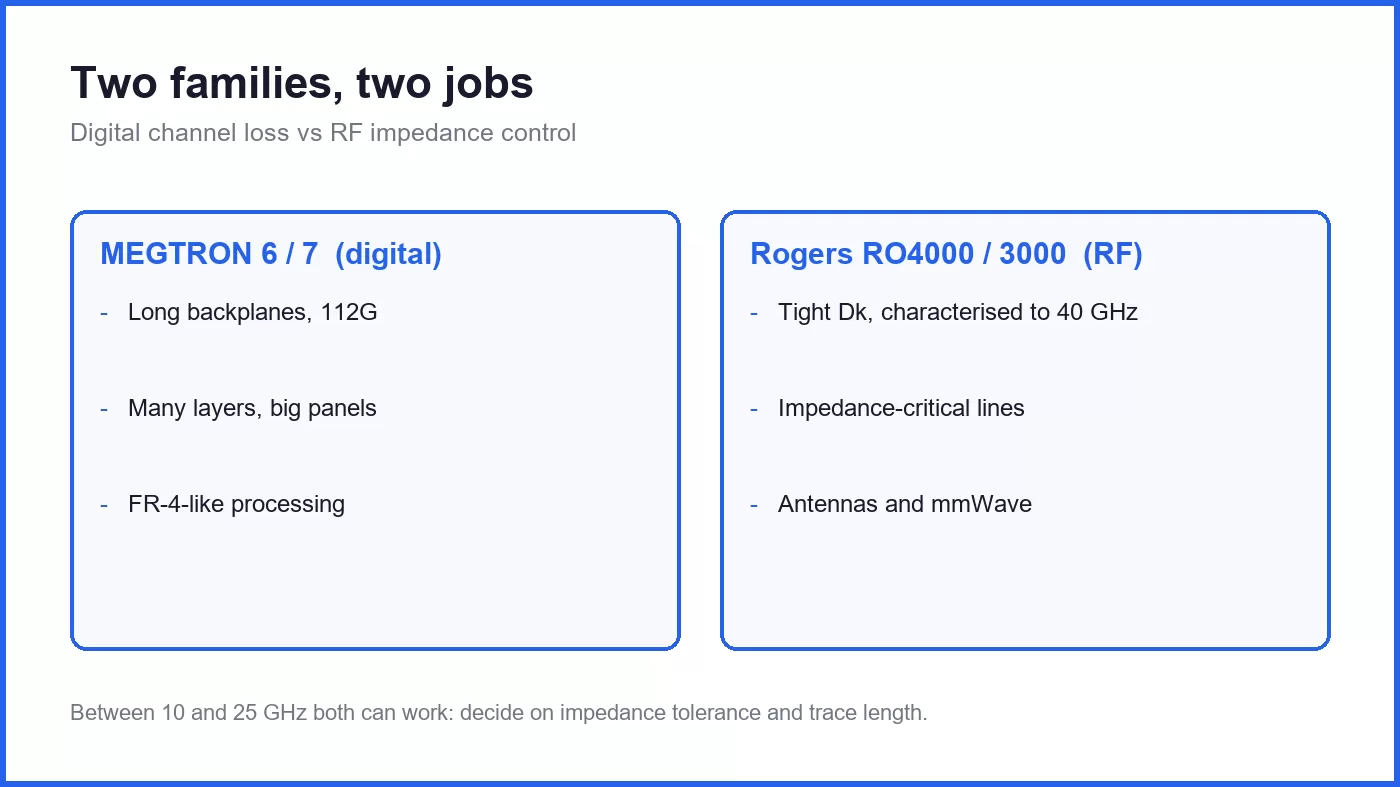
Long backplanes. MEGTRON7 on a 24 inch backplane with 30+ layers is the standard answer for 112G. Rogers does not compete here: the panel sizes, the layer counts and the price per square foot are all wrong for the job.
Large digital boards with many layers. Switch fabrics, line cards and compute boards are built on Panasonic or equivalent high-speed digital materials because the whole board is digital, the loss budget is set by the SerDes, and the fab is set up for that material family.
Volume programs. MEGTRON has better availability, more qualified fabs, and a lower price per panel at volume than any RF laminate.
Where Rogers wins
Impedance-critical RF. A 50 ohm line that must hold its impedance across 2 to 40 GHz needs a material with a characterised Dk curve and tight tolerance. MEGTRON's Dk is specified for digital loss modelling, not for impedance control over a decade of frequency.
Antennas and feed networks. Patch dimensions and feed impedance depend directly on Dk accuracy. Rogers publishes Dk with tolerance and process variation; that is the number an antenna designer needs.
Small, high-value RF boards. A 4 layer 2 inch by 3 inch radar front end does not benefit from large-panel economics. The material cost per board is small relative to the assembly and test cost.
PTFE options. When Df has to go below 0.0015 at 10 GHz, Rogers has PTFE materials (RO3003, RT/duroid) that Panasonic's digital family does not target.
The overlap zone: 10 to 25 GHz
This is where the argument happens. A 20 GHz RF board with a few inches of trace, or a 25 GHz digital channel of moderate length, can sometimes be built on either family. Three questions settle it.
Is impedance tolerance the limiting spec? If the board has filters, couplers, or matched lines where a 2 percent impedance error costs return loss, use Rogers. If the only spec is insertion loss on a differential pair, MEGTRON is fine.
How long is the trace? Under 3 inches, the loss difference between the families is small and process and price dominate. Over 10 inches at 20 GHz, the Df difference starts to show, and the lower-loss material wins regardless of family.
How big is the board? Large panels and high layer counts favour MEGTRON on price. Small RF boards favour Rogers on performance per dollar.
Hybrid stack-ups: the real answer for most mixed boards
Most modern RF products are not purely RF. A radar module has an antenna layer, an RF front end, a power section and a digital backend on one board or on a rigid-flex assembly. The economic answer is usually a hybrid: Rogers on the RF layers, MEGTRON or high-Tg FR-4 on the digital and power layers.
This works well, and it is common. It also creates three specific risks that have to be designed for.
CTE mismatch and warpage. Rogers hydrocarbon materials and Panasonic high-speed materials have different CTE and different moduli. An asymmetric build will bow, and a bowed RF board will not sit flat on a heat spreader. Copper balance and material symmetry have to be checked at stack-up stage.
Via transitions between material families. A via that crosses from Rogers to MEGTRON changes impedance twice: once at the material boundary and once at the pad and antipad geometry. At 20 GHz and above, this is where hybrid boards lose their advantage. The transition should be simulated and, ideally, measured on a coupon.
Process compatibility. Rogers PTFE materials need plasma desmear; MEGTRON does not. A hybrid stack forces the whole board through the PTFE process, which affects cost and yield for the digital layers too. Hydrocarbon Rogers materials (RO4000 series) avoid this because they process like FR-4, which is one reason they are popular in hybrids.
What to send to a fabricator
For either family, the stack-up request should include: layer count and thickness target, the material and prepreg part numbers with the datasheet revision, impedance targets with tolerance per layer, copper weight, surface finish, and the assembly profile the board will see.
For a hybrid, add: which layers are which material, the transition structures, and the warpage limit. Without that, the fab will build something reasonable and the RF performance will be a surprise.
Summary
MEGTRON is the high-speed digital answer: long channels, thick backplanes, big panels, volume pricing. Rogers is the RF answer: tight Dk, characterised to mmWave, built for impedance-critical and antenna work. Between 10 and 25 GHz, decide on impedance tolerance, trace length and board size, not on brand preference.
For mixed boards, a hybrid of Rogers on the RF layers and MEGTRON or high-Tg FR-4 on the digital layers is usually the best cost-performance point, provided the transitions and the warpage are designed rather than inherited.
Related reading
- Ceramic-Filled PTFE vs Pure PTFE: Which RF Substrate?
- How Dk and Df Are Measured, and Why Datasheets Disagree
- Dk Drift: Why an RF Board Changes With Temperature and Humidity
- PTFE PCB Manufacturing: Process Control From Drill to Lamination
- RO4350B vs RO4003C: Which RF Laminate Should You Specify?
- RF PCB manufacturing
- RF and microwave PCBA