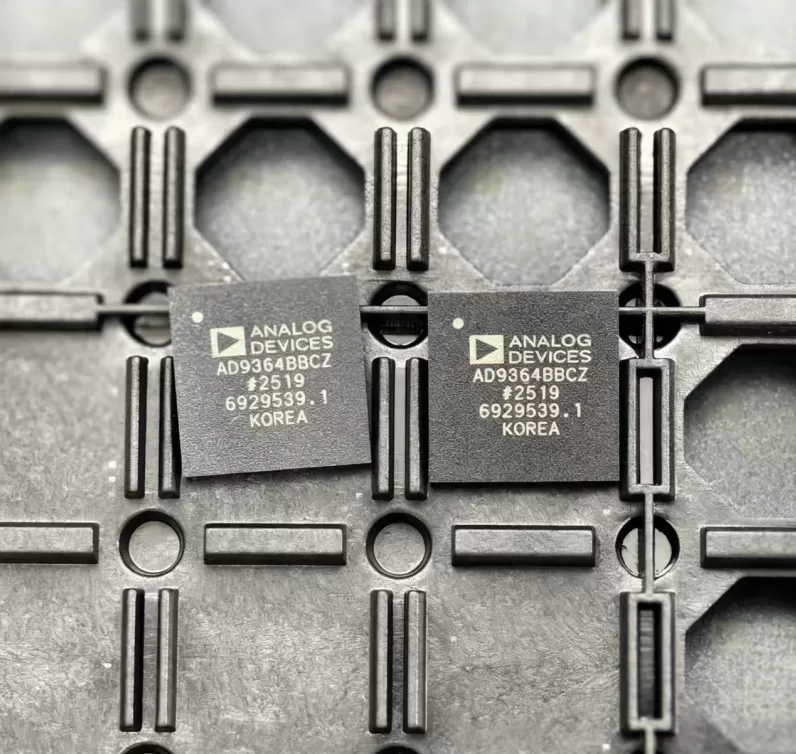
AD8616ARMZ
Brand: Analog Devices
Analog Devices AD8616ARMZ is a analog & mixed-signal component designed for Instrumentation and related applications. In stock at Superb Automation — request a quote for competitive pricing and fast delivery.
Product Specifications
AD8616ARMZ
Analog Devices — Analog & Mixed-Signal ICs
Product Overview
The AD8616ARMZ from Analog Devices is a high-performance analog / mixed-signal IC providing precision signal acquisition, conversion, and conditioning. Analog Devices (ADI) is a world leader in high-performance analog, mixed-signal, and DSP ICs for instrumentation, healthcare, automotive, and communications.
Superb Automation partners with leading brands including Qorvo, TI, ADI, XILINX, NVIDIA, Intel, ST, MACOM, Renesas, and Coilcraft to provide complete BOM and supply-chain solutions.
Key Features
- High-resolution data conversion with excellent SNR and THD
- Wide dynamic range and high linearity across operating conditions
- Integrated voltage reference with low temperature drift
- Flexible digital interface — SPI, I2C, or parallel options
- Industrial/automotive temperature range with guaranteed specs
- Low power consumption with power-down modes
Key Specifications
| Resolution | bits |
| Channels | — |
| Sample Rate | kSPS |
| Interface | — |
| Supply Voltage | V |
| Operating Temp | °C |
| Package | — |
| INL | LSB |
| SNR | dB |
| THD | dB |
Applications
Precision Instrumentation
Industrial Process Control
Medical Imaging & Diagnostics
Automotive Sensor Interfaces
Communications Infrastructure
Test & Measurement
Request Quote — In Stock, 100% New & Original, Full Warranty
AD8616ARMZ: dual 24 MHz amplifier with 150 milliamps of output in MSOP-8
The AD8616ARMZ is a two channel CMOS rail-to-rail amplifier in an 8-lead MSOP with 24 MHz of gain bandwidth, 12 V/us of slew rate, 10 nV/root Hz of noise and a 150 mA output stage, at 1.7 mA per amplifier from a 2.7 V to 5 V rail. The output current is the reason to choose it: it can drive a cable, a heavy capacitive load or a converter reference directly, which most precision amplifiers cannot.
Published values
| Parameter | Value |
|---|---|
| Offset voltage, 5 V supply | 23 uV typical, 60 uV maximum, 65 uV at 2.7 V |
| Offset voltage drift | 1.5 uV/C typical, 7 uV/C maximum |
| Input bias current | 0.2 pA typical, 1 pA maximum |
| Supply current per amplifier | 1.7 mA typical, 2 mA maximum |
| Gain bandwidth | 24 MHz at 5 V, 23 MHz at 2.7 V |
| Slew rate | 12 V/us |
| Voltage noise density | 10 nV/root Hz at 1 kHz |
| Output current | 150 mA |
| Settling to 0.01% | under 0.5 us at 5 V |
| Phase margin | 63 degrees at 5 V, 42 degrees at 2.7 V |
| Open loop gain | 105 V/mV minimum, 1500 V/mV typical at 5 V |
| Supply range | 2.7 V to 5.0 V single supply |
One hundred and fifty milliamps changes what the output stage is for
Most precision amplifiers deliver 20 to 40 mA and are specified with a 2 kOhm load. This one delivers 150 mA, so it can drive a 33 Ohm load to within 200 mV of the rail, run a small loudspeaker, charge a large capacitor, or hold a reference pin that has a switched capacitor load. Two things follow. The power dissipation at 150 mA into a low load is large for an MSOP body, so the thermal path has to be checked. And the output is no longer a small signal element in the loop, so the settling figures apply to the load they were measured with, not to a 10 Ohm load.
Phase margin at 2.7 V is the trap
Sixty three degrees of phase margin at 5 V drops to 42 degrees at 2.7 V. Forty two degrees is stable but peaked, and any capacitance at the output takes it lower. A 3.3 V circuit that copies a 5 V circuit including its 100 pF filter capacitor can oscillate, and the symptom is a 20 MHz burst at the output that a slow scope does not show. Check the margin at the rail the product actually uses.
Noise, bandwidth and current together
24 MHz, 10 nV and 1.7 mA is a consistent set: wideband low noise stages cost current, and this part spends it. For a 16-bit converter at 1 MSPS the combination is close to ideal, since the amplifier's 10 nV over a 1 MHz bandwidth is 10 uV rms, which is a seventh of a 5 V, 16-bit code. Below 100 kSPS the same resolution is reached with a tenth of the current by a slower part.
Where the part belongs
ADC drivers for 16 and 18 bit converters running at or above 1 MSPS, cable drivers, reference buffers with a switched load, and transducer excitation where the amplifier has to source real current. It is a poor choice for a battery instrument on a 1 mA total budget, where 2 mA per amplifier for two channels is the entire allowance.
Where a customer needs a second position on this part, the ADC and DAC cross reference is the starting point, the amplifier cross reference sets out the checks a substitution has to pass, and component lead time solutions is the short lead time route we quote against.
Two questions buyers ask
Can the AD8616ARMZ drive a 50 Ohm cable? Yes electrically, but 150 mA into 50 Ohm is well beyond the package dissipation. Use a series resistor and treat the cable as a terminated load, or add a dedicated line driver.
Why is the supply limited to 5.0 V rather than 5.5 V? That is the published maximum for this family. A 5 V rail with 10 percent tolerance reaches 5.5 V, which is outside the rating, so a 5 V circuit should use a regulator with a tighter tolerance.