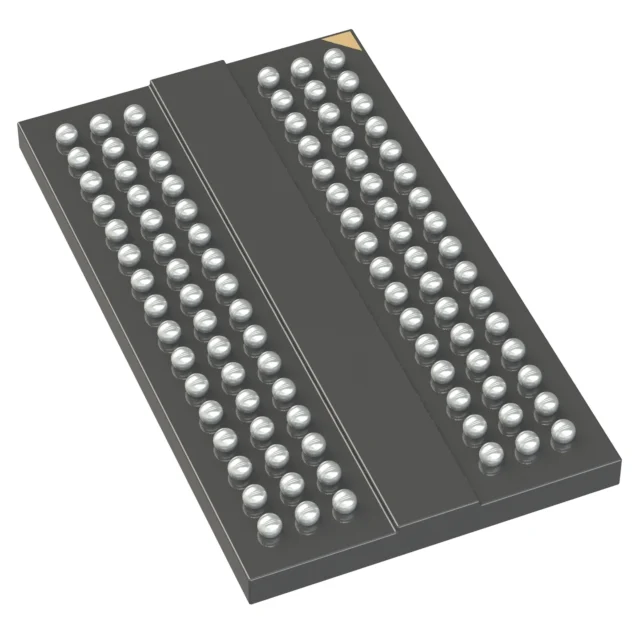
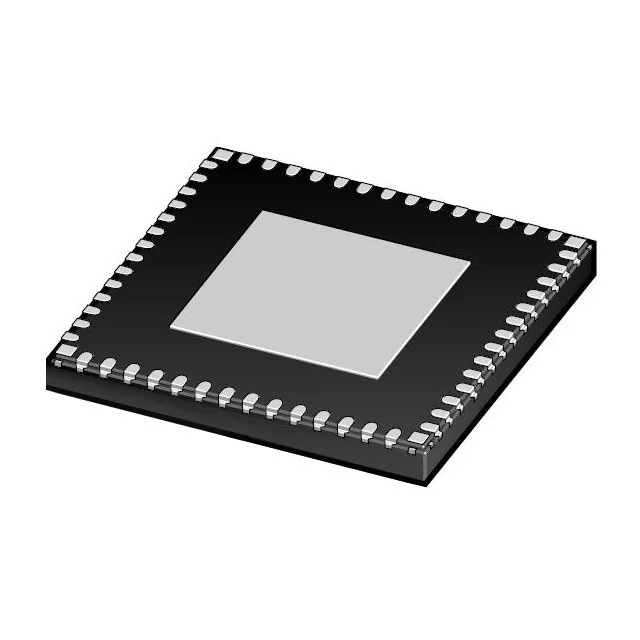
A 0.35 mm pitch BGA needs Type 5 solder paste, a 0.08 to 0.10 mm stencil and a round aperture of about 0.20 to 0.22 mm. Type 4 paste, which prints 0.5 mm pitch without trouble, runs out of margin at 0.35 mm because the aperture is only five to six particles wide and the area ratio falls below the release limit. Paste type and foil thickness have to be chosen together, and the deciding number is the area ratio, not the particle size on its own.
If the area ratio is already below 0.66 with Type 4 and a 0.10 mm foil, adding squeegee pressure does not recover the print. It only wears the foil and pushes paste under the stencil.
What the area ratio does at 0.35 mm
For a round aperture the area ratio is the diameter divided by four times the foil thickness. A 0.22 mm opening in a 0.10 mm foil gives 0.55. The same opening in a 0.08 mm foil gives 0.69, and in a 0.075 mm foil 0.73. Published print trials put transfer efficiency near 50 to 65 percent at 0.55, near 80 percent at 0.66, and above 90 percent once the ratio passes 0.75.
A square aperture of 0.20 by 0.20 mm gives 0.63 in a 0.08 mm foil, which is why round or rounded apertures are used at this pitch even when the pad is square. The aspect ratio is the second check: 0.22 mm over 0.08 mm is 2.75, comfortably above the 1.5 limit, so thickness is set by the area ratio and not by the hole depth.
Deposit volume per pad is small. A 0.22 mm round opening in a 0.08 mm foil holds about 0.003 mm3 of paste, against a 0.014 mm3 ball on a 0.35 mm pitch part. Most of the joint volume comes from the ball. What the print has to deliver is a flat, repeatable deposit with enough flux to wet the pad and the ball, and that is exactly what a low transfer efficiency destroys.
Why Type 4 runs out of margin
Type 4 paste is classified at 20 to 38 micron particle size, Type 5 at 15 to 25 micron, Type 6 at 5 to 15 micron. The five ball rule asks for at least five of the largest particles across the aperture: five times 38 microns is 190 microns, which just fits a 220 micron opening. Passing the rule is not the same as printing well. The paste is a distribution with a coarse tail, the flux has to flow around the particles, and the aperture is only 80 microns deep, so one large particle at the wall changes how the deposit releases.
The paste also sees high shear at 0.08 mm. Coarse powder shears less evenly, the deposit comes out with voids at the corners and the printed volume scatters. On a 0.35 mm pitch array that scatter turns into two defects: missing paste on a pad, which ends as an open after reflow, and paste that is thin at one side of the pad, which ends as a head in pillow joint under the ball.
What fails first on the line
Keeping Type 4 with a 0.10 mm foil to protect the deposit, then chasing the missing paste with more pressure and slower squeegee speed. The area ratio is 0.55 and no printer setting changes that. The line stays at roughly 60 percent transfer and yield depends on luck.
Dropping to a 0.06 mm foil to raise the area ratio without changing the paste. The ratio climbs to 0.92, but the deposit is only 0.0023 mm3, the foil is soft across a large panel, and step areas and tall parts start to matter. A 0.08 mm foil with Type 5 is the balance point.
Ignoring the foil surface. A laser cut foil with no coating loses 10 to 15 percent of transfer at ratios under 0.7, and that loss lands exactly on the fine pitch apertures. Nano coating or an electroformed foil is part of the process, not an upgrade.
Running Type 5 on a reflow profile copied from a Type 4 build. Finer powder carries more surface oxide per gram, so nitrogen below 1,000 ppm oxygen, a soak that lets the flux work and a ramp of 1 to 2 degrees C per second matter more. A profile taken from a 0402 board leaves dull joints and voids under the balls.
What the process sheet should state
Foil 0.08 mm, laser cut, nano coated, electroformed where the pitch goes below 0.3 mm. Aperture round, 0.20 to 0.22 mm, opening area 90 to 100 percent of the pad. Minimum area ratio 0.66, minimum aspect ratio 1.5. Paste Type 5, SAC305, 88.5 percent metal content, shelf life and working life logged. Solder in paste inspection on 100 percent of boards, volume limits 80 to 120 percent of nominal, process capability above 1.33. Nitrogen reflow, first article X ray, then X ray per shift on the corner balls.
How we build it
Fine pitch builds run on 0.08 mm laser cut foils with nano coating, Type 5 paste and nitrogen reflow. Solder in paste inspection covers every board, X ray covers the corner balls and any via in pad, and acceptance follows IPC-A-610 Class 2 or Class 3 as the drawing requires. Foil and paste are recorded per lot, so a drift can be traced back to a batch instead of a shift.
The process detail sits in turnkey PCBA assembly, the board rules in PCB capability, and the inspection limits in PCBA quality standards.
SUPERB PCBA and SUPERB Assembly quote the stencil, the paste type and the inspection plan with the build, because a print problem found after the first lot costs a second tool and a second qualification.
Next step
Send the Gerber, the BOM and the package list with pitches. We will confirm foil thickness, aperture per pad and paste type before the first print, and reply with the inspection plan for the array.