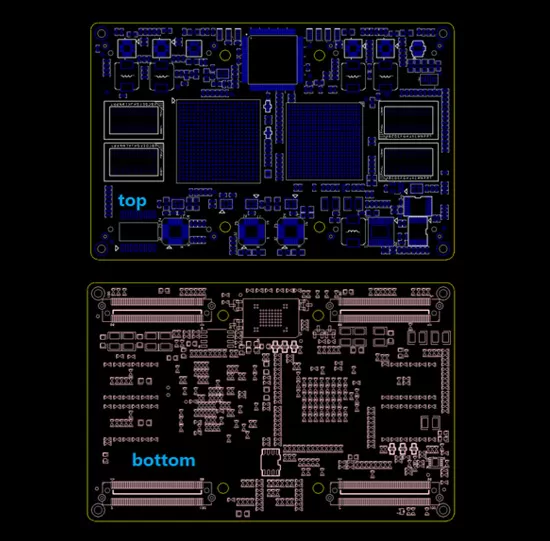


.webp "4-Layer Industrial Control PCB — 4× DDR Top/Bottom Mount, 167.64×111.15 mm, 4/4 mil, ENIG")
.webp "6-Layer High-Speed Communication PCB")
6-Layer High-Speed Communication PCB
483.61 × 279.15 mm · 4/4 mil Trace/Space · ENIG · Full DFM Report · Case Study: dm6446-v3.0-0331-2
Product Specifications
6-Layer High-Speed Communication PCB — 19-Inch Rack Mount
483.61 × 279.15 mm · 4/4 mil Trace/Space · ENIG · Full DFM Report · Case Study: dm6446-v3.0-0331-2
Solution Overview
This page showcases a 6-layer high-speed communication PCB manufactured for 19-inch rack-mount industrial network equipment — including managed Ethernet switches, edge computing gateways, and data-center network mainboards. Fabricated to the customer's Gerber specifications at 483.61 × 279.15 mm with 4/4 mil trace/space rules and ENIG surface finish, the board integrates high-density BGA processors, DDR memory, multi-port optical/electrical interfaces, and high-speed differential pairs on a single un-segmented 6-layer stackup. A full DFM analysis report covering 24 inspection categories was completed before production release, and 3,589-point flying-probe electrical testing verified 100% netlist continuity. This build is representative of the complex communication boards Superb Automation manufactures daily — from prototype verification through volume ramp.
The accompanying manufacturing process chart integrates the complete layer stackup, global routing layout, and full drill schedule into a single engineering reference. Combined with the DFM report's 3,589-point flying-probe netlist, this documentation package serves as the unified process baseline for PCB fabrication, SMT assembly, and quality assurance — eliminating multi-party communication gaps between R&D, procurement, PCB fab, and assembly house.
Key Specifications
| Layer Count | 6 layers |
| Board Thickness | 2.60 mm |
| Board Dimensions | 483.61 × 279.15 mm (standard 19-inch rack) |
| Min. Trace Width | 4.00 mil (0.10 mm) |
| Min. Trace Spacing | 4.00 mil (0.10 mm) |
| Surface Finish | ENIG (Au: 0.05–0.10 µm over Ni: 3–6 µm) |
| ENIG Pad Area | 3.95% of board surface |
| Copper Weight | 1 oz (outer), 0.5 oz (inner) |
| Impedance Control | 100 Ω differential / 50 Ω single-ended |
| Min. Drill (PTH) | 0.20 mm (8 mil) |
| Max. Drill (NPTH) | 128 mil (mounting holes) |
| Slot Machining | 200.0 × 122.05 mil (aspect ratio 1.64) |
| Solder Mask | Green LPI, double-sided |
| Silkscreen | White, double-sided |
| Test Method | Flying probe — 3,589 test points |
| Panel Utilization | 62.56% |
| Batch Quantity | 5 PCS (prototype); scalable to 10k+ volume |
| Application | Industrial switch, edge gateway, network transmission mainboard |
6-Layer Stackup Design
The TOP → GND → SIG1 → PWR → SIG2 → BOTTOM stackup is the industry-standard symmetric architecture for high-speed digital communication boards. This topology isolates high-speed differential pairs between continuous reference planes, suppresses crosstalk, and provides low-impedance power delivery across a 483 mm board span.
Layer-by-Layer Architecture
| L1 — TOP (Component + Signal) | Main processor, optical/electrical port connectors, DDR memory, BGA chips. 100 Ω differential pairs for 10 GbE, PCIe, and high-speed serial links. |
| Prepreg | 2116 or equivalent, ~0.10 mm |
| L2 — GND (Solid Ground Plane) | Uninterrupted copper pour. Immediate return-path reference for L1 signals. Shields external EMI and minimizes loop inductance. |
| Core | FR-4, ~0.50 mm |
| L3 — SIG1 (Inner Signal — Stripline) | Stripline routing for PCIe, Gigabit Ethernet, and other long-haul high-frequency signals. Sandwiched between GND (L2) and PWR (L4) — dual-plane isolation reduces insertion loss and far-end crosstalk by ~40% versus microstrip. |
| Prepreg | 2116 or equivalent, ~0.10 mm |
| L4 — PWR (Split Power Plane) | Multi-rail voltage distribution: VCC_CORE, VDD_DDR, 3.3V, 1.8V, 1.2V. Forms natural planar capacitance with adjacent GND (L2) through thin core dielectric, reducing PDN impedance at switching frequencies. |
| Core | FR-4, ~0.50 mm |
| L5 — SIG2 (Inner Signal — Stripline) | Auxiliary control buses, low-speed digital I/O, management interfaces (I2C, SPI, UART). Referenced to PWR (L4) above and GND (via L4 stitching vias). |
| Prepreg | 2116 or equivalent, ~0.10 mm |
| L6 — BOTTOM (Connector + Power) | Through-hole connectors, power regulation circuits, rack-mount fixing pads, decoupling capacitors. |
Stackup Advantages for 483 mm Large-Format Boards
Symmetric press construction: Identical prepreg and core thickness on both sides of the board centerline prevents warpage and layer-to-layer registration drift across 483 mm — a critical requirement for large-format boards where even 25 µm of bow can cause BGA solder opens.
Single-board integration: The full 483.61 × 279.15 mm area is fabricated as one continuous board. Manufacturing a single large-format PCB eliminates the need for panelization, reduces inter-board connector assembly steps, and simplifies SMT line setup — lowering total production cost and system-level failure points.
Long-trace fabrication capability: Trace lengths exceeding 400 mm across a 19-inch board require consistent etching accuracy from edge to edge. LDI (Laser Direct Imaging) ensures trace width uniformity within ±5% across the full 483 mm span, and TDR coupon testing on every panel validates impedance continuity on all controlled-impedance nets.
Impedance adaptability: Inter-layer dielectric thickness and copper weight are adjustable to match specific impedance targets — 100 Ω differential for Ethernet/PCIe, 85 Ω for DDR address/command, 50 Ω single-ended for RF traces — all verified by TDR coupon on every production panel.
Stackup Manufacturing Process Control
The 6-layer stackup is manufactured using a standardized, repeatable lamination process calibrated for 483 mm large-format boards. The symmetrical layer construction — identical prepreg and core thickness on both sides of the board centerline — suppresses warpage and layer-to-layer registration drift during the high-temperature press cycle. The complete layer structure, including all traces, pads, vias, and board outline, is superimposed in the manufacturing process chart for visual validation of routing density, zone partitioning, and via distribution — enabling DFM defect preemption (over-dense routing, insufficient hole spacing, incomplete split planes) before CAM release. Layer-to-layer dielectric thickness and copper weight are adjustable to match specific impedance targets, ensuring continuous impedance control across all high-speed signal paths. The standardized lamination process is proven across small-batch prototypes through high-volume production, delivering consistent quality for industrial control, telecommunications, high-power equipment, and high-speed data acquisition hardware.
Full-Spectrum Precision Drilling
The manufacturing process chart includes a standardized DRILL CHART covering every hole type on this board — from 0.20 mm micro-vias under BGA packages to 128 mil chassis mounting holes. The DFM report validates all 13 drilling inspection rules against factory process capabilities:
Drill Specifications
| Micro-via (PTH) | 0.20 mm (8 mil) — BGA breakout routing |
| Standard Signal Via (PTH) | 10 / 12 / 16 / 35.43 mil |
| High-Current Via (PTH) | 40 mil — power distribution |
| Mounting Hole (NPTH) | 128 mil — chassis/rack fixing |
| Slotted Hole (NPTH) | 200.0 × 122.05 mil (aspect ratio 1.64) |
| Via Type Total | 6 distinct drill sizes across PTH + NPTH |
DFM Drilling Validation
PTH vs NPTH process separation: Plated holes receive full electroless copper deposition for inter-layer connectivity; non-plated mounting holes retain bare substrate insulation. DFM inspection verifies NPTH-to-copper clearance on every hole — one high-risk instance identified at 7.99 mil clearance, with an optimized keep-out zone applied in the final CAM revision.
6 inspection modules: Annular ring adequacy, via-to-trace clearance, via-to-via spacing, via-to-board-edge distance, minimum drill diameter, and special slot geometry — all validated against the factory's CNC drilling and mechanical routing process windows.
Tens of thousands of holes verified: Every via on this 483 mm board is individually checked for annular ring sufficiency and trace clearance. Warning/danger flags for marginal holes are escalated to engineering for pre-production layout optimization, reducing batch-level open/short defect rates.
Drilling Tolerance & Volume Control
The DRILL CHART quantifies every hole type with exact processing parameters, using industry-standard mil units throughout. Standard round-hole tolerances are held at zero deviation; slotted-hole tolerances are controlled within ±4 mil — minimizing positional drift and diameter variation across the full 483 mm panel. Hole quantities are explicitly listed per drill size: the single board carries tens of thousands of precision vias, meeting the high-density multi-layer interconnect demands of BGA-packaged processors and large-pin-count connectors. Process differentiation between PLATED (electroless copper barrel) and NON-PLATED (bare substrate) holes is strictly enforced — plated holes guarantee inter-layer conductivity, while non-plated holes preserve insulation integrity to prevent power-to-ground shorts and ground-loop anomalies during system integration.
Full DFM Manufacturability Analysis
The pre-production DFM inspection covers 8 analysis modules, 24 check categories, yielding 4 warnings and 5 high-risk danger items — all addressed before fabrication release. This proactive approach eliminates 2–3 revision cycles and prevents field failures caused by manufacturability defects.
DFM Report Summary
| Module | Result |
| Solder Mask Analysis | ✅ Pass — 100% coverage compliance |
| Electrical Signal Integrity | ⚠ 5 danger items: acute-angle routing (9 warnings), isolated copper (5 danger), dangling traces |
| Minimum Trace / Spacing | ⚠ 6,388 passed; 682 spacing warnings (within ±10% tolerance) |
| SMD Pad Spacing | ⚠ 114 instances near process threshold — pad expansion optimization applied |
| Silkscreen Inspection | ⚠ 1,063 passed; 68 danger: silkscreen encroaching on pads → layout adjusted pre-production |
| Drilling (13 rules) | ⚠ 1 danger: NPTH-to-copper clearance at 7.99 mil limit → keep-out zone added |
| Component & Assembly (DFA) | ⚠ 2 danger: Mark-point metal clearance insufficient → guard ring added for SMT pick-and-place accuracy |
| Flying Probe Electrical Test | ✅ 3,589 test points — 100% netlist open/short coverage |
🔴 Critical Pre-Production Fixes Applied: 5 isolated copper islands removed (eliminates etching-induced shorts). 68 silkscreen-on-pad instances clipped. 2 Mark-point keep-out zones expanded for reliable SMT optical alignment. NPTH-to-copper clearance increased from 7.99 mil to 12 mil at the flagged location.
🟡 Monitored Warnings (In-Spec, No Rework Required): 9 acute-angle routing instances (≥85°, IPC Class 2 compliant). 682 spacing violations at 3.90–3.98 mil — within the ±10% etching tolerance window for 4/4 mil design rules on 1 oz copper.
DFM Value to Customers
Risk preemption: Danger-grade defects (isolated copper, silkscreen on pads, Mark-point violations, NPTH clearance) are caught and corrected before fabrication — eliminating post-production board respins and SMT placement failures.
Process-capability alignment: All inspection rules are calibrated to the factory's actual CNC drilling, LDI imaging, precision etching, and ENIG plating process windows. No borderline process parameters are pushed — production yield is stabilized above 95%.
Cycle-time reduction: A single comprehensive DFM pass eliminates 2–3 design-for-manufacturing revision cycles, compressing the typical hardware development timeline by 2–4 weeks.
Standardized process baseline: The DFM report + manufacturing process chart dual-document package provides a single source of truth for R&D, procurement, PCB fabrication, and SMT assembly teams — eliminating specification drift and miscommunication.
Application Scenarios
Managed Industrial Switch5G Edge Computing GatewayData Center ToR SwitchNetwork Transmission MainboardIndustrial Firewall ApplianceRailway Communication ControllerSmart Grid Substation GatewayCampus Network AggregatorVideo Surveillance NVR MainboardSD-WAN Edge ApplianceIoT Data Collection GatewayTelecom Central Office Line Card
Application Deep-Dive
1. Managed Industrial Ethernet Switch
Layer 2/3 managed switches deployed in factory floors, substations, and transportation systems require PCB platforms capable of handling 24–48 ports of Gigabit Ethernet. The 6-layer stackup provides the routing layer count needed for high-density switch ASICs with SFP+ uplink interfaces across a 483 mm board span. The independent power plane delivers isolated voltage rails to the switch ASIC, PHY chips, and PoE controllers. The 19-inch rack-mount form factor matches standard enclosure dimensions without mechanical rework. Boards of this class represent a core production volume for Superb Automation's 6-layer PCB line.
2. 5G Edge Computing Gateway
Edge gateways deployed at 5G base stations aggregate backhaul traffic from multiple radio units and perform local packet processing, protocol translation, and traffic shaping. The 483 mm large format accommodates high-core-count network processors, multiple DDR4 memory channels, and QSFP28 100 GbE uplink ports — all on a single un-segmented PCB. The GND-PWR plane pair provides the low-impedance power delivery network needed for processors drawing 80–120 W. Manufacturing boards of this density requires precise layer-to-layer registration and controlled impedance across the full board span — both standard capabilities in Superb Automation's 6-layer production process.
3. Data Center Top-of-Rack Switch
ToR switches aggregate server rack traffic into high-speed uplink ports. The 483 mm board length matches standard 1U rack-mount chassis, with SFP28/QSFP28 cage connectors along the front panel edge. The 6-layer stackup provides sufficient routing layers for high-port-count switch fabrics. ENIG surface finish ensures coplanarity across the large BGA switch ASIC footprint (typically 45×45 mm, 3,000+ balls) — a critical requirement for reliable solder joint formation that Superb Automation verifies through 3D X-ray inspection on first-article builds. The comprehensive DFM inspection validates every BGA breakout via for annular ring integrity before production.
4. Railway Communication Controller
Railway signaling and communication systems (ETCS, CBTC, PTC) demand extended-temperature PCBs (−40°C to +85°C) with guaranteed reliability over 15–20 year service lifetimes. The 6-layer FR-4 stackup with symmetrical construction minimizes warpage under thermal cycling. ENIG finish provides corrosion resistance in high-humidity trackside enclosures. The DFM report's hole-to-copper clearance validation is especially critical here — NPTH mounting holes for vibration-damped chassis attachment must maintain strict isolation from internal copper planes to prevent ground-loop noise in safety-critical signaling circuits.
5. Smart Grid Substation Gateway
Substation automation gateways bridge IEC 61850 station-bus networks with utility SCADA systems, requiring simultaneous operation of multiple Ethernet ports, serial interfaces (RS-485/RS-232), and timing synchronization (IEEE 1588 PTP). The 6-layer board's isolated power plane supports multiple voltage domains (5V, 3.3V, 1.8V, 1.0V core) with galvanic separation between communication ports and the main processor. The large board format accommodates the physical isolation barriers and creepage distances required by IEC 61850-3 for 2 kV surge withstand capability.
Standardized Volume Production — Prototype to Mass Manufacturing
This manufacturing solution bridges the critical gap between engineering validation and production scaling. The fabrication process is engineered for repeatability at every stage:
Unified process baseline: The manufacturing process chart serves as the single source of truth for all stakeholders — R&D engineers verify design intent, procurement specifies materials, the PCB fab configures CAM tooling, and the SMT house programs pick-and-place — all from one fully dimensioned, fully annotated reference document. This eliminates specification drift, misinterpretation, and the costly "throw it over the wall" handoff between teams.
DFM-preemptive fabrication: Before any copper is etched, the complete layer stackup, routing layout, via map, and board outline are digitally superimposed for visual validation. Routing bottlenecks, insufficient via-to-trace clearances, incomplete ground-plane continuity, and silkscreen encroachment are flagged and corrected in the CAM environment — not discovered after a failed first-article inspection.
Small-batch to volume scalability: The standardized 6-layer lamination, 4/4 mil LDI imaging, ENIG plating, CNC drilling, and flying-probe test workflows are identical from 5-piece prototypes to 10,000-piece production runs. Customers qualify on prototype builds and ramp to volume with process continuity — no requalification, no supplier switching, no manufacturing surprises.
Cross-industry compatibility: The mature 6-layer FR-4 process is proven across industrial control, telecommunications, high-power equipment, high-speed data acquisition, and network infrastructure hardware. Production quality is maintained at high consistency, high repeatability, and high reliability — with documented first-pass yields above 95% on production batches.
Why Choose Superb Automation for 6-Layer Communication PCBs
483 mm large-format capability: Our production line handles boards up to 600 × 500 mm — well beyond the 483.61 mm requirement. Single-board routing eliminates inter-board connectors, reducing signal loss and assembly cost.
4/4 mil production-grade process: Standard capability, not a premium surcharge. LDI (Laser Direct Imaging) ensures consistent 4 mil trace width across the full 483 mm span with<5% variation="" edge-to-edge.="">
6-layer stackup expertise: Hundreds of 6-layer communication boards manufactured. Our lamination process maintains<50>
Full DFM report — free, 24-hour turnaround: Every order includes the 8-module DFM analysis. Danger-grade defects are flagged and corrected before CAM release. No hidden engineering charges.
ENIG process control: With 3.95% pad area in ENIG, our plating line maintains Au thickness at 0.05–0.10 µm with<5% panel="" variation.="" consistent="" gold="" thickness="" prevents="" both="" black-pad="" defects="">
3,589-point flying probe — 100% netlist coverage: Open/short testing on every net. Optional 4-wire Kelvin testing for power distribution nets (VCC_CORE, VDD_DDR) verifies PDN resistance under 5 mΩ.
Frequently Asked Questions
Q: What PCB layer counts can you manufacture?
We manufacture rigid PCBs from 2 to 68 layers. Our standard process covers 2–16 layers with 4/4 mil trace/space; high-layer-count (20+) and HDI boards are handled through dedicated process lines. This 6-layer board represents a volume-optimized sweet spot in our capability range — high enough for complex digital designs, cost-effective enough for production scaling.
Q: What is the lead time for a 5-piece prototype batch?
Standard prototype turnaround is 7–10 working days including DFM review. Expedited 5-day service is available. Volume production lead time is 3–4 weeks for quantities of 1,000–10,000 pieces.
Q: Do you provide impedance test coupons?
Yes. Every production panel includes TDR test coupons placed at the panel edge. We test and report impedance on all controlled-impedance traces (100 Ω differential, 50 Ω single-ended) and ship the coupon report with every order.
Q: Can you assemble this board as a full PCBA?
Yes. Our 9 SMT lines support double-sided assembly with BGA placement (verified by 3D X-ray), selective wave soldering for through-hole connectors, and full functional testing. We offer a turnkey PCBA service — you provide the BOM, we handle procurement, assembly, and test.
Request Quote — Free DFM Report, 7–10 Day Prototype Turnaround, Volume Production Available
.webp "10-Layer High-Precision Multilayer Main Control PCB")