

.webp "10-Layer 2.60mm HD Multimedia Main Control PCB")
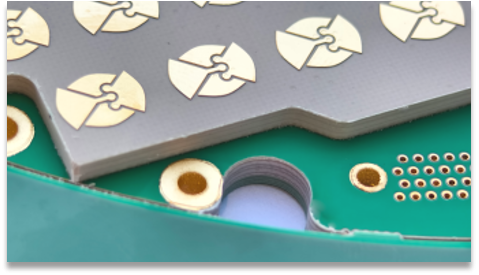
10-Layer 2.60mm HD Multimedia Main Control PCB
2.60 mm Thick · 4/4 mil Trace/Space · 0.20mm Micro-Via at 12.8 Aspect Ratio · High-Coverage ENIG · Double-Sided High-Density BGA · Case Study: 10-Layer Multimedia Development Board
Product Specifications
10-Layer 2.60mm HD Multimedia Main Control PCB — Build-to-Print Fabrication
2.60 mm Thick · 4/4 mil Trace/Space · 0.20mm Micro-Via at 12.8 Aspect Ratio · High-Coverage ENIG · Double-Sided High-Density BGA · Case Study: 10-Layer Multimedia Development Board
Solution Overview
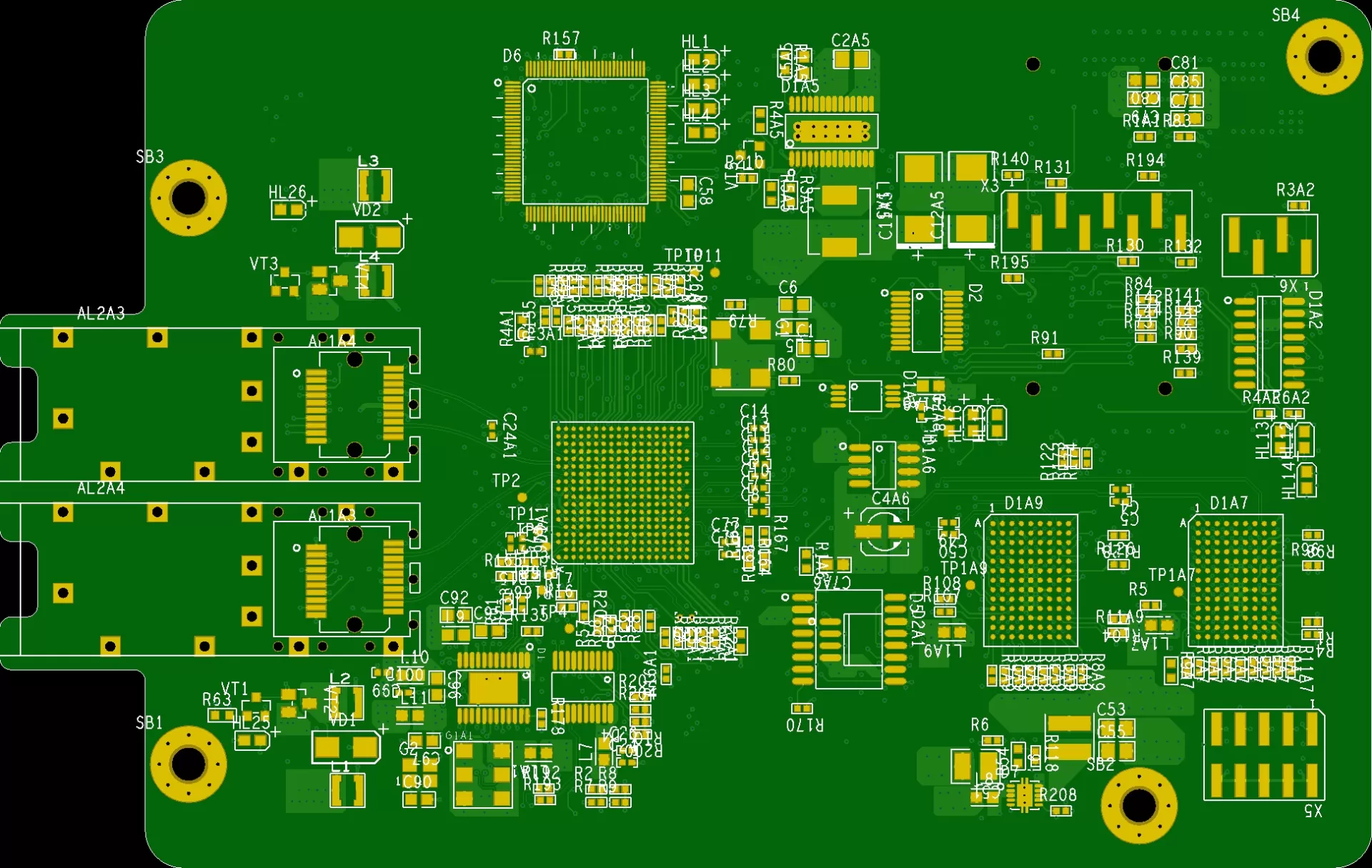
This page documents the build-to-print fabrication of a 10-layer 2.60mm HD multimedia main control PCB at 223.52 × 220.98 mm form factor. The board features double-sided high-density component placement with multiple large-array BGA multimedia processors, multi-channel video I/O connectors, an LCD display interface, Ethernet, DDR memory, and multiple expansion slots. Superb Automation receives the customer's complete schematic, Gerber package, drill files, and stackup specification — performs CAM engineering conversion and full DFM process validation — and delivers finished boards.
The board was fabricated to 4/4 mil trace/space rules with high-coverage ENIG surface finish at 13.98% gold coverage area. Flying probe testing covered 4,974 electrical test points across all layer-to-layer networks. The manufacturing process addresses four primary challenges: 12.8 aspect ratio micro-via plating at 0.20mm on a 2.60mm board, 4 mil fine-line etching uniformity across all 10 layers, thick-board lamination warpage and layer shift, and double-sided high-density solder mask / silkscreen defect control.
Key Specifications
| Layer Count | 10 layers — symmetrical signal / ground / power stackup |
| Board Thickness | 2.60 mm |
| Board Dimensions | 223.52 × 220.98 mm — large-format development board |
| Min. Trace Width | 4.00 mil (0.10 mm); process capable to 3.50 mil |
| Min. Trace Spacing | 4.00 mil (0.10 mm); process capable to 3.50 mil |
| Surface Finish | ENIG — Au: 0.03–0.10 µm, coverage ~13.98% |
| Copper Weight | 1 oz (outer), 0.5 oz (inner) |
| Min. Drill (PTH) | 0.20 mm — aspect ratio 12.8 |
| Hole Types | PTH signal vias, high-current power vias, NPTH alignment holes, mounting holes |
| Solder Mask | Green LPI, double-sided, LDI-exposed |
| Silkscreen | White, double-sided |
| Edge Routing Density | 18.39 m/m² — multiple connector slot milling |
| Test Method | Flying probe — 4,974 points, full netlist continuity / isolation |
| Inspection | AOI (full), AXI (sampling for via barrel plating) |
| Service Model | Build-to-print — customer schematic + Gerber in, finished PCB out |
| Board Category | HD multimedia multilayer — digital / mixed-signal |
10-Layer Symmetrical Multimedia Stackup
The board was manufactured using a 10-layer symmetrical stackup with dedicated high-speed signal layers, continuous ground planes, and split power plane regions — designed to support parallel HD video buses, DDR differential pairs, and Ethernet high-speed signals. Adjacent ground planes reduce video crosstalk and suppress EMI.
| L1 — TOP | Signal + Components — BGA processors, multi-channel video/LAN connectors, DDR memory |
| Prepreg | 2116 or equivalent |
| L2 — GND1 | Solid ground plane — continuous reference for L1 signals |
| Core | FR-4 (low-CTE) |
| L3 — SIG1 | Inner signal — HD video parallel bus routing |
| Prepreg | 2116 or equivalent |
| L4 — PWR1 | Split power plane — primary voltage domains |
| Core | FR-4 |
| L5 — SIG2 | Inner signal — DDR differential routing, shielded between power planes |
| Prepreg | 2116 or equivalent |
| L6 — SIG3 | Inner signal — Ethernet high-speed signal routing |
| Core | FR-4 |
| L7 — PWR2 | Split power plane — auxiliary voltage domains |
| Prepreg | 2116 or equivalent |
| L8 — SIG4 | Inner signal — memory expansion and debug interface routing |
| Core | FR-4 (low-CTE) |
| L9 — GND2 | Solid ground plane — continuous reference for L10 signals |
| Prepreg | 2116 or equivalent |
| L10 — BOTTOM | Signal + Components — expansion BGAs, external terminal blocks, debug ports |
Stackup Manufacturing Process Control
Symmetrical thick-board lamination: At 2.60 mm across 10 layers, low-CTE core materials and matched prepreg sequences balance thermal expansion symmetrically. Post-lamination X-ray inspection verifies layer-to-layer registration within ±0.05 mm — critical for thick 10-layer boards where cumulative dimensional changes in each core and prepreg can produce layer shift and warpage.
Multi-plane signal isolation: Independent signal layers, solid ground planes, and partitioned power layers are fabricated to the customer's stackup specification. The multi-ground-plane architecture provides inherent isolation between high-speed digital video regions and mixed-signal routing zones — a standard fabrication outcome of the 10-layer architecture.
Thick-board core handling: At 2.60 mm total thickness, individual core and prepreg layers provide adequate resin-fill volume. The lamination press cycle is profiled for multi-core thick-board constructions to prevent resin starvation, bubble formation, and inter-layer delamination during the multi-stage cure cycle.
Board Characteristics — Fabrication Perspective
The customer's Gerber files describe a double-sided, high-density, 10-layer multimedia PCB. From a manufacturing standpoint, the following characteristics drive the process requirements:
Large-format double-sided high-density multi-interface layout: Both sides carry multiple BGA processors, multi-channel video I/O connectors, LCD interface, Ethernet, JTAG debug, DDR memory, and expansion slots. Double-sided BGA placement doubles the solder mask registration demand — LDI-exposed solder mask on both sides maintains BGA pad opening accuracy and prevents mask encroachment.
4/4 mil fine-line across all layers: The entire board — parallel 16-bit video data buses, DDR differential pairs, and Ethernet signal traces — operates at 4 mil line width and 4 mil spacing. Thousands of trace-to-pad and pad-to-pad clearance points sit at the process boundary. LDI imaging with segmented etching parameter control maintains uniformity, particularly in BGA fanout regions where trace density is highest.
High-density BGA with multi-spec drilling: BGA via fields are densely packed with 0.20 mm minimum PTH vias — creating a 12.8 aspect ratio at 2.60 mm board thickness. The board also contains signal vias, high-current power vias, NPTH alignment holes, and large mounting holes — multiple hole types in conflicting proximity create annular ring, clearance, and via-on-pad risk conditions.
High-coverage ENIG for repeated debug soldering: BGA pads, connectors, and debug test points are all ENIG-finished at 13.98% coverage. The coverage ratio is within standard ENIG process capacity — gold thickness uniformity is maintained through controlled immersion timing and automated chemistry replenishment.
Multi-channel differential impedance control: Parallel video data buses and DDR differential pairs require simultaneous line width and differential impedance management. Differential pair width deviation directly causes impedance mismatch and HD image data distortion. TDR impedance coupons verify every production panel.
Core Manufacturing Challenges — 10-Layer, 2.60 mm Thick Board
Combining 10 layers at 2.60 mm with 4/4 mil design rules, double-sided high-density placement, and 0.20 mm micro-vias creates five primary manufacturing challenges:
1. 12.8 Aspect Ratio Micro-Via Plating at 0.20mm
At 2.60 mm finished thickness with 0.20 mm minimum PTH, the aspect ratio reaches 12.8 — well beyond the conventional 8:1 threshold. Standard plating can produce thin barrel copper, internal voids, and layer-to-layer opens. Multi-layer video buses depend on these micro-vias for layer transitions; via failures directly cause display artifacts and memory read/write errors. Extended plasma desmear and vertical continuous plating with increased duration ensure uniform copper deposition in 12.8 aspect ratio micro-vias.
2. 4/4 mil Fine-Line Etching Yield Across All Layers
With thousands of trace-to-pad and pad-to-pad clearances at the process limit and dense parallel video bus routing, etching risk is twofold: under-etching creates copper bridges and micro-shorts; over-etching thins traces, creating neck-downs and opens. In high-copper-density regions, etch rate varies with local copper distribution — isolated traces etch faster than dense arrays. LDI imaging provides precise photoresist patterning; the etching line adjusts spray pressure and conveyor speed in segments matched to local copper density. AOI is calibrated to 4/4 mil defect thresholds on all layers.
3. 10-Layer Thick-Board Lamination: Layer Shift and Warpage
Ten layers across multiple cores at 2.60 mm total thickness accumulate dimensional changes from each core and prepreg during the multi-stage press cycle. Uneven component distribution with concentrated large copper areas creates asymmetric thermal expansion — causing panel warpage during reflow and BGA / LCD connector solder opens. Low-CTE core materials with symmetrical prepreg distribution, followed by X-ray layer-shift measurement on every panel, maintain registration within ±0.05 mm. Panel flatness is verified before drilling; non-compliant panels are rejected at the lamination QC gate.
4. High-Volume Solder Mask and Silkscreen Defect Control
Multiple video, Ethernet, and expansion connectors concentrated on both sides create extremely high solder mask opening counts. Mask-on-trace and mask-on-pad risks are elevated. Double-sided component placement doubles the silkscreen-on-pad risk — a leading cause of solderability failure. CAM process automatically clips silkscreen from all pad regions on both layers. Optical fiducial marks on both sides require clear metal-free keep-out zones — validated as part of the standard DFM workflow.
5. Multi-Type Hole Clearance Conflicts
PTH vias, NPTH alignment holes, and large mounting holes are intermixed at close proximity. Conditions include: through-holes too close to surface copper, NPTH holes directly overlapping pads, and insufficient annular ring width. Insulation clearance violations create power-on short-circuit risks; annular ring breakout causes multi-layer power or video signal opens. CAM DFM identifies all three conditions: annular ring deficiencies receive plating thickness compensation; NPTH-to-copper clearance violations trigger copper pullback or hole relocation; via-on-pad geometries receive solder mask dam optimization.
Production Capabilities — 10-Layer Thick-Board Multimedia PCB Fabrication
Superb Automation's multilayer production line handles 10-layer thick-board fabrication from CAM engineering through final inspection. All process steps are performed in-house — the customer's Gerber files are received, DFM-validated, fabricated, tested, and inspected under one production management system.
Fabrication Policy: All DFM-based optimizations are CAM-level adjustments — annular ring compensation, mask opening micro-adjustment, silkscreen relocation, and clearance tuning. The customer's original netlist, routing, and circuit function are preserved. Defects requiring design-level decisions are escalated with coordinates, risk grades, and recommended solutions for customer approval before production release.
1. Symmetrical Multilayer Thick-Board Lamination
Stable 4–16 layer FR-4 production; 2.60 mm 10-layer thick-board process mature
Low-CTE core materials with matched prepreg distribution for symmetrical stress balance
Post-lamination X-ray layer-shift inspection — registration within ±0.05 mm
Panel flatness verified at lamination QC gate; non-compliant panels rejected before drilling
2. 4/4 mil Fine-Line LDI Imaging & Etching
LDI (Laser Direct Imaging) across the full production line — no film-based imaging
Stable production at 4/4 mil; process capability extends to 3.5/3.5 mil
Segmented etching parameters tuned for local copper density — prevents under-etch in dense BGA regions and over-etch in sparse areas
Differential impedance control per customer stackup — TDR coupon verified
3. Multi-Spec Drilling & Vertical Continuous Plating
Standard PTH at 0.20 mm; BGA signal vias; large-format mounting holes; NPTH alignment holes
Vertical continuous plating with extended duration — uniform copper in 12.8 aspect ratio micro-vias
Plasma desmear post-drill — removes resin smear from inner-layer copper in multi-layer hole walls
PTH / NPTH process separation: conductive vias receive full electroless copper; NPTH holes retain bare substrate
4. High-Coverage ENIG Surface Finish
ENIG, OSP, HASL, and immersion silver available
Au thickness: 0.03–0.10 µm, controlled through automated immersion timing and chemistry monitoring
LDI solder mask exposure on both sides — ±1 mil pad opening registration
Double-sided mask verification before ENIG: all BGA pads confirmed fully exposed
5. Full-Spectrum Final Inspection
Flying probe — full netlist continuity/isolation, 4,974 test points covered
AOI — 100% trace, pad, and solder mask defect scanning on all layers
AXI sampling — cross-sectional verification of via barrel plating integrity in high-density BGA regions
Fiducial mark validation — keep-out zone clearance verified for double-sided SMT pick-and-place
Full DFM Pre-Production Risk Control — 8-Module Inspection
Every customer Gerber package undergoes a comprehensive 8-module DFM inspection before CAM release — free of charge. Defects are graded on a 3-tier scale (pass / warning / danger) and documented with coordinates, risk level, and suggested process optimizations.
| Module | Inspection Scope |
| 1. Electrical & Routing | Acute-angle video differential traces, dangling/stub traces, trace-to-pad minimum spacing, isolated copper islands. Flagged for CAM cleanup to prevent post-etch shorts and signal anomalies. |
| 2. Fine-Line & SMD Spacing | 4/4 mil limit-case verification across all layers. Pad-to-pad and component spacing at process boundary — flagged for pad expansion or clearance tuning. |
| 3. Drilling Process | Annular ring verification, NPTH-to-copper clearance, via-on-pad detection. Annular ring deficiencies receive plating compensation; clearance violations trigger copper pullback. |
| 4. Solder Mask Compliance | Double-sided mask-on-pad detection, opening dimension adequacy. Mask openings micro-adjusted to guarantee full BGA and connector pad exposure on both sides. |
| 5. Silkscreen Compliance | Double-sided silkscreen-on-pad screening. Silkscreen automatically clipped from all pad regions on both layers. |
| 6. Assembly DFA | Component height clearance, screw/mechanical keep-out zones, board-edge safety margins, BGA peripheral clearance for rework access — both sides. |
| 7. Fiducial Mark Validation | Mark size, quantity, and metal-free clearance — verified on both sides to SMT equipment recognition specifications. |
| 8. Rout & Contour | 18.39 m/m² edge routing — connector slots, board outline, mounting features. Matched to dedicated tooling parameters to prevent burrs and copper lift. |
DFM Value to Customers
Rapid file review: Gerber packages are scanned and a graphical defect report is delivered with coordinates, risk grades, and actionable process recommendations.
Thick-board risk preemption: The highest-frequency failure modes for 10-layer 2.60 mm boards — lamination warpage and layer shift, 4/4 mil fine-line shorts, and BGA annular ring breakout — are specifically targeted in the DFM workflow.
CAM-level corrections, circuit preserved: All optimizations are fabrication-process adjustments. The customer's netlist, routing, and circuit function remain unchanged. Design-level defects are escalated with supporting data for customer approval.
Defect prevention at the CAM stage: DFM review catches process risks in the digital environment — before copper is etched. This eliminates the rework and scrap costs of discovering lamination, etching, or drilling issues on physical first articles.
Dual-document archival: Optimized production files and the complete DFM report are delivered to the customer. Prototype, production, and post-sales QC reference the same baseline — eliminating specification drift across production runs.
Typical Applications
10-layer PCBs with double-sided high-density component placement, fine-pitch BGA, and multi-channel video interfaces serve as main control boards in HD multimedia processing and embedded development systems. Boards of this architecture have been manufactured by Superb Automation for the following application areas:
| HD Video Processing | Multi-channel video I/O development boards integrating LCD display, parallel video buses, and high-speed image data transmission |
| Surveillance Multimedia | DVR/NVR main control boards with multi-channel video codec, network transmission, and storage interfaces on a single PCB |
| Embedded Development Platforms | Multi-interface embedded processing development boards integrating DDR memory, Ethernet, USB, JTAG debug, and multiple expansion slots |
| DDR High-Speed Memory Systems | DDR4/DDR5 parallel differential memory buses with large-capacity DRAM arrays — demanding strict differential impedance and length matching |
| Industrial Multimedia Terminals | Industrial LCD touch-panel main control boards combining multi-channel video input, communication interfaces, and high-current power delivery |
Standardized Volume Production — Prototype to Mass Manufacturing
This 10-layer manufacturing workflow bridges prototype verification and scaled production:
Unified process baseline: The manufacturing process chart — integrating stackup, component layout, and drill schedule — serves as the single reference across all production stages. Customer engineering verifies design compliance; procurement specifies materials; CAM configures fabrication parameters; SMT programs placement — all from one fully annotated document.
DFM-preemptive fabrication: Every layer, trace, pad, via, and outline is validated in CAM against the 8 DFM inspection modules before any copper is etched. Defects are corrected in the digital environment.
Prototype-to-volume process continuity: The same LDI imaging, symmetrical thick-board lamination, vertical continuous plating, high-coverage ENIG finishing, and flying-probe test processes are used from prototype quantities to production batches. The customer qualifies on the prototype build and ramps with the identical process flow.
In-house, full-process control: All 10-layer fabrication steps — lamination, drilling, plating, imaging, etching, solder mask, ENIG, routing, and test — are performed under one production management system. No sub-contracted process steps.
Why Choose Superb Automation for 10-Layer Multimedia PCBs
2.60 mm, 10 layers — thick-board lamination under control: Thick 10-layer boards demand precise lamination process control to prevent warpage and layer shift. Our symmetrical press process with low-CTE materials and post-lamination X-ray verification maintains layer registration within ±0.05 mm on every panel.
4/4 mil fine-line production — standard capability: LDI imaging across the full line. 4/4 mil is a proven production sweet spot; capable of 3.5/3.5 mil for tighter designs.
Double-sided high-density placement — mask and silkscreen on both sides: LDI solder mask exposure on both layers with ±1 mil registration. Silkscreen automatically clipped from pad regions on both sides during CAM. Double-sided fiducial mark validation before production release.
12.8 aspect ratio micro-via plating — proven process: 0.20 mm PTH at 2.60 mm thickness with vertical continuous plating. AXI sampling verifies barrel integrity in every production lot.
8-module DFM — free, fast, detailed: Every order includes the full DFM report with 3-tier defect grading. Danger-grade items escalated with supporting data before production.
Full electrical test — flying probe, full netlist: Every net tested for continuity and isolation. Defective boards identified and removed before shipment.
In-house, end-to-end production: Lamination, drilling, plating, LDI, etching, mask, ENIG, routing, AOI, AXI, flying probe — all under one roof.
Frequently Asked Questions
Q: What is your capability limit for high aspect ratio micro-vias?
0.20 mm PTH at 2.60 mm board thickness corresponds to a 12.8 aspect ratio. This is demanding but within our proven process window. Vertical continuous plating with extended duration and plasma desmear ensure uniform barrel copper. AXI sampling verifies via integrity on every production lot.
Q: What files do you need for build-to-print orders?
Customers provide the complete schematic, Gerber package (including drill files and stackup specification), and BOM (if PCBA is also required). We perform CAM-level process optimization only — the original netlist and circuit function are preserved unchanged.
Q: What are typical lead times for prototypes and volume production?
10-layer prototype quantities (including DFM review) typically ship in 7–10 working days. Volume production lead times depend on quantity and process complexity. Expedited service is available for time-critical projects.
Q: How do you handle DFM defects that require design changes?
Process-level defects — mask clearance, silkscreen clipping, annular ring compensation — are corrected in CAM without customer involvement. Design-level defects — such as NPTH-to-copper clearance requiring routing changes, or via-on-pad geometries requiring pad redesign — are flagged in the DFM report with specific coordinates and recommendations. The customer reviews and approves changes before production proceeds.
Request Quote — Free DFM Report, Build-to-Print from Your Gerber Files, 7–10 Day Prototype Turnaround, Volume Production Available
Tags
10-Layer Multimedia PCB
HD Video Processing PCB
2.6mm Thick PCB
High-Density BGA Multilayer
4/4 mil Fine-Line PCB
Gerber Build-to-Print
High Aspect Ratio Via Plating
DFM Process Control
Multimedia Main Control PCB
Differential Impedance PCB
ENIG Fine-Line PCB
10-Layer FR4 Volume Production
Surveillance Multimedia Board
Flying Probe Full Test
Symmetrical Stackup PCB
Thick-Board Lamination
LDI Imaging
Superb Automation