


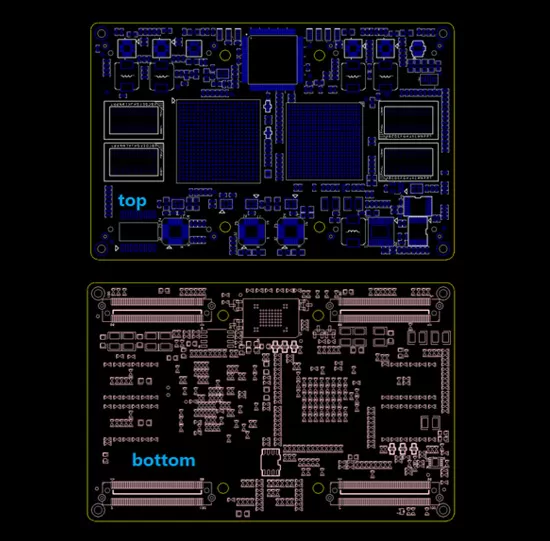
Communication Mainboard PCB — High-Density BGA Fanout Design
Lattice CPLD + TI FPGA · 4 Bottom-Plate Connectors · 3× Differential · Mid-Board Cutouts · 10–14 Layers · Superb Automation
Product Specifications
Communication Mainboard PCB — High-Density BGA Fanout Design
Lattice CPLD + TI FPGA · 4 Bottom-Plate Connectors · 3× Differential · Mid-Board Cutouts · 10–14 Layers · Superb Automation
Customer Requirement
A communication equipment manufacturer required a custom mainboard integrating a Lattice CPLD and a Texas Instruments FPGA in an extremely constrained form factor. The board needed to interface with a larger system via four board-to-board connectors buckled onto a bottom backplane — three of which carry multi-lane differential signals — while accommodating four mechanical positioning holes cut through the middle of the board.
| Requirement | Specification |
|---|---|
| Logic Devices | Lattice CPLD (control/glue logic) + TI FPGA (signal processing) |
| Board-to-Board Connectors | 4× high-density mezzanine connectors, buckled onto a bottom backplane |
| Differential Signals | 3 connectors carry multi-lane differential pairs (LVDS / M-LVDS / sub-LVDS) |
| Remaining Connector | 1× single-ended + power/ground distribution |
| Mechanical Constraint | 4 positioning holes machined through the board body (internal cutouts, not edge-mounted) |
| Form Factor | Custom small footprint — board outline dictated by enclosure, not by routing comfort |
Design Challenges
1. BGA Fanout in a Constrained Footprint
The TI FPGA uses a fine-pitch BGA package (0.8 mm pitch typical for mid-range FPGAs). Under normal conditions, a 4-row-deep BGA escape pattern on a standard 4/4 mil design requires substantial routing real estate. But here, the board size was dictated by the mechanical enclosure — leaving no room for conventional fanout. Every signal layer under the BGA shadow had to be fully utilized, and the outer rows needed via-in-pad (VIP) or microvia escape to free up inner-layer routing channels.
2. Three Differential Connectors — BGA Escape Bottleneck
Three of the four bottom-plate connectors carry high-speed differential signals (LVDS at 400 Mbps–1 Gbps per lane, multiple lanes per connector). Each differential pair requires:
▸ Length-matched traces (±5 mil within-pair, ±25 mil pair-to-pair within a bus)
▸ 100Ω controlled differential impedance
▸ Continuous reference plane (no splits under diff pairs)
▸ Adequate pair-to-pair spacing (≥3× trace width to suppress crosstalk)
Routing 30–40 differential pairs from a BGA to three different connector locations — all while avoiding the mid-board cutouts — created a routing channel bottleneck that required layer-by-layer breakout planning before a single trace was placed.
3. Mid-Board Mechanical Cutouts
Four positioning holes cut through the board introduce significant layout disruption:
▸ Signal traces must route around each cutout — no signals can pass through the hole zone
▸ Power planes are fragmented — current paths must be verified to ensure no neck-down that starves BGA core or I/O rings
▸ Cutout edges introduce board warpage risk during reflow — requires balanced copper distribution (copper thieving) on all layers around each hole to maintain flatness
4. BGA Power Delivery Under High Transient Load
The TI FPGA, when configured for signal processing, draws dynamic current with slew rates exceeding 10 A/μs on its core voltage rail. The Lattice CPLD, while lower power, adds I/O switching current. With the constrained board area, placing sufficient bulk capacitance close to each BGA — and maintaining low-inductance power delivery paths through the PCB stackup — required co-optimization of the PDN (Power Distribution Network) and signal routing, not sequential optimization.
Our Solution
1. BGA-Driven Stackup Design
Instead of starting with a fixed layer count and fitting the design into it, we determined the minimum layer count by the BGA escape requirement, then optimized the stackup around that:
| Layer | Function | Routing Content |
|---|---|---|
| Top | Component + Signal | BGA outer row escapes, short single-ended routes, connector landing pads |
| L2 | GND (continuous) | Solid reference plane — no splits under FPGA or CPLD footprints |
| L3 | Signal (inner) | BGA row 2–3 escapes, differential pairs group A, single-ended control signals |
| L4 | PWR (split) | FPGA VCCINT (1.0V) + VCCIO (3.3V/2.5V) + CPLD VCC, split by polygon pours |
| L5 | GND (continuous) | Solid reference plane — mirror of L2 for symmetric stackup |
| L6 | Signal (inner) | BGA row 3–4 escapes, differential pairs group B, connector-to-BGA long routes |
| L7 | PWR (split) | FPGA VCCAUX + PLL analog supplies, separated from digital VCCINT by 2 mm isolation gap |
| L8 | GND (continuous) | Solid reference plane |
| L9 | Signal (inner) | Differential pairs group C (remaining connector lanes), clock distribution |
| L10 | PWR / GND | Combined power polygon for connector I/O supplies + bottom-side ground pour |
| Bottom | Signal | Decoupling capacitor placement, connector signals, JTAG/debug header |
Stackup Rationale: The 10-layer stackup (signal-GND-signal-PWR-GND-signal-PWR-GND-signal-PWR/signal) provides three full stripline signal layers (L3, L6, L9) sandwiched between continuous ground planes — essential for the 3 differential connector groups. Power islands on L4 and L7 deliver low-inductance paths to BGA balls directly beneath the devices. For higher I/O count FPGA variants, this extends to 12 or 14 layers by adding signal-GND pairs.
2. BGA Escape Strategy
| BGA Row | Escape Method | Rationale |
|---|---|---|
| Outer 2 rows | Top-layer dog-bone fanout with through-hole vias | Standard escape — vias placed outside BGA shadow, traces route outward on top layer |
| Row 3–4 | Via-in-pad (VIP) with filled & capped microvias (0.1 mm laser drill) to L3/L6 | Frees inner BGA area for decoupling cap placement on bottom side; VIP eliminates dog-bone stub that would degrade signal at >500 Mbps |
| Inner rows (5+) | Blind via L1–L3, escape on L3 (stripline); or L1–L4 with escape on L6 | Deep BGA devices (400+ balls) require multi-level via strategy; blind vias avoid through-hole vias that would block inner-layer routing channels |
| Ground/Power balls | Direct via to L2 (GND) or L4/L7 (PWR) with 0.25 mm drill, no escape trace needed | Minimizes inductance; plane-connected vias act as distributed decoupling |
3. Differential Pair Routing Around Cutouts
With four cutouts in the board, we treated each cutout as a routing obstacle and planned the differential pair topology before placement:
| Connector | Signal Type | Routing Strategy |
|---|---|---|
| Conn A (differential) | 8× LVDS lanes, 400 Mbps | Routed on L3 as a bus group; serpentine delay matching within BGA-to-connector span; avoids cutout-1 by routing east-then-north around the hole perimeter with 2 mm clearance to cutout edge |
| Conn B (differential) | 12× sub-LVDS lanes, 200 Mbps | Routed on L6; split into two 6-lane sub-buses to pass between cutout-2 and cutout-3; ground-guard traces (no connect, grounded at both ends) placed between sub-buses for crosstalk isolation |
| Conn C (differential) | 10× M-LVDS lanes, 500 Mbps | Routed on L9 (bottom-side stripline); these are the longest traces (~80 mm) — impedance TDR verified at 100Ω ±7% end-to-end; return vias stitched every 8 mm along the route for continuous reference |
| Conn D (single-ended) | 16× GPIO + I²C + SPI, < 50 MHz | Routed on top and bottom layers; non-critical, no impedance constraint; 8 mil trace / 8 mil space |
4. Power Integrity Design
| Challenge | Root Cause | Solution |
|---|---|---|
| FPGA core voltage droop under load step | VCCINT plane necked-down between cutout-2 and cutout-3, causing IR drop > 50 mV at 5A draw | Re-routed VCCINT as dual-path power polygon (route around both sides of the cutout group); DC IR drop simulation confirmed < 15 mV at worst-case 8A load |
| BGA decoupling capacitor placement | Insufficient backside real estate under BGA shadow due to via array density | Moved 0402 decoupling caps to top side, within 2 mm of BGA perimeter; used reverse-geometry (0306) caps where height clearance permitted — lower ESL than standard 0402 at same capacitance |
| FPGA PLL analog supply noise | Digital VCCINT switching noise coupling into VCCPLL through shared plane cavity resonance at 800 MHz | Isolated VCCPLL as a dedicated island on L7, separated from digital VCCINT by 2 mm moat with ferrite bead bridge (BLM18PG121SN1, 120Ω @ 100 MHz); PLL jitter measured < 15 ps RMS after isolation |
| Mid-board cutout edge return current disruption | Ground reference plane interrupted at cutout edges — return currents forced to find alternate paths, increasing loop area and EMI | Stitching vias placed every 2 mm along both sides of each cutout perimeter; stitching vias connect L2-GND to L5-GND to L8-GND, creating a low-impedance return cage around each hole |
PCB Manufacturing Specifications
| Parameter | Specification |
|---|---|
| Layer Count | 10 layers (baseline); 12–14 layers for high I/O FPGA variants |
| Material | FR-4 High-Tg (Tg ≥ 170°C) with mid-loss laminate option (Isola 370HR or equivalent) for >1 Gbps differential lanes |
| Board Thickness | 1.6 mm ±10% |
| Copper Weight | 0.5 oz (inner signal), 1 oz (outer + power planes) |
| Minimum Trace / Space | 3.5/3.5 mil for BGA escape zone; 4/4 mil general routing |
| Minimum Drill | 0.2 mm mechanical; 0.1 mm laser (microvia for VIP) |
| Via-in-Pad | Laser-drilled 0.1 mm, copper-filled & planarized (flat to pad surface ±5 μm) |
| Controlled Impedance | 100Ω differential (LVDS/M-LVDS/sub-LVDS); 90Ω differential (USB if present); 50Ω single-ended (clocks, RF if applicable) |
| Impedance Tolerance | ±7% on all controlled pairs; TDR coupon report provided |
| Surface Finish | ENIG (Au: 0.05–0.12 μm over Ni: 3–6 μm) — required for fine-pitch BGA coplanarity |
| Cutout Machining | CNC routing with ±0.1 mm positional tolerance; cutout edge copper-to-edge clearance ≥ 0.5 mm; chamfered edges to prevent glass fiber protrusion |
| Solder Mask | Green LPI, dual-side; 0.075 mm solder dam between VIP pads and adjacent traces |
| Testing | 100% flying probe (continuity + isolation); impedance TDR on panel coupon; AOI after solder mask; X-ray on all VIP arrays for void detection (< 5% void rate) |
🔧 DFM Review — What We Check Before Production: Our free 24-hour DFM review for this communication mainboard covers: (1) BGA escape via count vs. available routing channels per layer, (2) cutout edge-to-trace clearance compliance, (3) power plane ampacity through neck-down zones between cutouts, (4) differential pair length matching budgets (within-pair and pair-to-pair), (5) VIP copper fill uniformity across the BGA array to prevent warpage, (6) solder mask registration tolerance vs. VIP pad pitch. Typical first-pass yield after our DFM review exceeds 95%.
Key Differentiators
| Aspect | Generic PCB Fab | Superb Automation |
|---|---|---|
| BGA Escape Planning | Rule-of-thumb layer count estimation | BGA-driven stackup: layer count determined by fanout requirement, pre-simulated via count per row |
| Differential Pair Integrity | ±10% impedance tolerance | ±7% impedance tolerance; ground-guard traces between adjacent pairs; return via stitching along full route length |
| Power Integrity | Post-layout DC check only | Pre-layout PDN simulation; IR drop analysis through cutout-constrained planes; PLL analog supply island with ferrite isolation |
| Mid-Board Cutouts | Standard routing — traces may violate clearance | Return-via cage around every cutout perimeter; dual-path power routing; copper thieving for thermal balance |
| Via-in-Pad | Standard VIP — dimpling risk | Copper-filled & planarized (±5 μm flatness); X-ray verified < 5% void rate on every panel |
Target Applications
▸ Base station backhaul communication processing boards
▸ FPGA-based software-defined radio (SDR) mainboards
▸ Network protocol converter / gateway embedded boards
▸ Industrial machine vision processing engines (FPGA + sensor interface)
▸ Data acquisition (DAQ) mainboards with high-channel-count differential inputs
▸ Telecom line-card mezzanine boards with backplane interconnect
▸ Test & measurement instrument digital processing boards
Inquiries: Info@superb-tech.com | Request Quote | Explore more: PCB Solutions