Communication Board Signal Integrity Simulation
60,000 Pins | SFP+ · Interlaken · QPI · PCIe3 · DDR4 · DDR3 | TU872SLK-sp | Intel Platform Loss Spec | 1-Month Turnaround
Project Overview
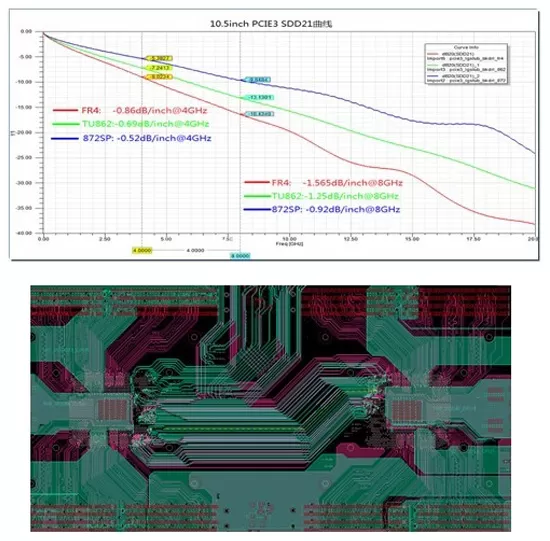
This communication board carries approximately 60,000 pins and required simultaneous completion of design, signal integrity simulation, and production within a single month — an aggressive timeline given the board's interface diversity and high pin density. The board integrates six high-speed interface types operating at three distinct data rates under five industry standards, with multiple low-voltage, high-current power rails driving BGA devices. Simulation revealed that standard FR-4 could not meet the Intel platform loss specification; a material change to TU872SLK-sp resolved the margin without altering any trace geometry.
Interface Portfolio
Six interface types spanning serial, memory, and backplane protocols — each with independent loss budgets, jitter margins, and routing constraints.
| SFP+ | 10.3125 Gbps | SFF-8431 | Optical / copper cage connector — receive and transmit differential pairs |
| Interlaken | 12.5 Gbps | Interlaken Protocol | Multi-lane chip-to-chip serial interconnect for packet processing |
| QPI | 8 Gbps | QPI 3.0 | Intel QuickPath Interconnect — processor-to-processor link on Intel platform |
| PCIe 3.0 | 8 Gbps | PCIe 3.0 Base Spec | Multi-lane expansion interconnect — Intel platform compliance required |
| DDR4 | — | JESD79-4 | High-speed memory interface — address/command/control bus + DQ/DQS groups |
| DDR3 | — | JESD79-3E | Legacy memory interface — parallel bus timing and termination constraints |
Power Delivery Network — Multi-Voltage, Low-Voltage, High-Current
The board hosts multiple power rails with low voltage and high current — typical of BGA-intensive designs where core voltages run below 1.0 V while drawing tens of amperes. IR drop across power planes and vias becomes a dominant constraint.
PDN Simulation Scope
| DC IR Drop | Static voltage drop across power planes and vias at max current — verified < 2% of nominal rail voltage |
| AC Impedance (Z-Parameter) | Frequency-domain impedance profile across each rail — target impedance met from DC to the decoupling capacitor self-resonant frequency |
| Decoupling Strategy | Distributed MLCC decoupling per BGA rail — bulk tantalum on board edge, mid-frequency MLCC arrays, high-frequency 0201/0402 local to BGA pins |
| Via Current Capacity | Multiple parallel power vias per BGA rail to meet current density limits — plating thickness verified on cross-section |
Material Evaluation — FR-4 vs TU872SLK-sp
The Intel platform imposes a loss specification for high-speed serial links routed on the board. The requirement is defined as maximum insertion loss per inch, measured at 4 GHz and 8 GHz, with separate limits for stripline and microstrip routing.
Intel Platform Loss Specification
| Routing Topology | At 4 GHz | At 8 GHz |
| Stripline | -0.80 dB/inch max | -1.60 dB/inch max |
| Microstrip | -0.84 dB/inch max | -1.68 dB/inch max |
Simulation Comparison
| Parameter | Standard FR-4 | TU872SLK-sp |
| Dk (dielectric constant) | ~4.2–4.5 (at 4 GHz) | ~3.5 (at 4 GHz) |
| Df (dissipation factor) | ~0.018–0.022 (at 4 GHz) | ~0.008 (at 4 GHz) |
| Stripline loss at 4 GHz | Exceeds -0.80 dB/inch ❌ | Within spec ✅ |
| Stripline loss at 8 GHz | Exceeds -1.60 dB/inch ❌ | Within spec ✅ |
| Microstrip loss at 4 GHz | Borderline ❌ | Within spec ✅ |
| Microstrip loss at 8 GHz | Exceeds -1.68 dB/inch ❌ | Within spec ✅ |
| Line width / space impact | — (baseline) | Unchanged ✅ — same design rules |
Material Selection Outcome: TU872SLK-sp, a low-loss laminate with a dissipation factor approximately half that of standard FR-4, brought both stripline and microstrip insertion loss within the Intel platform specification at both 4 GHz and 8 GHz. The dielectric constant difference did not change the original trace width and spacing, avoiding a complete re-layout. This allowed the project to stay on schedule — design, simulation, and production completed within one month.
Simulation Methodology
Signal Integrity — Full-Link Channel Simulation
| 3D EM Extraction | Full-wave 3D electromagnetic extraction of critical nets — vias, BGA breakout, connector transitions, and impedance discontinuities |
| Channel Budget | End-to-end insertion loss, return loss, and crosstalk budget computed per standard — SFF-8431 eye mask for SFP+, PCIe 3.0 channel compliance per Base Spec |
| Jitter Analysis | Total jitter (TJ), deterministic jitter (DJ), and random jitter (RJ) decomposed for each high-speed link |
| Eye Diagram | Eye height, eye width, and eye mask margin reported for all serial links at BER 10⁻¹² or better |
| Crosstalk | Near-end (NEXT) and far-end (FEXT) crosstalk simulated between adjacent differential pairs across the full channel length |
DDR Timing — DRAM Interface Verification
| Address/Command | Fly-by topology — timing skew across all DRAM devices verified per JESD79-4 (DDR4) and JESD79-3E (DDR3) |
| DQ / DQS | Per-byte-lane DQ-to-DQS skew — write-leveling timing budget verified |
| Termination | On-die termination (ODT) values and parallel termination resistors verified against Intel platform reference design |
Design Constraints Resolved
| High Pin Density | 60,000 pins on a compact form factor — fan-out routing optimized per BGA device, with blind/buried via options where surface routing was infeasible |
| Multi-Interface Coexistence | Six interface types on one board — physical separation of analog SFP+ lanes from digital parallel buses, independent ground references per interface domain |
| Multi-Voltage PDN | Low-voltage (< 1.0 V), high-current rails — multiple power plane splits with adequate copper weight, parallel via arrays for BGA core supply |
| 1-Month Turnaround | Design, simulation, and production in parallel — simulation results fed back into layout incrementally rather than waiting for a complete layout freeze |
Manufacturing Parameters
| Material | TU872SLK-sp — low-loss laminate |
| Layer Count | Per DFM — high-layer-count with multiple ground references for signal integrity |
| Min Trace / Space | Per original design — unchanged after material swap |
| Impedance Control | Differential impedance modeled and verified per Intel platform — TDR coupon on every panel |
| Surface Finish | ENIG (standard) / ENEPIG (on request for gold wire bonding) |
| Testing | Flying probe full netlist; TDR impedance verification; AXI via barrel sampling; cross-section for plating thickness |
| Facilities | Wuxi (up to 128 layers) + Huizhou (up to 68 layers) |
| Turnaround | 1 month — design, simulation, and production complete |
Applicable Interface & Platform Types
| Communication Mainboards | Multi-interface aggregation boards — SFP+ cages, QPI links, PCIe expansion, DDR memory |
| Intel Platform Designs | Boards requiring Intel-specified loss budgets for QPI, PCIe3, and DDR interconnects |
| Data Plane Processors | Packet processing boards with Interlaken backplane interconnects and SFP+ line-side interfaces |
| High-Pin-Count BGA Boards | Designs with large BGA devices (>2000 pins each), multiple power rails, and tight form-factor constraints |
| Multi-Standard Compliance | Boards carrying interfaces governed by several standards simultaneously — SFF, PCIe, JESD, QPI |
Send your high-speed communication board requirements to pcba@superb-tech.com for a free DFM review and quotation. Material evaluation and SI simulation included in our pre-production service.