


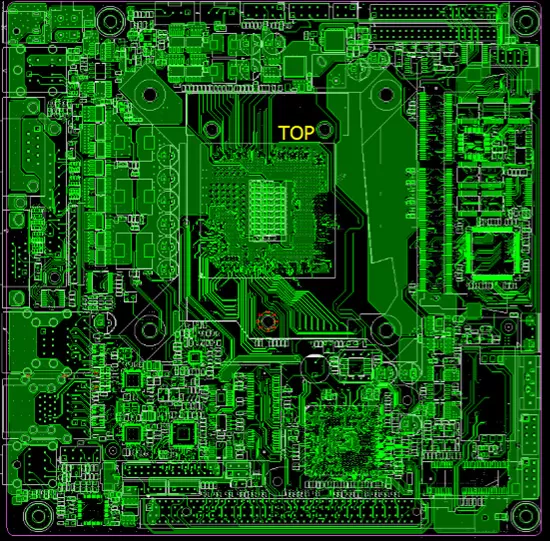
Intel H81 Mini-ITX Industrial Control Motherboard PCB
6–8 Layer · DDR3L · Dual GbE · 10× COM · PCIe 16X · LVDS · mSATA/mPCIe · 8× USB · High-Density Layout · Superb Automation
Product Specifications
Intel H81 Mini-ITX Industrial Control Motherboard PCB
6–8 Layer · DDR3L · Dual GbE · 10× COM · PCIe 16X · LVDS · mSATA/mPCIe · 8× USB · High-Density Layout · Superb Automation
Customer Requirement
The customer required an industrial-grade embedded control motherboard built around the Intel H81 chipset in the compact Mini-ITX form factor (170 × 170 mm). Despite the constrained PCB area, the board needed to accommodate an unusually dense set of industrial I/O peripherals while maintaining signal integrity and reliable power delivery.
| Requirement | Specification |
|---|---|
| Chipset | Intel H81 Express |
| Form Factor | Mini-ITX (170 × 170 mm) |
| Memory | DDR3L SODIMM, dual-channel |
| Ethernet | Dual Realtek RTL8111E Gigabit LAN |
| Expansion Slot | 1× PCIe 16X (mechanical), PCIe 2.0 |
| Storage | mSATA (full-size) + mPCIe (half/full-size) + SATA 3.0 port |
| Serial Ports | 10× COM ports (RS-232/422/485 configurable) — via onboard pin headers |
| Parallel Port | 1× LPT (PRINT) — IEEE 1284, via onboard pin header |
| Display | VGA (D-Sub 15) + LVDS (dual-channel 24-bit, onboard header) |
| USB | 8× USB ports (rear I/O + internal headers, USB 2.0/3.0) |
| Legacy I/O | PS/2 keyboard/mouse, audio (Line-out / Mic-in), 8-bit GPIO pin header |
Design Challenges
1. Extreme Routing Density in Mini-ITX Footprint
Packing 10 COM ports, dual GbE, PCIe 16X, LVDS, mSATA, mPCIe, LPT, 8× USB, VGA, PS/2, audio, and GPIO onto a 170 × 170 mm board pushes the limits of Mini-ITX routing density. The COM port pin headers alone consume significant board edge real estate, competing with rear I/O connectors, expansion slots, and power delivery circuitry.
2. Power Integrity and Ground Bounce
The combination of a CPU VRM (multi-phase buck converter for the H81 platform), DDR3L memory power, multiple peripheral voltage rails (3.3V, 5V, 12V for COM/USB/LVDS), and the dual GbE PHY analog supplies creates a complex power delivery network (PDN) on a small board. Without careful planning, switching noise from the CPU VRM couples into sensitive analog domains — especially the LVDS differential pairs, audio codec, and COM port transceivers.
3. Mixed-Signal Coexistence
High-speed digital interfaces (PCIe 2.0 at 5 GT/s, GbE MDI, DDR3L at up to 1600 MT/s) must coexist with noise-sensitive analog circuits (audio codec, LVDS transmitter, COM port RS-232/485 line drivers) on the same substrate. Crosstalk between adjacent signal groups can degrade COM port data integrity and introduce audible noise on the audio output.
4. Thermal Management Under Industrial Conditions
Industrial control environments often operate at elevated ambient temperatures (up to 60°C). The H81 chipset TDP (~4.1W), plus dual RTL8111E controllers and COM port transceivers (which can dissipate significant heat when driving long RS-485 cables into termination), require careful thermal planning — especially in a fanless enclosure.
Our Solution
1. Parallel Design Methodology
Rather than sequential layout (place → route → verify → re-spin), we adopted a parallel design workflow:
▸ Pre-layout PDN simulation — Modeled the complete VRM-to-load impedance profile before placement, identifying resonant peaks that would amplify switching noise at 300–500 kHz (CPU VRM switching frequency)
▸ Concurrent placement & constraint entry — Power team defined plane splits, voids, and via stitching zones while the signal team placed critical differential pairs (PCIe, GbE, LVDS, DDR3L) simultaneously
▸ Iterative DRC-on-the-fly — Real-time constraint checking during routing prevented late-stage discovery of impedance violations or clearance errors
2. Spatial Optimization Strategy
| Zone | Strategy | Result |
|---|---|---|
| COM Port Density | Split 10 COM ports into two groups of 5, placed on opposite board edges with shared RS-232 transceiver arrays (MAX3243 × 2 + MAX3485 × 2 for RS-485). Pin headers staggered on top and bottom layers to avoid congestion. | 10 COM ports fit within 85 mm of board edge while maintaining 2.54mm pin pitch accessibility |
| Dual GbE + PCIe | Dual RTL8111E placed adjacent to PCIe 16X slot, sharing a common PCIe 2.0 root complex lane group. MDI magnetics integrated into RJ45 jacks with center-tap decoupling to reduce loop area. | GbE differential pairs < 60 mm total length; PCIe Gen2 eye diagram wide open at 5 GT/s |
| LVDS + VGA | LVDS transmitter (CH7511B) placed close to H81 FDI interface; VGA DAC routed as single-ended 75Ω impedance-controlled traces with R-C filters at connector end for EMI suppression. | LVDS @ 1920×1080, VGA @ 1920×1200 — both passed display compatibility testing |
| SATA / mSATA / mPCIe | mSATA and mPCIe connectors placed on component side with shared SATA controller lanes; mPCIe routed as differential 85Ω to maintain Gen2 compliance. | Full 6 Gbps SATA throughput on mSATA; mPCIe recognized by BIOS as x1 Gen2 device |
3. Power Integrity Design
| Problem | Root Cause | Solution |
|---|---|---|
| CPU VRM noise coupling to audio | Shared return path between VRM switching loop and audio codec analog ground | Split analog ground island under audio codec (ALC662), connected to digital ground at a single star-point via 0Ω jumper. VRM loop area minimized with phase-node copper pour. |
| COM port RS-485 data errors | Ground bounce from CPU load transients pulling RS-485 common-mode voltage outside ±7V window | Dedicated RS-485 transceiver ground plane (isolated by slot cuts from main digital ground), TVS clamping (SM712) at each COM port pin header, 10μF + 0.1μF decoupling at every transceiver VCC pin |
| DDR3L VTT ripple | Sinking/sourcing transients on VTT regulator output (up to ±3A) causing reference voltage drift | VTT regulator placed within 20 mm of DIMM slot; dual 10μF MLCC + 100μF polymer cap at VTT output; VREF routed as differential sense pair to memory controller |
| LVDS pixel jitter | Switching noise on 3.3V rail (shared between LVDS transmitter and COM port transceivers) | Dedicated LDO (3.3V → 3.3V, 300mA) for LVDS transmitter only; ferrite bead + π-filter on LVDS VCC pin to reject residual ripple below 1 mVpp |
PCB Manufacturing Specifications
| Parameter | Specification |
|---|---|
| Layer Count | 6–8 layers (depending on COM port count and isolation requirements) |
| Material | FR-4 High-Tg (Tg ≥ 170°C) — compatible with lead-free reflow and industrial temperature range |
| Board Thickness | 1.6 mm standard |
| Copper Weight | 1 oz (35 μm) outer layers; 0.5 oz (18 μm) inner signal layers; 2 oz (70 μm) power plane layers |
| Minimum Trace / Space | 4/4 mil (0.1/0.1 mm) for general routing; 3.5/3.5 mil for BGA escape under H81 PCH |
| Minimum Hole Size | 0.25 mm mechanical drill; 0.1 mm laser via (HDI option for 8-layer stackup) |
| Controlled Impedance | DDR3L: 40Ω single-ended; PCIe/GbE/mSATA: 85Ω differential; LVDS: 100Ω differential; USB 3.0: 90Ω differential; VGA: 75Ω single-ended |
| Surface Finish | ENIG (Immersion Gold over Nickel) — flat surface for BGA, fine-pitch QFP, and DIMM socket coplanarity |
| Solder Mask | Green LPI, dual-side; black or matte black optional for aesthetics |
| Silkscreen | White legend, both sides — component designators, polarity marks, connector pin-1 indicators |
| Testing | 100% flying probe electrical test (continuity + isolation); impedance TDR coupon on every panel; AOI after solder mask |
🔧 Design-for-Manufacturing (DFM) Notes: Our engineering team provides a free 24-hour DFM review before production. We flag potential issues including annular ring violations on BGA breakout vias, solder mask slivers between fine-pitch COM port pin headers, and thermal relief adequacy on high-current power planes. For this H81 Mini-ITX design, our DFM review typically identifies 8–12 actionable items that prevent first-article failures.
Key Differentiators
| Aspect | Generic PCB Fab | Superb Automation |
|---|---|---|
| PDN Pre-Simulation | Not offered | Pre-layout PDN simulation identifies resonant peaks before fabrication — prevents power noise issues at first-article test |
| Parallel Design | Sequential (6–8 week turnaround) | Concurrent placement + constraint + routing reduces engineering time by 40% |
| Mixed-Signal Expertise | Digital-only or limited analog | Dedicated analog ground islands, star-point grounding, LVDS/RF-aware routing — proven across 200+ industrial board designs |
| DFM Review | Basic DRC check | 24h free DFM report covering BGA breakout, annular ring, thermal relief, solder mask slivers, and impedance coupon placement |
| Impedance Control | ±10% typical | ±7% guaranteed on all controlled-impedance traces; TDR report included with every shipment |
Target Applications
▸ Factory automation controllers (PLC / DCS human-machine interface)
▸ Digital signage and kiosk embedded computers
▸ Medical instrument embedded control boards (patient monitor, diagnostic device)
▸ Transportation ticketing and fare collection terminals
▸ Retail point-of-sale (POS) mainboards with multi-peripheral support
▸ Industrial IoT edge gateway with multi-COM sensor aggregation
▸ Building automation and HVAC control panels
Inquiries: Info@superb-tech.com | Request Quote | Explore more: PCB Solutions