


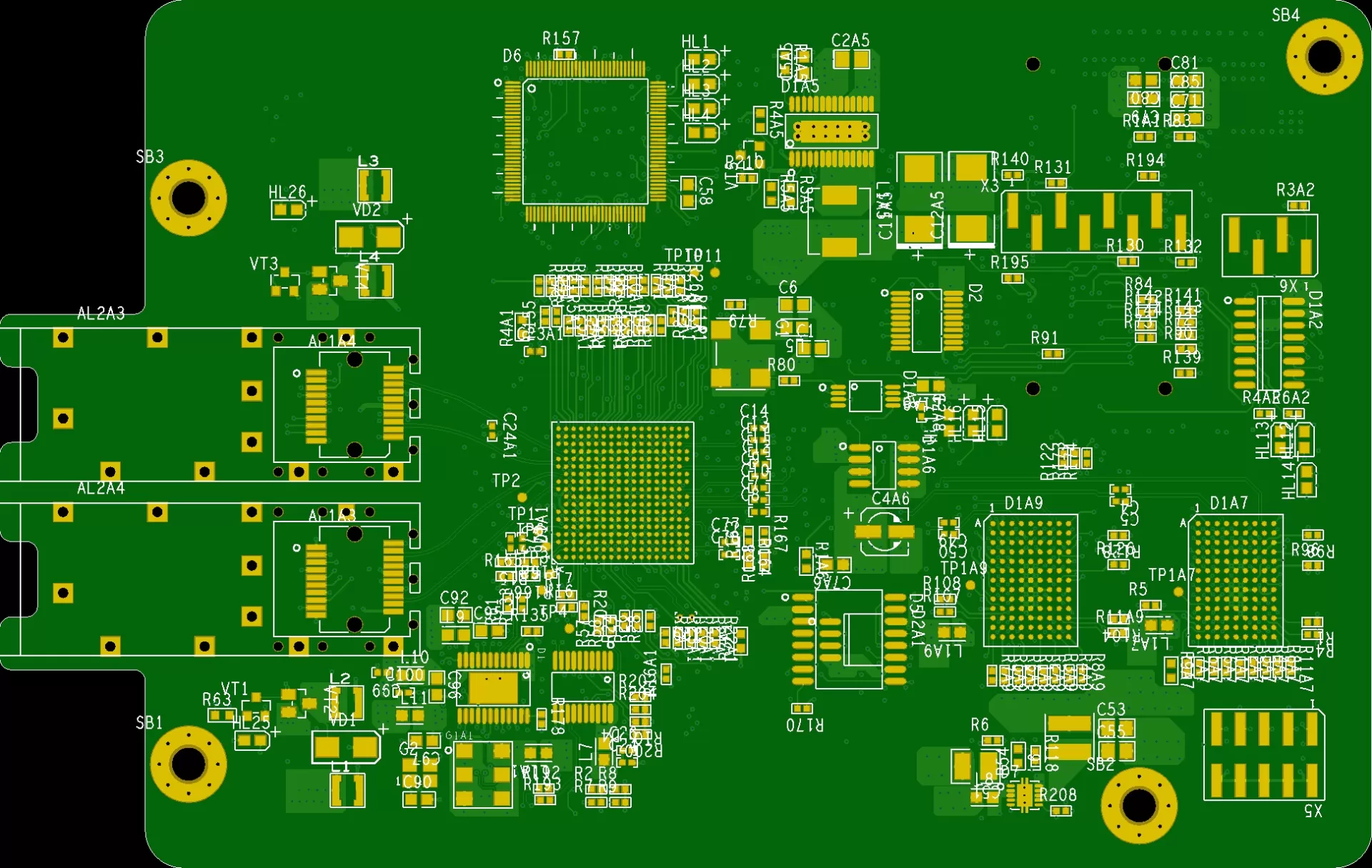
8-Layer Optical Fiber Transmission PCB
2.60 mm Thick · 4/5 mil Trace/Space · ENIG · 0.19 mm Micro-Via · Case Study: 10G Optical Fiber Transmission Board
Product Specifications
8-Layer 10G Optical Fiber Transmission PCB — Build-to-Print Fabrication
2.60 mm Thick · 4/5 mil Trace/Space · ENIG · 0.19 mm Micro-Via · Case Study: 10G Optical Fiber Transmission Board
Solution Overview
This page documents the build-to-print fabrication of an 8-layer 10G optical fiber transmission PCB at 2.60 mm finished thickness. The board carries high-density BGA processors alongside 10 Gbps optical transceiver interfaces — SFP+ cages and associated high-speed differential pairs — on a compact 145.40 × 91.99 mm form factor. Superb Automation operates on a strict build-to-print model — we receive customer Gerber, drill, and stackup files, perform engineering conversion and DFM process validation, and deliver finished boards.
The board was fabricated with 4/5 mil trace/space rules, ENIG surface finish with high gold-coverage area, and 0.19 mm minimum plated micro-vias — a specification that pushes the ultra-high aspect ratio boundary (>13:1 at 2.60 mm board thickness). The manufacturing process is supported by a comprehensive process chart integrating the full 8-layer stackup, BGA routing layout, and complete drill schedule, alongside an 8-module DFM inspection report with 3-tier defect grading (pass / warning / danger). This build represents the high-complexity end of our standard multilayer PCB production capability.
Key Specifications
| Layer Count | 8 layers |
| Board Thickness | 2.60 mm |
| Board Dimensions | 145.40 × 91.99 mm (compact form factor) |
| Min. Trace Width | 4.00 mil (0.10 mm) |
| Min. Trace Spacing | 5.00 mil (0.127 mm) |
| Surface Finish | ENIG — high coverage ratio, Au: 0.03–0.10 µm |
| Copper Weight | 1 oz (outer), 0.5 oz (inner) |
| Min. Drill (PTH) | 0.19 mm — ultra-high aspect ratio |
| Standard PTH | 0.35 mm |
| Aspect Ratio | >13:1 (2.60 mm / 0.19 mm) |
| Impedance Control | Differential 100 Ω ±10%, verified by TDR coupon |
| Via Technology | Through-hole vias only (no blind/buried) |
| Solder Mask | Green LPI, double-sided, LDI-exposed |
| Silkscreen | White, double-sided |
| Test Method | Flying probe — full netlist coverage (thousands of points) |
| Inspection | AOI (full), AXI (sampling for via barrels) |
| Service Model | Build-to-print — Gerber in, finished PCB out |
| Board Category | High-density digital multilayer — embedded processing / data transport |
8-Layer Stackup
The board was manufactured using an 8-layer symmetrical stackup with dedicated signal, ground, and power plane layers:
| L1 — TOP | Signal + Components — BGA devices, high-speed differential pairs, decoupling capacitors |
| Prepreg | 2116 or equivalent |
| L2 — GND1 | Solid ground plane — continuous reference for L1 signals |
| Core | FR-4 |
| L3 — SIG1 | Inner signal layer — stripline routing, shielded between GND1 and PWR1 |
| Prepreg | 2116 or equivalent |
| L4 — PWR1 | Split power plane — VCC_CORE, VDD_IO, auxiliary rails |
| Core | FR-4 (main thickness carrier) |
| L5 — PWR2 | Split power plane — additional voltage domains |
| Prepreg | 2116 or equivalent |
| L6 — SIG2 | Inner signal layer — stripline routing, shielded between PWR2 and GND2 |
| Core | FR-4 |
| L7 — GND2 | Solid ground plane — continuous reference for L8 signals |
| Prepreg | 2116 or equivalent |
| L8 — BOTTOM | Signal + Components — additional BGA fanout, passive components, test points |
Stackup Manufacturing Process Control
Symmetrical lamination: Identical prepreg and core layers on both sides of the board centerline suppress warpage during the 8-layer press cycle. Post-lamination X-ray layer-shift inspection verifies registration within ±0.05 mm across the full panel — critical for 2.60 mm thick boards where even small misregistration can cause BGA via-to-pad opens.
Dedicated plane isolation: Independent signal, ground, and power layers are fabricated to the customer's stackup specification. The multi-ground-plane architecture is a standard fabrication configuration in our 8-layer line — no process surcharge for split power planes or multiple ground references.
4–16 layer production range: Our symmetrical lamination process covers 4 to 16 layers at thicknesses from 2.0 to 3.2 mm. This 8-layer, 2.60 mm build sits in the middle of our capability envelope — well within proven, high-yield process windows.
Board Characteristics — Fabrication Perspective
The customer's Gerber files describe a compact, high-density digital PCB. From a manufacturing standpoint, the following characteristics drive the process requirements:
Multiple large BGA packages: The board hosts several large-array BGA devices with dense fanout routing. BGA pad-to-trace clearances approach the 4/5 mil process limit, requiring precise LDI imaging and controlled etching to maintain line width and spacing uniformity across all BGA breakout regions.
Compact, high-utilization layout: At 145.40 × 91.99 mm, the board packs connectors, passives, and BGA devices into a small footprint with high component density. This demands tight solder mask registration — LDI-exposed solder mask is used to maintain BGA pad opening accuracy and prevent mask encroachment onto pads.
High ENIG coverage ratio: A large proportion of the board surface receives ENIG finish, primarily under BGA devices. Consistent gold thickness control across the entire panel — from dense BGA pad arrays to isolated test points — is maintained through our ENIG line's automated immersion time and chemistry replenishment control.
Digital + optical interface coexistence: The routing consists of high-speed digital differential pairs for the BGA processor interconnect alongside controlled-impedance traces for 10 Gbps SFP+ optical cage interfaces. The 8-layer stackup with dedicated ground and power planes provides the signal isolation needed when digital switching noise and sensitive optical transceiver lanes share the same board.
Core Manufacturing Challenges — 8-Layer, 2.60 mm, High-Density BGA
The combination of thick board cross-section, ultra-fine traces, and high-density BGA placement creates five primary manufacturing challenges for this board class:
1. Ultra-High Aspect Ratio Micro-Via Plating
At 2.60 mm board thickness with a 0.19 mm minimum plated hole, the aspect ratio exceeds 13:1 — well beyond the typical 8:1 threshold for conventional PCB fabrication. This creates a high risk of non-uniform copper deposition inside the via barrel: thin spots, voids, and insufficient plating at the barrel center can cause intermittent opens or reliability failures under thermal cycling. Our process uses extended-duration vertical continuous plating with pulse-reverse current waveforms, verified by AXI cross-section sampling on first-article panels to confirm barrel copper thickness uniformity.
2. BGA Fine-Line Etching at Process Limits
With 4 mil line / 5 mil space design rules, BGA fanout traces operate at the boundary of standard process capability. The risk of shorts (under-etching) or necking/opens (over-etching) increases with trace density. LDI (Laser Direct Imaging) ensures precise photoresist patterning, and our etching line uses segmented spray pressure and conveyor speed parameters tuned for fine-line BGA regions. Every panel receives AOI inspection with fine-line defect detection thresholds calibrated to 4/5 mil geometries.
3. 8-Layer Thick-Board Lamination Flatness
Eight layers of FR-4 prepreg and core material, compressed to 2.60 mm, are susceptible to warpage and layer-to-layer shift if copper distribution is uneven or the press cycle is not optimized. Our symmetrical stackup press process, combined with post-lamination X-ray alignment verification, maintains layer registration within ±0.05 mm. Panel flatness is measured before and after the press cycle — excessive bow or twist triggers rework before drilling begins, preventing downstream BGA solderability issues caused by board warpage during reflow.
4. High-Coverage ENIG + Solder Mask Registration
Large ENIG areas combined with dense BGA solder mask openings create two interdependent quality risks: gold thickness variation (leading to black-pad defects if too thin, or solder embrittlement if too thick) and solder mask misregistration (mask encroaching onto BGA pads, reducing solderable area). Our ENIG line maintains Au thickness at 0.03–0.10 µm with automated chemistry control. LDI solder mask exposure achieves ±1 mil registration accuracy on BGA pad openings — the mask is verified before ENIG plating to ensure all pads are fully exposed.
5. Silkscreen Clearance and SMT Fiducial Integrity
On compact boards with dense component placement, silkscreen legends easily encroach onto pad areas — a leading cause of solderability defects. Optical fiducial marks (global and local) require clear metal-free keep-out zones for reliable SMT pick-and-place recognition. Our CAM process automatically clips silkscreen from pad regions and validates fiducial keep-out clearances as part of the standard DFM workflow, before any copper is etched.
Mature Production Capabilities — Build-to-Print Only
Superb Automation's 8-layer production line is fully self-contained. We receive customer Gerber files and handle engineering conversion, DFM validation, fabrication, test, and inspection in-house — all work is performed to the customer's original circuit specification, with process optimizations limited to CAM-level adjustments (trace width compensation, mask clearance, silkscreen clipping) that do not alter the customer's circuit logic or connectivity.
Build-to-Print Policy: We do not modify customer schematics, netlists, or routing topology. All DFM-based optimizations are limited to fabrication-process adjustments — annular ring compensation, mask expansion, silkscreen relocation, and clearance tuning — applied in the CAM environment only. High-risk defects requiring design-level changes are escalated to the customer for approval before production release.
1. Symmetrical Multilayer Lamination
Proven 4–16 layer FR-4 production, thickness range 2.0–3.2 mm
Symmetrical press construction with matched prepreg/core thickness distribution
Post-lamination X-ray layer-shift inspection — registration held within ±0.05 mm
Panel flatness verified before drilling; non-compliant panels rejected at lamination QC gate
2. Precision Micro-Via Drilling & High-Aspect-Ratio Plating
Minimum stable drill diameter: 0.18 mm — covers the 0.19 mm requirement with margin
Extended-duration vertical continuous plating for aspect ratios exceeding 13:1
PTH / NPTH process separation: conductive vias receive full electroless copper; mounting holes retain bare substrate
Slot and contour routing with dedicated tooling — eliminates edge burrs and copper peeling
3. 4/5 mil Fine-Line Imaging & Etching
LDI (Laser Direct Imaging) across the full production line
Stable production at 3.5/3.5 mil; 4/5 mil is a standard-process sweet spot
Segmented etching parameter control for BGA-dense regions
Differential impedance control per customer stackup — TDR coupon verified on every panel
4. High-Coverage ENIG Surface Finish
ENIG, OSP, HASL, and immersion silver available
Au thickness: 0.03–0.10 µm, controlled per immersion time and chemistry replenishment
LDI solder mask exposure — ±1 mil BGA pad opening registration
No mask-on-pad tolerance: all BGA openings verified before ENIG
5. Full-Spectrum Final Inspection
Flying probe — full netlist continuity/isolation, thousands of test points
AOI — 100% trace, pad, and solder mask defect scanning
AXI sampling — cross-sectional verification of micro-via barrel plating integrity
Fiducial mark validation — keep-out zone clearance verified for SMT pick-and-place
Full DFM Pre-Production Risk Control — 8-Module Inspection
Every customer Gerber package undergoes a comprehensive 8-module DFM inspection before CAM release — free of charge. Defects are graded on a 3-tier scale (pass / warning / danger) and documented with coordinates, risk level, and suggested process optimizations. No circuit-level changes are applied without customer approval.
| Module | Inspection Scope |
| 1. Electrical & Routing | Acute-angle traces, dangling/stub traces, trace-to-pad minimum spacing, isolated copper islands — flagged for CAM cleanup to prevent etching shorts and signal anomalies. |
| 2. Fine-Line & SMD Spacing | BGA pad-to-pad clearance, component safety spacing. Limit-case geometries receive pad expansion or clearance tuning within process capability. |
| 3. Drilling Process | Aspect ratio verification, minimum drill diameter, annular ring sufficiency, hole-to-copper clearance. Over-limit aspect ratios trigger drill-upsize or plating-compensation recommendations. |
| 4. Solder Mask Compliance | Mask-on-pad detection, opening dimension adequacy, mask registration offset. Mask openings are micro-adjusted to guarantee full BGA pad exposure. |
| 5. Silkscreen Compliance | Silkscreen-on-pad screening, legend overlap with components. Silkscreen is automatically clipped from all pad regions. |
| 6. Assembly DFA | Component height clearance, screw/mechanical keep-out zones, board-edge safety margins, BGA peripheral clearance for rework access. |
| 7. Fiducial Mark Validation | Mark size, quantity, and surrounding metal-free clearance — verified to SMT equipment recognition specifications. |
| 8. Rout & Contour | Milling path length, edge clearance, slot geometry — matched to dedicated tooling parameters to prevent burrs and copper lift. |
DFM Value to Customers
Rapid file review: Gerber packages are scanned within one working day. A graphical defect report is delivered with coordinates, risk grades, and actionable process recommendations — no need for the customer to interface with factory process engineers.
Thick-board risk preemption: The three highest-frequency failure modes for 8-layer 2.60 mm boards — ultra-high aspect ratio via plating voids, lamination layer shift, and BGA fine-line shorts — are specifically targeted in the DFM workflow with validated countermeasures.
Process-only, no circuit changes: All optimizations are CAM-level adjustments. The customer's original netlist, routing, and circuit function are preserved. High-risk defects requiring design-level decisions are escalated with supporting data for customer approval.
Stable volume production: Post-DFM 8-layer BGA boards benefit from defect prevention at the CAM stage, reducing the rework and scrap costs typically associated with un-reviewed thick-board fabrication.
Dual-document archival: Optimized production files and the complete DFM report are delivered to the customer for archival. Prototype, production, and post-sales QC all reference the same baseline — eliminating specification drift.
Typical Applications
8-layer PCBs with BGA processors and 10G optical fiber interfaces are commonly deployed in high-speed data transport and optical networking equipment. Boards of this architecture have been manufactured by Superb Automation for the following application areas:
| 10G Optical Fiber Transmission | SFP+ based optical line cards, fiber media converters, optical transport network (OTN) access boards |
| High-Speed Data Transport | Multi-port 10 Gigabit switch fabrics, protocol conversion boards, data aggregation modules with optical uplinks |
| Embedded Networking Hardware | Compact embedded systems requiring high-density digital processing with fiber optic network interfaces |
| Telecom Access Equipment | Customer-premises equipment (CPE) with 10G optical WAN interfaces, fiber-to-the-x (FTTx) termination boards |
| Industrial Optical Communication | Ruggedized fiber-optic communication modules for industrial automation, transportation, and utility networks |
Standardized Volume Production — Prototype to Mass Manufacturing
This 8-layer manufacturing workflow bridges the gap between prototype verification and scaled production:
Unified process baseline: The manufacturing process chart serves as the single reference document — R&D verifies design compliance, procurement specifies materials, the PCB fab configures CAM, and the SMT house programs placement — all from one fully annotated document.
DFM-preemptive fabrication: Before copper is etched, every layer, trace, pad, via, and outline is validated in CAM against the 8 DFM inspection modules. Defects are corrected in the digital environment — not discovered on physical first articles.
Prototype-to-volume process continuity: The same LDI imaging, symmetrical lamination, high-aspect-ratio plating, ENIG finishing, and flying-probe test processes are used from 5-piece prototypes to production batches. No requalification needed — the customer qualifies on the prototype and ramps with the identical process.
In-house, full-process control: All 8-layer fabrication steps — lamination, drilling, plating, imaging, etching, solder mask, ENIG, routing, and test — are performed on our own production line. No outsourced sub-processes, no supplier handoff delays, no quality discontinuity.
Why Choose Superb Automation for 8-Layer High-Density BGA PCBs
Build-to-print fabrication: We manufacture to your Gerber files — engineering conversion, DFM validation, and full-process production in-house. Your design IP stays yours.
2.60 mm thick, 0.19 mm micro-via — proven in production: Aspect ratios exceeding 13:1 are handled with our extended-duration vertical continuous plating process. Barrel copper uniformity is verified by AXI cross-section on first-article panels.
4/5 mil fine-line production — standard, not premium: LDI imaging across the full line. 4/5 mil is a comfortable production sweet spot; our capability extends to 3.5/3.5 mil for tighter designs.
8-module DFM — free, fast, detailed: Every order includes the full DFM report with 3-tier defect grading. Danger-grade items are escalated with supporting data before production. No hidden engineering fees.
High-coverage ENIG with LDI mask registration: BGA pads are fully exposed, gold thickness is uniform, and mask encroachment is eliminated — all verified before ENIG plating begins.
Full electrical test — flying probe, full netlist: Every net is tested for continuity and isolation. No sampling, no spot-checking. Defective boards are identified and removed before shipment.
In-house, end-to-end production: Lamination, drilling, plating, LDI, etching, mask, ENIG, routing, AOI, AXI, flying probe — all under one roof. No sub-contractor quality gaps, no delays, no finger-pointing.
Frequently Asked Questions
Q: What PCB layer counts can you manufacture?
We manufacture rigid PCBs from single-sided to multilayer. The 8-layer process documented here is a standard capability — our symmetrical lamination line routinely produces 4-to-16-layer boards at 2.0–3.2 mm thickness, with higher-layer-count builds supported through dedicated process flows.
Q: What is the lead time for prototypes and volume production?
Prototype quantities ship in 7–10 working days including DFM review. Volume production lead time is typically 3–4 weeks depending on quantity and complexity. Expedited service is available for time-critical projects.
Q: How do you handle DFM defects that require design changes?
Process-level defects (mask clearance, silkscreen clipping, annular ring compensation) are corrected in CAM without customer involvement. Design-level defects — such as insufficient pad-to-trace clearance requiring routing changes, or missing drill files — are flagged in the DFM report with specific coordinates and recommendations. The customer reviews and approves changes before we proceed. Nothing is modified at the circuit level without explicit customer authorization.
Request Quote — Free DFM Report, Build-to-Print from Your Gerber Files, 7–10 Day Prototype Turnaround, Volume Production Available
Tags
8-Layer PCB · 10G Optical Fiber PCB · Fiber Transmission PCB · High-Density BGA PCB · 2.6mm Thick PCB · 4/5 mil PCB · ENIG PCB · 0.19mm Micro-Via · High Aspect Ratio PCB · SFP+ PCB · Multilayer Lamination · Build-to-Print · DFM Inspection · LDI Imaging · Flying Probe Test · PCB Manufacturer · Superb Automation