


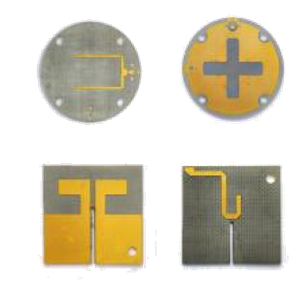


2-Layer High-Frequency Microwave PCB
High-frequency microwave PCB on PTFE laminate. 2 layers, 0.127–5.0 mm thickness range, 1 × 3 mm minimum board size. Microwave transmission line width tolerance ± 0.015 mm. Full-board ENIG soft gold plus localized thick gold 2 μm. Planar resistor integration and laser cutting.
Product Specifications
RF, Microwave & High-Frequency PCB Manufacturing2-Layer High-Frequency Microwave PCB — PTFE, ±0.015 mm Trace, Soft Gold
High-frequency microwave PCB on PTFE laminate. 2 layers, 0.127–5.0 mm thickness range, 1 × 3 mm minimum board size. Microwave transmission line width tolerance ± 0.015 mm. Full-board ENIG soft gold plus localized thick gold 2 μm. Planar resistor integration and laser cutting.
1. Board Specifications
| Layer Count | 2 layers |
| Finished Board Thickness | 0.127–5.0 mm (application-dependent) |
| Minimum Board Size | 1 mm × 3 mm |
| Material | PTFE-based laminate (Rogers / Taconic / Arlon grade) |
| Copper Weight | 0.5 oz (18 μm) — standard for microwave designs |
| Surface Finish — Primary | Full-board ENIG soft gold (Au ≥ 0.05 μm, Ni ≥ 3 μm) |
| Surface Finish — Selective | Localized thick gold 2 μm on wire-bond / contact pads |
| Special Processes | Planar resistor, laser cutting |
| Application | Microwave communication, radar, satellite, 5G mmWave |
2. Material: PTFE Laminate
PTFE (Polytetrafluoroethylene) laminates are the standard substrate for microwave and millimeter-wave PCB designs. Compared to standard FR-4, PTFE offers dramatically lower dielectric loss (Df) and stable dielectric constant (Dk) across frequency and temperature — critical for phase-sensitive microwave circuits.
| Property | PTFE (Typical) | Standard FR-4 (for reference) |
|---|---|---|
| Dk @ 10 GHz | 2.20–3.50 | 4.2–4.6 (unstable above 1 GHz) |
| Df @ 10 GHz | 0.0009–0.0025 | 0.015–0.025 |
| Tg (DSC) | N/A (PTFE does not have a Tg) | 135–150 °C |
| Moisture absorption | < 0.02% | 0.1–0.3% |
| Z-axis CTE | High (requires special PTH process) | 55–70 ppm/°C |
PTFE processing challenge: PTFE is a soft, low-surface-energy material that requires specialized handling. Standard FR-4 desmear and electroless copper processes do not work — PTFE requires plasma treatment (O₂/CF₄) or sodium naphthalene etch to activate the hole wall surface before metallization.
3. Microwave Trace Width Tolerance: ± 0.015 mm
At microwave frequencies, transmission line characteristic impedance is highly sensitive to trace width. A deviation of 0.015 mm in a 50 Ω microstrip line on 0.254 mm PTFE can shift impedance by approximately 0.8 Ω — significant for narrowband and phased-array applications where phase matching is critical.
| Parameter | Specification |
|---|---|
| Microwave trace width tolerance | ± 0.015 mm |
| Minimum trace width | 0.075 mm |
| Minimum spacing | 0.075 mm |
| Trace edge roughness (Ra) | ≤ 3 μm |
| Imaging method | LDI (Laser Direct Imaging) |
| Etching process | Precision cupric chloride spray etching with real-time shower pressure control |
Why ± 0.015 mm matters: Standard PCB trace tolerance is ± 20% of nominal width. For a 0.30 mm microwave trace, that's ± 0.06 mm — 4× wider than this specification. Achieving ± 0.015 mm requires LDI with sub-pixel positioning, tight etch factor control (≥ 3.0), and real-time optical width measurement during etching.
4. Surface Finish — Full-Board Soft Gold + Localized Thick Gold 2 μm
ENIG Soft Gold (Full Board)
The entire board receives ENIG (Electroless Nickel Immersion Gold) with a thin gold layer optimized for solderability and surface protection:
Ni: 3–5 μm (barrier layer)
Au: 0.05–0.10 μm (solderability protection)
Uniform, flat surface — ideal for microwave transmission lines
Selective Thick Gold — 2 μm (Localized)
On specific contact pads (wire-bond pads, connector lands, test points), a selective electrolytic hard gold layer of 2 μm is plated. This provides the wear resistance and bondability that soft ENIG gold cannot:
Au: 2.0 μm ± 0.2 μm (hard gold, Type III, Grade A per MIL-G-45204)
Underplate: Ni 5–7 μm (electrolytic)
Knoop hardness: 130–200 HK
Application: Wire bonding, edge connectors, high-cycle test points
Dual finish process flow: ① Full-board ENIG → ② Apply dry film mask exposing only thick-gold areas → ③ Electrolytic Ni/Au plating on exposed pads → ④ Strip dry film → ⑤ Final inspection. The dry film mask must register to ± 25 μm to avoid gold bleed onto adjacent microwave traces.
5. Planar Resistor Integration
Thin-film planar resistors are integrated directly into the PCB stack-up, eliminating the need for discrete SMD resistors on microwave lines. This reduces parasitic inductance and improves high-frequency performance beyond 20 GHz.
| Parameter | Specification |
|---|---|
| Resistor material | NiCr (Nichrome) or TaN (Tantalum Nitride) thin film |
| Sheet resistivity | 25 Ω/sq, 50 Ω/sq, or 100 Ω/sq |
| Resistance tolerance (as-deposited) | ± 10% |
| Resistance tolerance (after laser trim) | ± 1% |
| Laser trimming | Nd:YAG laser, plunge-cut or L-cut pattern |
| Power rating | Up to 100 mW per resistor element |
| TCR (Temperature Coefficient of Resistance) | ≤ ± 50 ppm/°C |
Planar Resistor Applications on This Board
Wilkinson power divider isolation resistors
Lange coupler termination resistors
Attenuator pad networks (π-type, T-type)
Bias tee resistors for active device biasing
6. Laser Cutting — 1 × 3 mm Small-Size Capability
For microwave modules requiring extremely small form factors, mechanical routing (V-score or router bit) is not feasible. UV laser cutting delivers clean edges with minimal thermal stress on PTFE substrates.
| Parameter | Specification |
|---|---|
| Cutting method | UV laser (355 nm), pulsed |
| Minimum board size after cutting | 1 mm × 3 mm |
| Cutting tolerance | ± 0.03 mm |
| Edge quality | Clean, no carbonization, no delamination |
| Kerf width | ~ 0.025 mm |
| HAZ (Heat-Affected Zone) | < 0.05 mm |
Why laser cutting for PTFE: PTFE is soft and tends to smear when mechanically routed, creating burrs that short adjacent microwave traces. UV laser cutting vaporizes the material with minimal HAZ, producing clean edges essential for 1 × 3 mm micro-boards where the edge-to-trace clearance is often < 0.10 mm.
7. Quality Assurance
| Inspection / Test | Method | Coverage |
|---|---|---|
| Trace width measurement | Automated optical measurement (AOM) | 100% of microwave traces |
| Impedance verification | TDR (Time Domain Reflectometry) on coupon | Every panel |
| Gold thickness | XRF (X-Ray Fluorescence) | 5 points per panel |
| Planar resistor value | 4-wire Kelvin probe | 100% |
| Laser cut edge inspection | AOI + microscope | 100% |
| Wire bond pull test (thick gold pads) | Destructive pull test | Per lot qualification |
| Thermal stress | 288 °C, 10 s solder float | Per lot |
| Electrical test (continuity + isolation) | Flying probe | 100% |
Superb Automation Co., Limited — High-Frequency Microwave PCB Manufacturing · PTFE · ±0.015mm Trace · Soft Gold