

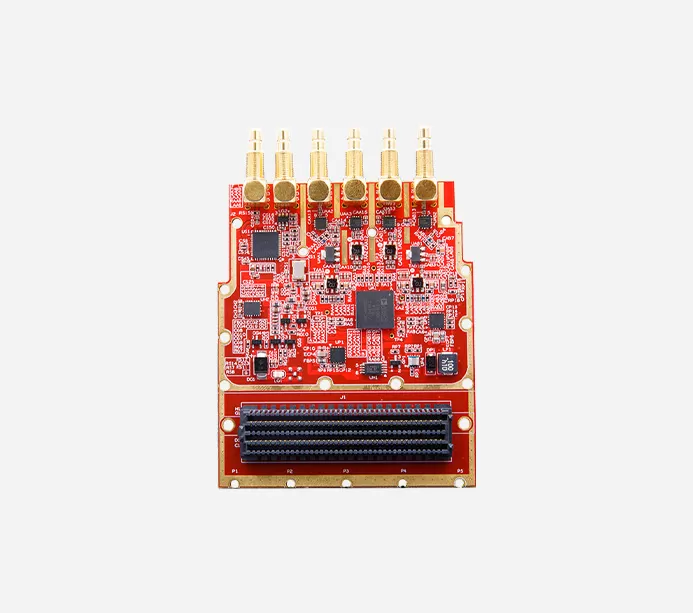
AD9361 Dual-Channel RF Transceiver FMC Card for SDR Platforms


Product Specifications
Product Overview
The AD9361 is the RF agile transceiver that most software defined radio platforms are built around, and an FMC card is the shortest path from a baseband design to a working radio. This mezzanine carries the transceiver, the RF front end and the clocking on a single width card that plugs into any carrier with a low pin count site.
The RF section covers 70 MHz to 6 GHz continuously on transmit and receive, with a 12-bit ADC and a 12-bit DAC in each of the two chains. Instantaneous bandwidth reaches 56 MHz in transmit and 56 MHz in receive. The on-board antenna switch allows half duplex and full duplex operation in TDD or FDD mode, the RF ports are matched to 50 ohm, and the transmit path includes an amplifier with 14 dB gain at 2 GHz and up to 10 dBm available at the port.
Clocking is taken from the on-board reference or from an external reference clock. The optional GPS module supplies both a reference clock and a pulse-per-second signal, which is what keeps several cards coherent inside one chassis. Both configurations below are grouped into this single product, so one list covers the standard card and the GPS variant with a separate quote line for each.
Electrical Specifications
| Parameter | Specification |
|---|---|
| RF transceiver | ADI AD9361 2x2 RF agile transceiver, 12-bit ADC and 12-bit DAC on each of the two chains |
| Frequency range | 70 MHz to 6 GHz, continuous on both transmit and receive |
| Channels | 2 transmit and 2 receive, usable as one 2x2 MIMO radio or as two separate chains |
| Instantaneous bandwidth | Up to 56 MHz transmit and up to 56 MHz receive |
| Duplex modes | TDD and FDD, half duplex and full duplex, switched in the on-board RF front end |
| Transmit output | Up to 10 dBm at the RF port, on-board amplifier with 14 dB gain at 2 GHz |
| RF ports | 50 ohm matched, SMA connectors |
| Clocking | On-board reference or external reference clock input |
| Synchronisation | Optional GPS module providing a reference clock and a pulse-per-second output for multi-card alignment |
| Host interface | FMC low pin count (LPC) mezzanine site, standard single width mechanical outline |
| Supply | Powered from the carrier card through the FMC connector |
| Configuration | Standard card or GPS clock variant; amplifier and clock options confirmed at order |
Included Models and Order Codes
| Order code | Description |
|---|---|
| SPB-AD9361-FMC-LPC | AD9361 dual-channel RF transceiver card, 70 MHz to 6 GHz, up to 56 MHz bandwidth, FMC LPC host interface, SMA RF ports |
| SPB-AD9361-FMC-LPC-GPS | The same card with the GPS reference clock and pulse-per-second option fitted for coherent multi-card operation |
Send the board reference or a photograph of the card in your design and we come back with the equivalent configuration, the order code and the delivery date in the same reply.
Key Features
70 MHz To 6 GHz Coverage – One mezzanine covers the HF, VHF, UHF, L-band, S-band and C-band work that otherwise needs three separate front ends.
Two Transmit And Two Receive Chains – 2x2 MIMO or two independent radio paths on a single card, sharing one clock domain so the channels stay aligned.
56 MHz Instantaneous Bandwidth – Wideband waveforms and multi-carrier captures without an external digitiser between the radio and the host.
TDD And FDD With On-Board Antenna Switch – The duplex mode is switched in the RF front end rather than the carrier card, so the host design stays unchanged.
Standard FMC LPC Host Interface – Fits any carrier card with a low pin count mezzanine site, which keeps the same radio usable across several development boards.
Internal Or External Clocking – Reference clock in or out as standard, and the GPS option adds a reference clock plus pulse-per-second for phase alignment across several cards.
Applications
Typical platforms this card is specified into: several of these designs are quoted together with the carrier board assembly and the RF devices on it, so the card, the carrier and the spare transceivers arrive as one line.
Software Defined Radio Prototyping – Waveform development where the radio front end changes faster than the baseband design, including bench and field trials of the same card.
Phased Array And Beamforming Test Beds – Several coherent cards in one chassis using the GPS reference clock and pulse-per-second to keep the transmit and receive channels aligned.
Spectrum Monitoring And Signal Intelligence – 70 MHz to 6 GHz coverage in one channel pair for wideband survey, recording and emitter classification work.
Radar And Electronic Warfare Development – TDD operation with up to 56 MHz bandwidth for pulse, chirp and fast frequency hopping experiments.
Satellite And 5G NR Modem Development – L-band and sub-6 GHz links where the same card serves the bench test, the field trial and the first production build.
RF Test And Measurement Fixtures – Stimulus and capture in one mezzanine inside a larger test rack, with the RF port count set by the fixture rather than the chassis.
Sourcing and Cross-Reference
The AD9361 is offered in several grades, and the pin compatible AD9363 and AD9364 devices are still designed into equipment that is in production, so the RF device on the card is confirmed against your requirement before the quote is issued. Where a design cannot take the original device, we review the alternative with our supply channel and tell you the difference in frequency range and bandwidth before you commit.
Parts we supply alongside this card: AD9361BBCZ, AD9363BBCZ, AD9364BBCZ, the four-channel ADRV9025ABBCZ, and the RFSoC devices used on wideband carrier cards, including XCZU48DR. Carrier boards, clocking devices and the passive RF chain can be added to the same order.
Why Source AD9361 FMC Cards from Superb Automation?
- Board level and chip level on one order, so the card and the spare RF devices arrive on the same line.
- Cross reference before the quote: we confirm the RF device, the bandwidth option and the clocking variant against the design you send.
- Lifecycle watching on the parts that obsolesce first, and supply of the transceiver alone when the card is no longer needed.
- Incoming inspection on every shipment, with quantity, marking and package checked before dispatch.
- Carrier board support: where the card is paired with a carrier of your own, we can quote the PCB and the assembly from your Gerber and BOM.
- Evaluation quantity and build quantity handled in the same process, from single cards to scheduled releases.