


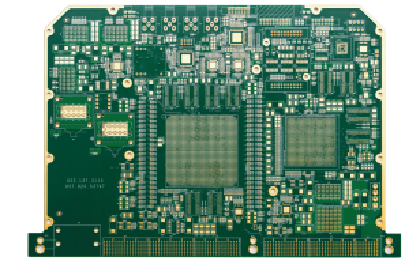
18-Layer High-Speed Multilayer PCB — Panasonic M6, 64Gbps, 20:1 Aspect Ratio
High-speed digital PCB with 18 layers on Panasonic M6 (R-5775) laminate. 4.0 mm finished thickness, 0.20 mm minimum drill at 20:1 aspect ratio. Double-sided back-drilling with stub < 0.08 mm. Differential impedance control ±7.5% (≤ 50 Ω) and ±5% (> 50 Ω). 64 Gbps NRZ/PAM4 signaling capability.
Product Specifications
18-Layer High-Speed Multilayer PCB — Panasonic M6, 64Gbps, 20:1 Aspect Ratio
High-speed digital PCB with 18 layers on Panasonic M6 (R-5775) laminate. 4.0 mm finished thickness, 0.20 mm minimum drill at 20:1 aspect ratio. Double-sided back-drilling with stub < 0.08 mm. Differential impedance control ±7.5% (≤ 50 Ω) and ±5% (> 50 Ω). 64 Gbps NRZ/PAM4 signaling capability.
1. Board Specifications
| Layer Count | 18 layers |
| Finished Board Thickness | 4.0 mm ± 0.2 mm |
| Material | Panasonic M6 (R-5775) — low-Dk, ultra-low-Df |
| Copper Weight | 1 oz (35 μm) outer / 0.5 oz (18 μm) inner |
| Surface Finish | ENIG (Au ≥ 0.05 μm, Ni ≥ 3 μm) |
| Solder Mask | Green LPI, both sides |
| Silkscreen | White, both sides |
| Application | 64Gbps high-speed digital backplane / line card |
2. Material: Panasonic M6 (R-5775)
Panasonic M6 (R-5775) is a high-performance low-Dk, ultra-low-Df laminate designed for high-speed digital applications up to 112 Gbps PAM4. Compared to standard FR-4, M6 offers significantly lower signal loss and better thermal reliability.
| Property | Panasonic M6 (R-5775) | Standard FR-4 (for reference) |
|---|---|---|
| Dk @ 1 GHz | 3.57 | 4.2–4.6 |
| Df @ 1 GHz | 0.002 | 0.015–0.020 |
| Tg (DSC) | 185 °C | 135–150 °C |
| Td (5% weight loss) | 370 °C | 310–330 °C |
| Z-axis CTE (α1) | 40 ppm/°C | 55–70 ppm/°C |
Why M6 for this design: At 64 Gbps (32 GHz Nyquist), signal loss through the dielectric dominates link budget. M6's Df of 0.002 reduces insertion loss by ~60% compared to standard FR-4, enabling longer trace lengths and cleaner eye diagrams at 18 layers.
3. Drilling & Aspect Ratio
A 0.20 mm mechanical drill through 4.0 mm board thickness yields a 20:1 aspect ratio — at the upper limit of conventional mechanical drilling capability. Achieving this reliably requires precision drill equipment, optimized drill parameters (RPM, infeed rate, retract rate), and high-quality drill bits with diamond-like carbon (DLC) coating.
| Parameter | Specification |
|---|---|
| Minimum mechanical drill diameter | 0.20 mm |
| Finished board thickness | 4.0 mm |
| Aspect ratio | 20 : 1 |
| Drill type | Solid carbide, DLC-coated |
| Drill registration accuracy | ± 25 μm |
| Plating | Direct current electroplating, Cu ≥ 25 μm in hole wall |
| Resin plug via | Filled and planarized (planarity ≤ 15 μm) |
High aspect ratio challenge: At 20:1, electrolyte exchange inside the hole during plating becomes the limiting factor. We use pulse-reverse plating with forced solution agitation to ensure uniform copper deposition (≥ 25 μm) throughout the 4.0 mm barrel depth. Post-plating microsection confirms Cu thickness at top, middle, and bottom of the barrel.
4. Impedance Control
All high-speed signal layers are designed for differential impedance control with tight tolerances:
| Impedance Target | Trace Type | Tolerance |
|---|---|---|
| ≤ 50 Ω | Single-ended | ± 7.5% |
| > 50 Ω (85 Ω, 100 Ω) | Differential | ± 5% |
Impedance is verified by TDR (Time Domain Reflectometry) on every panel. Typical differential impedance for 100 Ω pairs on M6 material with 0.5 oz inner-layer copper uses 100 μm trace width at 180 μm spacing, calculated with a 2D field solver and confirmed by TDR measurement.
5. Back-Drilling — Double-Sided, Stub < 0.08 mm
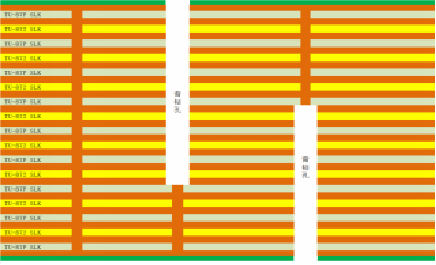
To minimize signal reflections caused by via stubs at 64 Gbps, double-sided back-drilling is applied to all high-speed signal vias. The back-drill removes the unused portion of the plated through-hole barrel from both sides of the board.
| Parameter | Specification |
|---|---|
| Back-drill method | Double-sided (top + bottom) |
| Maximum residual stub length | < 0.08 mm |
| Back-drill diameter | 0.45 mm (oversize from 0.20 mm PTH) |
| Back-drill depth control | ± 0.05 mm (controlled-depth drilling) |
| Post-drill inspection | 100% AOI + microsection sampling |
Why 0.08 mm matters: At 32 GHz Nyquist frequency (64 Gbps), a 0.08 mm stub creates approximately −0.8 dB of insertion loss deviation from ideal. Keeping stubs under 0.08 mm ensures the via stub resonance is pushed well above the signal bandwidth, maintaining a clean channel response.
6. 64 Gbps Signal Integrity
The finished board supports 64 Gbps NRZ and PAM4 signaling across all 18 layers. Key SI metrics validated on production panels:
| Metric | Specification | Measured (Typical) |
|---|---|---|
| Insertion loss @ 16 GHz | ≤ −1.2 dB/inch | −1.05 dB/inch |
| Return loss @ 16 GHz | ≤ −15 dB | −18.2 dB |
| Differential impedance (100 Ω) | 100 Ω ± 5% | 99.7 Ω (σ = 1.2 Ω) |
| Intra-pair skew | ≤ 2 ps | 0.8 ps |
| Inter-pair skew | ≤ 10 ps | 4.5 ps |
| Crosstalk (NEXT, 16 GHz) | ≤ −30 dB | −34.6 dB |
7. Resin Plug Via Process
All plated through-holes are filled with epoxy resin and planarized:
Via fill material: High-Tg epoxy resin (Tg ≥ 175 °C, CTE-matched to M6 laminate)
Fill method: Vacuum-assisted screen printing, both sides
Planarization: Mechanical scrubbing + micro-etch, final planarity ≤ 15 μm
Cap plating: 15–20 μm Cu over filled via (IPC-6012 Class 3 compliant)
100% AOI inspection of all plugged vias for voids
Resin plug purpose: Via-in-pad (VIP) design on BGA break-out areas requires resin-filled and capped vias to ensure flat solderable surfaces. Resin plug also prevents solder wicking during assembly and improves thermal cycling reliability (verified to 1,000 cycles per IPC-9701).
8. Quality Assurance
| Inspection / Test | Method | Coverage |
|---|---|---|
| Inner-layer AOI | Laser direct imaging AOI | 100% |
| Impedance TDR | Time domain reflectometry on coupon | Every panel |
| Back-drill depth verification | AOI + cross-section | 100% AOI, 2 coupons/panel |
| Microsection | Cross-section at worst-case locations | Per IPC-6012 sampling plan |
| Hi-Pot / Dielectric Withstand | 500 V DC, 60 s | 100% |
| Flying Probe / Bed-of-Nails | Continuity + isolation | 100% |
| Thermal Stress | 288 °C, 10 s solder float | Per lot |
| IST (Interconnect Stress Test) | 150–190 °C cycling to failure | Per lot qualification |
Superb Automation Co., Limited — High-Speed Multilayer PCB Manufacturing · Panasonic M6 · 64Gbps