
Medical Electronics Assembly
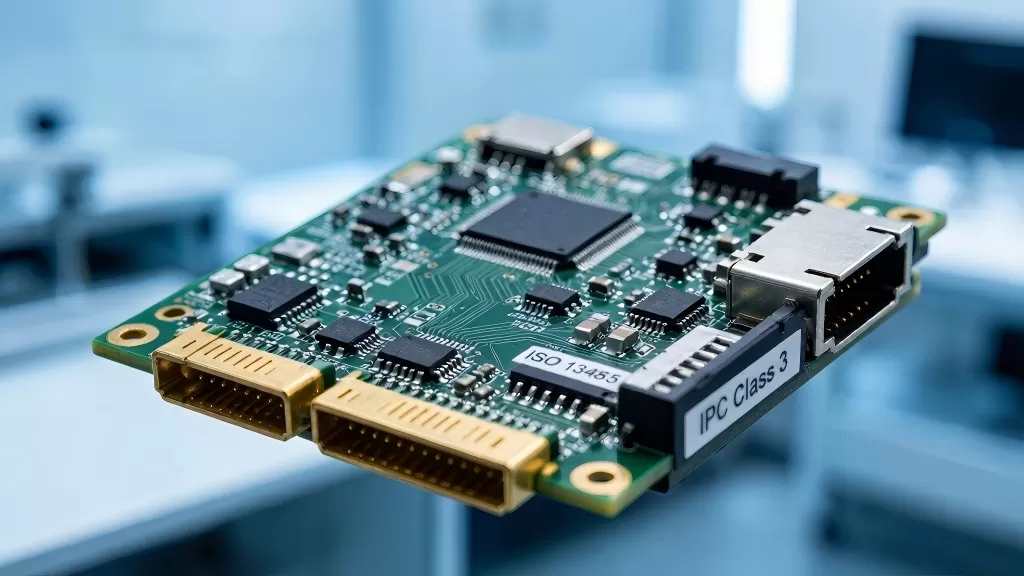
Superb Automation provides medical-grade PCBA assembly under ISO 13485 quality management with IPC-A-610 Class 3 acceptance criteria. Medical electronics demand a combination of attributes not found together in other industries: sub-microvolt analog precision alongside digital processing, battery-powered ultra-low-power operation alongside high-voltage isolation, and consumer-form-factor miniaturization alongside clinical reliability. Our medical PCBA line handles all of these requirements in a single, traceable production flow. We operate on a strict build-to-print model — customer Gerber, BOM, assembly drawings, and test specification drive the process.
Medical Device Categories We Assemble
| Patient Monitoring | Multi-parameter monitors (ECG, SpO₂, NIBP, temperature), bedside monitors, central station displays. Mixed-signal boards with high-channel-count analog front-ends, isolated power supplies, and touchscreen display interfaces. |
| In-Vitro Diagnostics | Blood glucose meters, blood gas analyzers, immunoassay readers, PCR thermal cyclers. Precision analog measurement with electrochemical or optical sensor interfaces. Temperature-controlled zones for assay incubation. |
| Wearable Health Devices | Continuous glucose monitors, ECG patches, pulse oximeter rings, sleep apnea monitors. Ultra-low-power design for multi-day battery life, flexible or rigid-flex PCB, BLE wireless connectivity, biocompatible conformal coating. |
| Medical Imaging | Ultrasound probe interface boards, X-ray detector readout, MRI gradient coil drivers. High-channel-count data acquisition, low-noise analog front-end, high-speed serial data output, precision timing distribution. |
| Surgical Instruments | Electrosurgical generator control boards, ultrasonic scalpel drivers, robotic surgery motor controllers. High-voltage isolation, high-current motor drive, safety-critical redundant monitoring circuits, sterilizable connector interfaces. |
Assembly Process for Medical Electronics
Component Selection and Procurement
Approved vendor list (AVL) only: Components are sourced exclusively from the customer's approved manufacturers and distributors. Substitutions require documented customer approval — no exceptions.
Lot traceability from reel to board: Every component reel is assigned a unique lot identifier at receiving. That identifier follows the components through placement, reflow, inspection, and test — linked to the assembled board serial number in the batch record.
Moisture-sensitive device (MSD) handling: Components rated MSL 3 and above are stored in dry cabinets, baked per J-STD-033 if floor-life exposure is exceeded, and tracked by exposure time from sealed-bag opening.
SMT Assembly with Class 3 Inspection
Solder paste inspection (SPI): Post-print paste volume, area, and height are measured on every pad. Out-of-spec deposits — insufficient volume for fine-pitch QFNs, bridging risk on 0.4 mm pitch BGAs — are flagged and the stencil is cleaned or the print is reworked before component placement.
Reflow profiling per assembly: A thermal profile is developed for each board — not each product family — using a thermocouple-instrumented test board. Soak time, time above liquidus, and peak temperature are recorded and attached to the batch record.
AOI 100% — Class 3 criteria: Every solder joint on every board is inspected. Defect thresholds are set to IPC-A-610 Class 3: minimum side fillet height, maximum void percentage, minimum toe fillet — all tighter than Class 2.
X-ray for hidden joints: BGA, QFN, and leadless package solder joints are X-ray inspected. Void percentage, ball collapse, and bridging are assessed per IPC-7095. X-ray images are archived with the batch record.
Cleaning, Coating, and Final Test
Ionic cleanliness verification: Post-assembly cleanliness is tested per IPC-TM-650 2.3.25. For implantable or long-term patient-contact devices, limits are set tighter than the standard 1.56 µg/cm².
Conformal coating: Acrylic, silicone, urethane, or parylene per customer specification. Selective coating with masking of connectors, test points, and uncoated areas. Coating thickness verified by eddy-current or micrometer measurement.
Functional test per customer protocol: A custom test fixture — designed from the customer's test specification — exercises the board through all operating modes. Test results are logged per serial number and delivered with the batch.
Why Superb Automation for Medical PCBA
ISO 13485 certified: Quality management system purpose-built for medical device manufacturing — not adapted from general industrial assembly.
IPC-A-610 Class 3 as standard: Medical orders are assembled and inspected to Class 3. No separate qualification, no upcharge.
Full component traceability: Lot-level tracking from reel to board serial number. Audit-ready traceability report with every batch.
Build-to-print: Customer design, AVL, and test protocol control the process. No unauthorized changes.
Cleanliness management: Ionic contamination testing per batch. Conformal coating with thickness verification.
Request Quote — ISO 13485 Medical PCBA, IPC-A-610 Class 3, Full Traceability, Build-to-Print