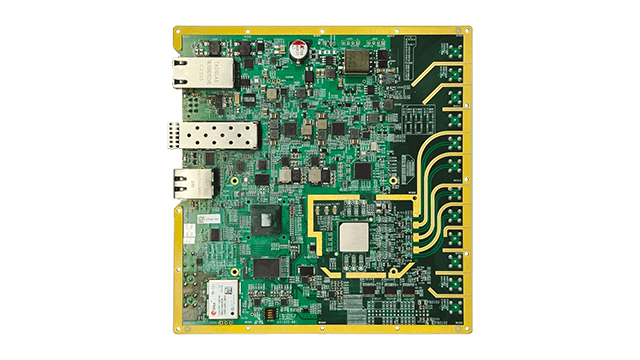



Load Balancer Processing Board PCBA
Load Balancer Processing Board PCBA. 5G PCBA, BBU Baseband, RRU Remote Radio, AAU Active Antenna, DU/CU, O-RAN, UPF Core, OTN Optical, WDM/DWDM, PTP Grandm
Product Specifications
Load Balancer Processing Board PCBA
Hardware-Accelerated Layer 4–7 ADC — 800 Gbps Throughput, HTTP/3 QUIC Termination, TLS 1.3 Offload, Consistent Hashing for 5G SBA Service Mesh Load Distribution
Product Overview
The Load Balancer Processing Board is a high-performance application delivery controller (ADC) PCBA designed to distribute traffic across the 5G service-based architecture's network function instances. Built on a 30-layer ultra-low-loss PCB supporting 112 Gbps PAM4 signaling, the board features a programmable traffic management ASIC and multi-core x86/Arm processor complex capable of 800 Gbps of L4–L7 throughput. The board provides 16× 100GbE QSFP28 ports with hardware-based L4 load balancing supporting consistent hashing, least-connections, and weighted round-robin algorithms at line rate. For L7 (HTTP/2 and HTTP/3 QUIC), the board performs hardware-accelerated TLS 1.3 termination with session ticket reuse, reducing the cryptographic burden on backend NF instances. Deep health monitoring with active HTTP/2 health checks, gRPC liveness probes, and latency-based server selection ensures traffic is only forwarded to healthy SBI endpoints. Session persistence is maintained through a distributed in-memory state table synchronized across load balancer instances, enabling hitless failover. Advanced telemetry exports per-flow statistics via IPFIX and Prometheus endpoints for integration with carrier OSS/BSS monitoring systems.
Key Specifications
| Layer Count | 30 layers |
| Material | Ultra-low-loss (M6-class) laminate |
| Surface Finish | ENIG |
| Throughput | 800 Gbps L4–L7 aggregate |
| Network Ports | 16× 100GbE QSFP28 (112 Gbps PAM4 ready) |
| L7 Acceleration | TLS 1.3, HTTP/3 QUIC hardware offload |
| L4 Algorithms | Consistent hashing, least-connections, weighted round-robin |
| Session Persistence | Distributed in-memory state table, hitless failover |
| Health Monitoring | HTTP/2 health checks, gRPC liveness probes, latency-based selection |
| Telemetry | IPFIX, Prometheus, gRPC streaming telemetry |
| Operating Temperature | 0°C to +45°C |
| Application | 5G SBA load balancing / NFV service mesh |
PCBA Assembly Challenges
Assembling the 30-layer load balancer board represents the pinnacle of telecom PCBA complexity. The board's 16× 100GbE QSFP28 ports operate at 28 Gbps NRZ per lane (future-proofed for 112 Gbps PAM4), meaning 64 high-speed differential pairs must maintain precise impedance continuity from the ASIC to the cage connectors. The traffic management ASIC is a large BGA (50×50 mm, 4,500+ balls) requiring uniform coplanarity across its entire footprint to prevent opens on edge balls — a challenge compounded by the 30-layer board's inherent warpage tendency during reflow. The multi-core processor complex adds another large BGA with DDR5 memory channels running at 5,600 MT/s; the 16 RDIMM slots demand precision connector alignment with less than 0.1 mm positional tolerance. The board uses heavy copper power planes (2–3 oz) on dedicated internal layers to support the combined 400+ W power draw of the ASIC and processors. Staged reflow with multiple thermal zones and nitrogen atmosphere ensures all BGAs reach proper soldering temperature without overheating thermally sensitive components. 3D X-ray inspection is performed on all BGAs, and automated optical inspection (AOI) verifies all 16 QSFP28 cage solder joints.
Test Strategy
Each assembled load balancer board undergoes extensive performance and reliability testing. Boundary scan and flying-probe ICT verify all passive nets and interconnects. Network interface validation runs PRBS31 patterns at 28.05 Gbps on all 64 transceiver lanes across all 16 QSFP28 ports, measuring eye height, eye width, and jitter against IEEE 802.3 compliance masks. L4 load balancing is tested by generating 800 Gbps of traffic with millions of unique 5-tuple flows and verifying consistent hashing distribution across emulated backend servers within 5% of ideal uniformity. L7 performance is validated with 400 Gbps of TLS 1.3 handshakes and HTTP/3 QUIC sessions, measuring connections per second (target: >2 million CPS) and session resumption rate. gRPC health monitoring and IPFIX telemetry export are validated against a Prometheus metrics collector. Hitless failover is tested by disabling the active session table and confirming zero session loss during state table synchronization. Burn-in runs 72 hours at 45°C ambient with 600 Gbps of mixed L4/L7 traffic.
PCB Manufacturing Difficulty
Fabricating the 30-layer load balancer PCB pushes every manufacturing parameter to its limit. The 64 high-speed lanes from the ASIC to QSFP28 cages must be length-matched to ±1 mil within each 4-lane group and ±5 mil across all lanes to prevent inter-lane skew in 100GbE CAUI-4 and future 400GbE interfaces. Backdrilling removes via stubs with precision to sub-6-mil stub length on all signal layers above 14 GHz Nyquist frequency. The aspect ratio of plated through-holes exceeds 13:1 in the 30-layer stack, requiring advanced pulse-reverse plating with periodic reverse current to achieve uniform 1.0 mil copper thickness in the barrel without "dog-boning." Spread-glass Megtron 6 laminates with 0.002 in dielectric layers are used throughout to minimize skew and dielectric loss (Df < 0.002 at 10 GHz). The 16 QSFP28 connector footprints require precision routing with pad-to-hole registration within ±2 mil. Finished boards receive 100% TDR on all 64 high-speed lanes, impedance coupon testing, HiPot at 1,500 VDC, and automated optical inspection on all layers before lamination.
More information