



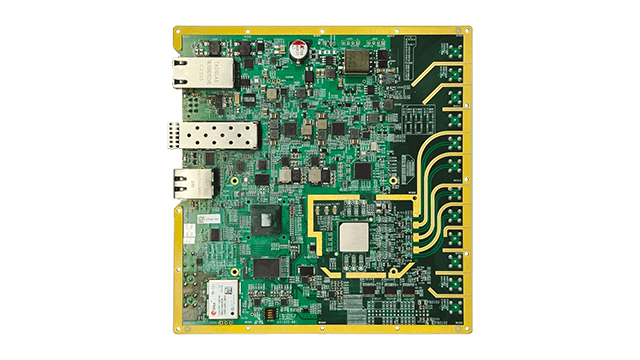
5G RU Radio Unit Board PCBA
5G RU Radio Unit Board PCBA. 5G PCBA, BBU Baseband, RRU Remote Radio, AAU Active Antenna, DU/CU, O-RAN, UPF Core, OTN Optical, WDM/DWDM, PTP Grandmaster, N
Product Specifications
5G RU Radio Unit Board PCBA
16-Layer Compact O-RAN 7.2 Board — 4T4R Transceiver, DFE Processing & 25G eCPRI Fronthaul for Small-Cell 5G
Product Overview
The 5G RU Radio Unit Board PCBA is a compact, power-efficient PCBA designed for O-RAN Alliance 7.2 split small-cell deployments. The board integrates a complete 4T4R RF transceiver chain with digital front-end (DFE) processing on a single 16-layer hybrid PCB combining Rogers 4350B for RF sections and standard FR-4 High-Tg for digital domains. Each transmit path includes a GaAs power amplifier delivering 250 mW (24 dBm) per antenna port — ideal for indoor and medium-range outdoor coverage — with integrated CFR and DPD running on the on-board DFE processor per O-RAN WG4 specifications. The receive chain achieves a noise figure below 2.5 dB with high-linearity LNAs, supporting 256QAM and higher modulation schemes. The board terminates the O-RAN 7.2 fronthaul interface via 25G eCPRI, transporting IQ samples in the frequency domain to the DU per the O-RAN fronthaul control, user, and synchronization plane (CUS-Plane) specification. A built-in IEEE 1588v2 PTP slave with hardware timestamping ensures tight TDD phase synchronization with the network grandmaster per ITU-T G.8275.1, supporting Class B accuracy (±50 ns). The board's compact form factor (200 × 150 mm) and low power consumption (<45w) make="" it="" suitable="" for="" ceiling-mounted="">
Key Specifications
| Layer Count | 16 layers |
| Material | Rogers 4350B / FR-4 High-Tg |
| Surface Finish | ENIG / Immersion Silver |
| Min. Trace/Space | 3.5/3.5 mil (RF: 5/5 mil) |
| Impedance Control | ±10% (50 Ω RF, 100 Ω diff) |
| Via Technology | Backdrill / blind & buried |
| Copper Weight | 1 oz inner, 0.5 oz outer |
| Application | 5G small-cell / indoor O-RAN RU |
PCBA Assembly Challenges
The RU board's compact size creates extreme component density challenges. The 4T4R RF chain — power amplifiers, LNAs, RF switches, filters, and matching networks — must fit in a 200 × 150 mm area alongside the DFE processor, memory, eCPRI interface, and PTP timing circuit. The GaAs PA devices require precise solder attachment with void rates below 5% on the thermal pad; vacuum reflow is standard. The PA output matching networks use 0201 components within 0.3 mm of PA pins — placement accuracy must be better than 35 µm to maintain the 50 Ω impedance transformation. The Rogers 4350B / FR-4 hybrid stack-up requires a carefully tuned reflow profile because the dissimilar materials expand at different rates; ramp rates above 2°C/sec risk delamination at the laminate boundary. The compact form factor leaves minimal space for fiducial marks — high-accuracy local fiducials are placed near each fine-pitch component. The board's low power budget (<45w) means="" all="" pa="" bias="" circuits="" must="" be="" verified="" before="" power-up="">
Test Strategy
RU board testing is optimized for high-volume small-cell production. Automated optical inspection (AOI) pre-screens for tombstoned RF passives and solder bridges before ICT. Pre-power ICT verifies DC resistance of all bias networks, PA drain paths, and LNA bias tees. Powered digital testing validates the DFE processor boundary scan, DDR4 memory interface, eCPRI 25G link BER (<10⁻¹² with="" prbs-31="">
PCB Manufacturing Difficulty
The 16-layer hybrid RU PCB requires tight process control. The Rogers 4350B outer layers need specialized drilling — standard FR-4 parameters cause PTFE smear that shorts RF vias. The RF trace impedance (50 Ω) on Rogers 4350B is modeled with 3D EM simulation and verified by TDR on every panel; the hybrid stack means RF traces crossing from Rogers to FR-4 layers require careful impedance transition design. Registration between Rogers outer layers and FR-4 inner layers must stay within ±2 mil to maintain via pad annular rings and prevent RF trace impedance discontinuities. The compact board format (200 × 150 mm) forces dense routing — 3.5/3.5 mil trace/space on digital layers with laser-drilled microvias for BGA break-out. Solder mask registration on RF matching networks is critical; misregistration over ±1.5 mil detunes the matching circuit and degrades PA efficiency. Finished boards undergo 100% AOI, impedance coupon TDR testing, and RF probe testing of key transmission lines to validate S11 and S21 before release to assembly.
More information