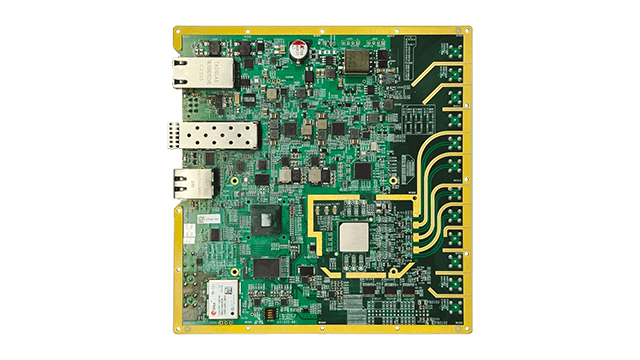



WDM / DWDM Multiplexer Board PCBA
WDM DWDM Multiplexer Board PCBA. 5G PCBA, BBU Baseband, RRU Remote Radio, AAU Active Antenna, DU/CU, O-RAN, UPF Core, OTN Optical, WDM/DWDM, PTP Grandmaste
Product Specifications
WDM / DWDM Multiplexer Board PCBA
16-Layer ROADM Optical Layer Platform — 96-Channel Flex-Grid DWDM with WSS Switching and OpenROADM SDN
Product Overview
The WDM/DWDM Multiplexer Board is a compact, high-density optical layer PCBA that provides wavelength multiplexing, demultiplexing, and dynamic routing for up to 96 DWDM channels on the ITU-T G.694.1 C-band grid (191.35–196.10 THz). The board integrates a reconfigurable optical add-drop multiplexer (ROADM) using wavelength-selective switch (WSS) technology based on LCoS (Liquid Crystal on Silicon), enabling any wavelength to be independently added, dropped, or expressed at the optical layer without O-E-O conversion. Built on a 16-layer specialized PCB with Rogers 4003C RF laminates on the top layers for the high-speed analog control signals (up to 2 GHz bandwidth) driving the LCoS spatial light modulator, the board supports flexible channel spacing — 50 GHz, 75 GHz, and 100 GHz grids — and mixed baud rate operation that allows 100G, 200G, 400G, and 800G wavelengths to coexist on the same fiber pair. Integrated optical channel monitors (OCM) based on scanning Fabry-Pérot filter technology provide per-wavelength optical power, optical signal-to-noise ratio (OSNR), and center frequency measurement with ±2.5 GHz accuracy per ITU-T G.697. The board's control plane exposes OpenROADM MSA and OpenConfig YANG models via NETCONF/RESTCONF for full SDN-based wavelength provisioning, and includes embedded OTDR (optical time-domain reflectometer) functionality for automated fiber plant monitoring and precise fault localization to within ±2 meters.
Key Specifications
| Layer Count | 16 layers |
| Material | Rogers 4003C / FR-4 hybrid |
| Channels | Up to 96 DWDM (ITU-T G.694.1 C-Band) |
| Channel Spacing | 50 / 75 / 100 GHz Flex-Grid |
| ROADM Degree | WSS-Based, Any-to-Any Add/Drop |
| Monitoring | OCM (Power/OSNR/Frequency) + OTDR |
| SDN Control | OpenROADM / OpenConfig YANG Models |
| Compliance | ITU-T G.694.1 / G.697 / OpenROADM MSA |
PCBA Assembly Challenges
The DWDM multiplexer board's hybrid PCB material construction — Rogers 4003C RF laminate on layers 1–3 bonded to FR-4 on layers 4–16 — introduces significant assembly complexity. The dissimilar CTE of Rogers (11 ppm/°C in Z-axis) and FR-4 (70 ppm/°C above Tg) requires carefully managed reflow profiles to prevent delamination at the material boundary; the peak reflow temperature is limited to 235°C with a controlled ramp of 1.2–1.8°C/sec to minimize Z-axis expansion stress. The LCoS WSS module is a highly sensitive optoelectronic component with a maximum body temperature rating of 85°C — it is attached via a low-temperature solder process (SnBiAg solder paste, melting point 138°C) as a secondary assembly step after the main reflow. The integrated optical channel monitor includes a precision scanning Fabry-Pérot etalon that must be mounted with less than 10 µm of tilt relative to the optical axis; its SMT attachment uses an active alignment process with in-situ optical power monitoring during soldering. The board's mixed signal nature — combining sensitive analog RF control lines (2 GHz bandwidth for LCoS pixel drive) with digital I²C/SPI management interfaces — demands careful component placement to isolate the analog zones from digital switching noise. All optical fiber pigtails from the WSS and OCM modules are strain-relief bonded with UV-cured epoxy after electrical assembly.
Test Strategy
DWDM board testing combines electrical and optical verification stages. Electrical ICT validates all passive networks, power rail sequencing for the WSS LCoS driver ASIC (requiring 8 voltage rails sequenced in precise order), and the OTDR laser pump driver circuit. The wavelength-selective switch is calibrated by injecting a broadband ASE (amplified spontaneous emission) source and measuring the spectral response at each of the 96 ITU-T channel frequencies, verifying insertion loss below 6 dB per add/drop path and channel isolation exceeding 35 dB for adjacent channels. Flex-grid operation is validated by programming 50 GHz, 75 GHz, and 100 GHz channel plans and measuring the spectral passband shape — the 0.5 dB passband must exceed 75% of the nominal channel width per OpenROADM specifications. Optical channel monitor accuracy is verified using a calibrated multi-wavelength reference source across all 96 channels, with power accuracy within ±0.5 dB and OSNR accuracy within ±1 dB. The embedded OTDR is tested on fiber spools of 25 km and 50 km with known reflective events, verifying fault location accuracy of ±2 meters. A 120-hour burn-in with continuous wavelength switching at 2-minute intervals validates WSS reliability.
PCB Manufacturing Difficulty
The 16-layer DWDM board's hybrid Rogers 4003C/FR-4 construction requires specialized lamination processes. The Rogers 4003C layers (Dk 3.38 ±0.05 at 10 GHz) must be bonded to FR-4 using low-flow prepreg with precisely controlled pressure (350 ±25 PSI) and temperature (185 ±5°C) to prevent resin starvation at the material boundary while maintaining overall board thickness tolerance of ±8%. The high-speed analog control traces on the Rogers layers require 50 Ω single-ended impedance with ±5% tolerance — tighter than the typical ±10% — to prevent reflections on the LCoS pixel drive signals that would cause WSS passband ripple. Registration between the Rogers layers and the underlying FR-4 layers must stay within ±3 mil to ensure alignment of the LCoS module mounting pads with internal routing. The board uses ENIG surface finish on all SMT pads with gold thickness controlled to 2–4 µ" to prevent solder embrittlement on the fine-pitch WSS interconnect. Finished boards undergo 100% AOI, TDR impedance verification on the Rogers layers, and cross-section analysis at the material boundary to verify void-free lamination per IPC-6012DS.
More information