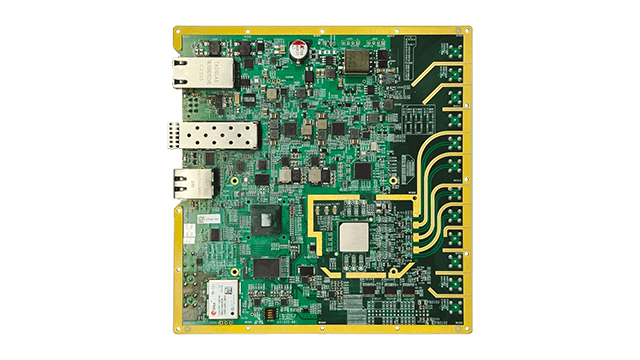



OTN Framer / Mapper Board PCBA
OTN Framer Mapper Board PCBA. 5G PCBA, BBU Baseband, RRU Remote Radio, AAU Active Antenna, DU/CU, O-RAN, UPF Core, OTN Optical, WDM/DWDM, PTP Grandmaster,
Product Specifications
OTN Framer / Mapper Board PCBA
22-Layer Multi-Rate OTN Framing Engine — ODU0–ODU4, GFP-F/AMP/BMP/GMP, G.7044 Hitless Bandwidth Adjustment
Product Overview
The OTN Framer/Mapper Board is a specialized PCBA that performs the critical mapping and framing functions between native client signals and the OTN hierarchy, enabling transparent transport of any service type across optical wavelength channels. Built on a 22-layer Megtron 6 PCB with tightly controlled impedance on all high-speed serial lanes, the board supports client-side rates from 1GE to 100GbE and maps them into ODU0 (1.25G), ODU1 (2.5G), ODU2 (10G), ODUflex (n×1.25G), and ODU4 (100G) containers per ITU-T G.709. The board features a multi-channel framer/mapper ASIC supporting 4× OTU4 ports and up to 20 client ports across a mix of QSFP28 and SFP28 cages. It implements GFP-F (Generic Framing Procedure - Framed per G.7041) for Ethernet mapping with Ethernet-specific OAM transparency, AMP (Asynchronous Mapping Procedure) for legacy TDM and CPRI services, BMP (Bit-synchronous Mapping Procedure) for constant-bit-rate services requiring frequency transparency, and GMP (Generic Mapping Procedure) for the most flexible, jitter-tolerant mapping. Hitless bandwidth adjustment per ITU-T G.7044 (ODUflex HAO) enables operators to resize ODUflex containers in-service without dropping traffic — critical for adapting to the dynamic bandwidth demands of 5G fronthaul where CPRI line rates may change based on carrier aggregation and MIMO layer configurations. The board also includes built-in PRBS generators and checkers on every port for comprehensive bit-error-rate testing (BERT) during commissioning.
Key Specifications
| Layer Count | 22 layers |
| Material | Megtron 6 low-loss |
| OTN Rates | ODU0, ODU1, ODU2, ODU3, ODU4, ODUflex |
| Ports | 4× OTU4 + 20× Client (SFP28/QSFP28) |
| Mapping Modes | GFP-F / AMP / BMP / GMP (G.709) |
| Bandwidth Adjustment | G.7044 Hitless ODUflex Resize (HAO) |
| Diagnostics | PRBS Generator/Checker per Port |
| Compliance | ITU-T G.709 / G.7041 / G.7044 |
PCBA Assembly Challenges
The 22-layer framer/mapper board presents unique assembly challenges due to its diverse mix of optical transceiver cage types — QSFP28 cages (38 SMT pins each), SFP28 cages (20 SMT pins each), and the large framer ASIC BGA (4,200+ balls at 0.92 mm pitch). The close proximity of the cages to the board edge demands tight placement accuracy (within ±75 µm) to ensure alignment with the front-panel, and each cage connector requires coplanarity within 0.08 mm across all pins to prevent intermittent contact with the inserted optical transceiver. The framer ASIC's high-speed serdes lanes (28 Gbps NRZ) route to all 24 optical ports with matched-length differential pairs — any solder voiding under the AC-coupling capacitors placed in-line on these pairs creates impedance discontinuities that degrade the eye diagram. The board's 2.8 mm thickness and 22 layers create significant thermal mass, demanding a 10-zone reflow oven profile with extended soak above 200°C to ensure complete solder wetting on all QSFP28 ground pads. Double-sided assembly requires the lighter top-side components (passives, small ICs) to be placed first, with the heavy BGA and cage side processed on the second reflow pass. Post-reflow 3D X-ray inspects all BGA balls and QSFP/SFP connector leads for void content and solder fill percentage.
Test Strategy
Framer/mapper board testing begins with in-circuit test validating all passive components, clock synthesis PLL lock, and power rail sequencing for the framer ASIC's multiple voltage domains. Functional BERT testing then validates every client port (SFP28 and QSFP28) using internal PRBS generators at the maximum supported client rate — PRBS-31 for 25GbE/100GbE ports — with BER < 10⁻¹⁵ verified over a 24-hour continuous test. OTN framing is validated by mapping PRBS-carrying client signals into ODUk containers and measuring end-to-end BER through the framer pipeline, with ODUk overhead byte verification confirming correct FAS (Frame Alignment Signal), MFAS (Multi-Frame Alignment Signal), and PM (Path Monitoring) insertion. GFP-F mapping is tested with 802.3 Ethernet frames of varying lengths (64–9,600 bytes) including VLAN-tagged and QinQ frames, verifying transparent transport of all Ethernet control frames. G.7044 hitless resizing is validated by initiating an ODUflex resize from 10 Gbps to 25 Gbps while carrying live traffic and measuring zero packet loss and < 50 ms of increased latency during the resize operation. A 48-hour burn-in at 55°C with sustained BERT on all 24 ports screens for thermal marginality in the framer ASIC and optical transceiver interfaces.
PCB Manufacturing Difficulty
The 22-layer framer/mapper PCB requires precise impedance control across all high-speed layers. The 28 Gbps NRZ lanes from the framer ASIC to each optical cage span up to 200 mm and must maintain insertion loss below -8 dB at 14 GHz — requiring Megtron 6 dielectric with Df under 0.002. Differential pair routing is done exclusively on inner layers sandwiched between solid reference planes to maintain consistent 100 Ω impedance. Backdrilling removes via stubs on every high-speed signal via, with stub length under 8 mil to eliminate resonances in the 14 GHz Nyquist band. The board uses a combination of through-hole vias and blind vias (layers 1–4 and 19–22) to manage routing density while keeping via aspect ratios below 10:1. Registration across all 22 layers must stay within ±2.5 mil, as the framer ASIC's BGA escape routing requires exact pad-to-via alignment. Impedance couplons on every panel are TDR-tested to verify 100 Ω ±10% for all differential pairs. Finished boards receive 100% AOI, cross-section analysis, and impedance verification per IPC-6012 Class 3 standards.
More information