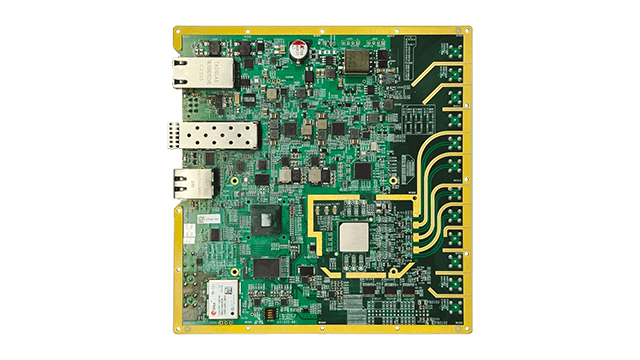



Fibre Channel Switch Board PCBA
Fiber Channel Switch Board PCBA. 5G PCBA, BBU Baseband, RRU Remote Radio, AAU Active Antenna, DU/CU, O-RAN, UPF Core, OTN Optical, WDM/DWDM, PTP Grandmaste
Product Specifications
Fibre Channel Switch Board PCBA
28-Layer Gen 7 64GFC Director Switch — FC-NVMe-2, 96 FC Lanes, Sub-10 µs Latency, Hardware Zoning
Product Overview
The Fibre Channel Switch Board is a director-class storage networking PCBA that delivers the deterministic low-latency switching fabric essential for all-flash NVMe storage arrays serving 5G core and edge functions. Built on a 28-layer Megtron 6 PCB with precision back-drilling and strict intra-pair skew control (under 2 ps), the board supports FC-NVMe-2 protocol (INCITS 560-2020) at 64GFC Gen 7 line rates per the Fibre Channel Physical Interface specification (FC-PI-7). The switch silicon provides 768 Gbps of non-blocking Fibre Channel switching capacity across 24× QSFP-DD cages, each supporting 4 independent 64GFC lanes for a total of 96 FC ports. The switch ASIC implements hardware-accelerated NPIV (N_Port ID Virtualization per FC-FS-6) enabling thousands of virtual initiators in multi-tenant SAN environments, and automatic inter-switch link (ISL) trunking that dynamically load-balances traffic across up to 8 parallel ISLs. Integrated NVMe/FC support eliminates the SCSI translation layer (FCP), reducing storage I/O latency to below 10 µs port-to-port — critical for 5G edge computing where storage access latency directly impacts user-plane packet processing delay. Hardware-enforced fabric zoning with cryptographic authentication per FC-SP-2 (INCITS 496-2019) prevents unauthorized initiator-target access, while integrated IO Insight analytics provide per-flow I/O latency, IOPS, and bandwidth metrics natively in the switch ASIC without external probes. The board features redundant hot-swappable power, dual control processors, and non-disruptive firmware upgrade (NDFU) capability for 99.9999% availability in mission-critical 5G core deployments.
Key Specifications
| Layer Count | 28 layers |
| Material | Megtron 6 low-loss with backdrill |
| Speed | 64GFC Gen 7 (FC-NVMe-2 Compliant) |
| Ports | 24× QSFP-DD (96 independent FC lanes) |
| Latency | <10 µs port-to-port (cut-through) |
| Zoning | HW-Accelerated + FC-SP-2 Cryptographic |
| Fabric Analytics | IO Insight per-Flow (Latency/IOPS/BW) |
| Compliance | FC-PI-7 / FC-FS-6 / FC-SP-2 / FC-NVMe-2 |
PCBA Assembly Challenges
Assembling the Fibre Channel switch board demands extreme precision due to the 96 independent 28 Gbps PAM4 serdes lanes fanning out from the central switch ASIC (over 7,000 balls at 0.8 mm pitch — one of the largest BGA packages in networking). The 24 QSFP-DD cages, each with 76 SMT pins, must achieve coplanarity within 0.08 mm and placement accuracy within ±50 µm to align with the front-panel cutouts across the full 340 mm board width. The 28-layer board's heavy power planes (2 oz copper on 8 inner layers for 0.8V core at 250A) create extreme thermal mass that demands a precisely tuned 12-zone reflow oven profile — the peak temperature window of 238–243°C must be held for 60–75 seconds at the BGA ball level while keeping the QSFP-DD cage body temperatures below 235°C to prevent plastic deformation. A custom step stencil with 5 thickness zones (ranging from 90 µm for the switch ASIC inner balls to 130 µm for the QSFP-DD ground pads) is fabricated using laser-cut nano-coating technology to optimize paste release. The high pin count drives double-sided assembly — the switch ASIC, retimers, and heavy power magnetics are placed on the bottom side for the second reflow pass. Post-reflow, the switch ASIC undergoes full 3D X-ray laminography with automated void analysis on all 7,000+ balls, flagging any ball with void content exceeding 15% per IPC-7095 Class 3.
Test Strategy
Fibre Channel switch testing begins with flying probe ICT validating all passive components, 12 voltage rail domains, and the redundant power path isolation. Boundary scan (JTAG 1149.1/1149.6) tests the switch ASIC-to-retimer and retimer-to-QSFP-DD high-speed interconnects using AC-coupled differential boundary scan to verify continuity without physical probe access. Functional testing validates all 96 FC lanes using the switch's internal loopback and PRBS-31 generators, with each lane verified at 28.05 Gbps PAM4 and BER below 10⁻¹⁵. Fabric zoning is tested by programming 1,024 hardware-enforced zones and verifying that only trusted initiator-target pairs can communicate. FC-NVMe-2 protocol compliance is validated by connecting NVMe over Fabrics initiators and targets and measuring I/O latency below 10 µs under 100% fabric load (768 Gbps aggregate). IO Insight analytics are verified by injecting traffic with known latency profiles and confirming the switch ASIC reports per-flow metrics within 5% accuracy. A 72-hour burn-in at 40°C ambient with sustained 700 Gbps of 64GFC traffic across all 96 ports screens for early-life failures, while integrated environmental monitoring tracks ASIC junction temperature and all transceiver optical power levels throughout the burn-in.
PCB Manufacturing Difficulty
Fabricating the 28-layer Fibre Channel switch PCB combines the challenges of extreme layer count registration, high-speed PAM4 signal integrity, and massive power delivery. The 28 Gbps PAM4 serdes lanes from the switch ASIC to each QSFP-DD cage span up to 300 mm of trace length, demanding insertion loss below -12 dB at 14 GHz (Nyquist frequency for 28G PAM4). Megtron 6 dielectric with Df below 0.002 at 14 GHz is used on all signal layers, with conductor surface roughness (Rz) below 2 µm to minimize skin-effect losses. Registration across all 28 layers must hold within ±2 mil — the switch ASIC's 0.8 mm pitch BGA escape routing under the package uses staggered microvias on layers 1–3 that must precisely align with buried vias on layers 4–25. Backdrilling removes via stubs on every high-speed differential pair via, with stub length controlled to under 6 mil for PAM4 lanes to eliminate stub resonance below 28 GHz. The power delivery network (PDN) for the switch ASIC core voltage (0.8V at 250A) uses 8 dedicated copper planes with embedded planar capacitance on layers 2–3 and 26–27, achieving a target impedance below 0.5 mΩ from DC to 100 MHz. Finished boards undergo 100% AOI, full-panel TDR impedance verification on all signal layer coupons (±8% tolerance for PAM4 lanes), and destructive microsection analysis per IPC-6012DS.
More information