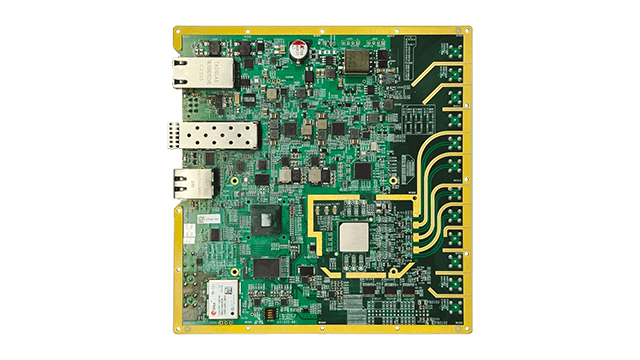



5G Edge Computing Board PCBA
5G Edge Computing Board PCBA. 5G PCBA, BBU Baseband, RRU Remote Radio, AAU Active Antenna, DU/CU, O-RAN, UPF Core, OTN Optical, WDM/DWDM, PTP Grandmaster,
Product Specifications
5G Edge Computing Board PCBA
MEC-Optimized Compute Acceleration — FPGA SmartNIC, GPU/AI Inference, HW-Accelerated UPF Local Breakout, <5 ms Edge Latency for URLLC Applications
Product Overview
The 5G Edge Computing Board is a multi-access edge computing (MEC) platform PCBA that brings cloud-native compute, storage, and networking to the far edge of the 5G network. Built on a 26-layer Megtron 6 PCB, the board combines a high-core-count server processor, an FPGA-based SmartNIC for user-plane acceleration, and an integrated GPU or AI inference accelerator in a single PCIe add-in card or 1U blade form factor. The SmartNIC implements a local UPF with ULCL (uplink classifier) functionality, enabling local breakout of selected traffic flows directly to edge applications without traversing the central UPF — reducing end-to-end latency below 5 ms for URLLC use cases. The board provides 2× 100GbE SFP-DD ports for N3/N6/N9 connectivity and 4× 25GbE SFP28 ports for edge application service chaining. Hardware-accelerated SR-IOV and VirtIO ensure near-native network performance for containerized edge workloads. The board also includes a hardware root-of-trust, measured boot, and an on-board HSM for secure credential storage, meeting ETSI MEC security requirements for multi-tenant edge deployments where multiple application providers share the same physical infrastructure.
Key Specifications
| Layer Count | 26 layers |
| Material | Megtron 6 ultra-low-loss |
| Surface Finish | ENIG |
| Compute | Multi-core CPU + FPGA SmartNIC + GPU/AI accelerator |
| Network Interfaces | 2× 100GbE SFP-DD + 4× 25GbE SFP28 |
| UPF Acceleration | Local UPF + ULCL hardware offload |
| Edge Latency | <5 ms (local breakout path) |
| Virtualization | SR-IOV, VirtIO, DPDK acceleration |
| Security | Hardware root-of-trust, measured boot, HSM |
| Compliance | ETSI MEC, 3GPP TS 23.501 (ULCL), NEBS Level 3 |
| Operating Temperature | 0°C to +55°C |
| Application | 5G edge URLLC / AR-VR / industrial closed-loop control |
PCBA Assembly Challenges
Assembling the 26-layer 5G edge computing board involves simultaneous placement of large BGA CPUs (3,000+ balls at 0.8–1.0 mm pitch), FPGA packages with high-speed transceiver banks, GPU/AI accelerator BGAs, and dense DDR5 memory arrays — all on a single board. The thermal mass of the Megtron 6 laminate with heavy copper power planes (2 oz on inner layers) requires a carefully optimized reflow profile with extended soak time above 200°C to ensure all BGA balls reach liquidus simultaneously. The FPGA SmartNIC has multiple 28 Gbps transceiver banks that demand ultra-precise solder joint quality — any void or head-in-pillow defect on a transceiver ball introduces impedance discontinuity that can cause lane failures at 28 Gbps. The 100GbE SFP-DD connector cages require coplanarity within 0.1 mm across their full footprint to avoid insertion loss variation. Double-sided assembly with selective wave solder for through-hole connectors is managed via staged reflow, protecting previously placed components with thermal shielding. 3D X-ray inspection verifies every BGA joint, with particular focus on the high-speed transceiver balls where void rates are held below 10%.
Test Strategy
Each assembled edge computing board undergoes a rigorous multi-domain validation. ICT and boundary scan (JTAG) verify all passive components and interconnects between the CPU, FPGA, GPU, and memory arrays. The high-speed digital interfaces are tested with IEEE 802.3 compliance patterns — PRBS31 at 25.78125 Gbps on each 25GbE lane and 53.125 Gbps PAM4 on 100GbE ports, validating eye diagram margins, jitter tolerance, and receiver sensitivity. The FPGA SmartNIC is loaded with a diagnostic UPF bitstream and tested for ULCL classification accuracy and forwarding throughput at 200 Gbps. GPU/AI accelerator validation includes memory stress testing (memtest), thermal soak under sustained compute load, and inference latency benchmarking. ETSI MEC security functions are validated by verifying measured boot attestation, HSM key generation/signing, and secure enclave isolation. System-level burn-in runs 48 hours with live traffic through the local UPF breakout path, verifying sub-5 ms latency under sustained load at 55°C ambient.
PCB Manufacturing Difficulty
Fabricating the 26-layer Megtron 6 edge computing PCB is among the most demanding jobs in telecom-grade manufacturing. Registration tolerance across all 26 layers must stay within ±2.5 mil — the 28 Gbps transceiver differential pairs run across multiple layers and a single misregistered via can introduce 2+ ps of skew, violating the transceiver's timing budget. Backdrilling removes via stubs on all signal layers above 10 Gbps to eliminate stub resonances at 14 GHz and 28 GHz. The aspect ratio of plated through-holes exceeds 10:1, requiring pulse plating for uniform copper distribution. Impedance is modeled and verified via TDR on every high-speed signal layer — 100 Ω differential for Ethernet and PCIe Gen4/5 lanes, 85 Ω for DDR5 command/address buses. The heavy copper power planes (2 oz) on eight internal layers demand advanced lamination cycles to prevent resin starvation and voids. Finished boards undergo 100% AOI with enhanced sensitivity for high-speed signal layers, impedance coupon testing per IPC-6012 Class 3, and HiPot testing at 1,500 VDC for NEBS Level 3 compliance.
More information