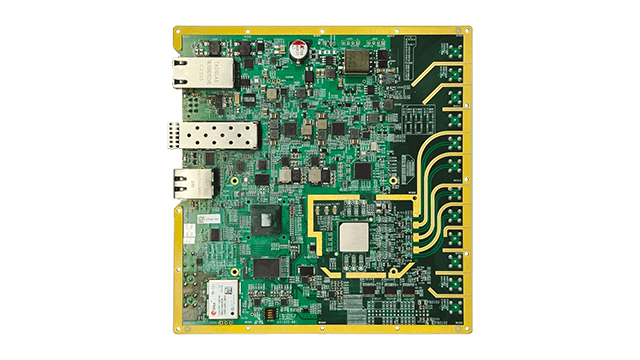



Network Security Gateway Board PCBA
Network Security Gateway Board PCBA. 5G PCBA, BBU Baseband, RRU Remote Radio, AAU Active Antenna, DU/CU, O-RAN, UPF Core, OTN Optical, WDM/DWDM, PTP Grandm
Product Specifications
Network Security Gateway Board PCBA
Carrier-Grade Security Platform — 400 Gbps IPsec AES-256-GCM, 200 Gbps DPI, 3GPP SEPP/N3IWF, FIPS 140-3 Level 3 HSM, 8× 100GbE Hardware Bypass Ports
Product Overview
The Network Security Gateway Board is a dedicated security processing blade that provides carrier-grade encryption, authentication, and threat prevention for all 5G core network interfaces. Built on a 28-layer PCB with Megtron 6 and ultra-low-loss materials, the board features a programmable security processing ASIC that delivers 400 Gbps of IPsec throughput with AES-256-GCM and SHA-384 acceleration — sufficient to protect all N2, N3, N4, and N6 traffic in a large-scale 5G core deployment. The board implements the 3GPP Security Edge Protection Proxy (SEPP) function for N32 interconnect security between visited and home networks, and the N3IWF for non-3GPP access security. It also includes a next-generation firewall (NGFW) engine with hardware-accelerated deep packet inspection (DPI) at 200 Gbps, enabling application-layer filtering, intrusion prevention (IPS), and anti-malware scanning without throughput degradation. The board provides 8× 100GbE QSFP28 ports with hardware bypass/fail-to-wire on critical links to ensure network continuity during power loss or software failure. A FIPS 140-3 Level 3 hardware security module (HSM) on the board stores all encryption keys securely.
Key Specifications
| Layer Count | 28 layers |
| Material | Megtron 6 / ultra-low-loss laminate |
| Surface Finish | ENIG |
| IPsec Throughput | 400 Gbps AES-256-GCM / SHA-384 |
| DPI Throughput | 200 Gbps hardware-accelerated |
| Network Ports | 8× 100GbE QSFP28 with hardware bypass |
| 5G Security Functions | SEPP (N32), N3IWF, N32-FW |
| NGFW Features | Application-layer filtering, IPS, anti-malware |
| HSM | FIPS 140-3 Level 3, secure key storage |
| Compliance | 3GPP TS 33.501, TS 33.310, NEBS Level 3 |
| Operating Temperature | 0°C to +45°C |
| Application | 5G core network perimeter security / N32 interconnect |
PCBA Assembly Challenges
Assembling the 28-layer security gateway board presents extreme challenges in high-speed signal integrity and thermal management. The security processing ASIC is a large BGA (typically 45×45 mm, 3,500+ balls at 1.0 mm pitch) dissipating 150–200 W, requiring a robust thermal solution with integrated heat spreader and direct-contact liquid cooling interface. The 8× 100GbE QSFP28 ports operate at 25.78125 Gbps per lane (4 lanes per port), totaling 32 high-speed transceiver pairs that must maintain impedance continuity across the PCB, connector, and cable assembly. Each QSFP28 cage footprint requires coplanarity within 0.08 mm to ensure reliable mating with pluggable optics. The hardware bypass relays on critical links add mechanical complexity — these electromechanical components must withstand the reflow profile and maintain contact resistance below 50 mΩ post-assembly. The FIPS 140-3 Level 3 HSM module requires tamper-evident assembly with physical security mesh connections verified by electrical continuity testing. All high-speed traces are assembled with nitrogen reflow to prevent oxidation on the ENIG surface finish, and every BGA joint is verified by 3D X-ray with void rates below 15% per IPC Class 3.
Test Strategy
Each assembled security gateway board undergoes comprehensive security and performance validation. Flying-probe ICT verifies all passive components and power rails. The IPsec engine is tested with IKEv2 key exchange and 400 Gbps of bidirectional IPsec traffic using AES-256-GCM, measuring packet loss (target: 0%), latency (target: <50 µs per packet), and verifying anti-replay protection. DPI performance is validated with a commercial traffic generator replaying 200 Gbps of mixed application traffic while confirming 100% signature match rate. SEPP functionality is validated against a test SEPP peer, verifying N32-F message protection, TLS 1.3 mutual authentication, and JSON Web Encryption (JWE). N3IWF testing validates IPsec tunnel establishment with simulated non-3GPP UEs and verifies 5G NAS signaling encapsulation per TS 24.502. Hardware bypass is tested by power-cycling the board and confirming link re-establishment within 50 ms. The FIPS 140-3 HSM is validated for key generation, zeroization, and tamper response. Burn-in runs 72 hours at 45°C ambient with sustained 400 Gbps encrypted traffic.
PCB Manufacturing Difficulty
The 28-layer security gateway PCB demands the most advanced manufacturing techniques in the telecom industry. Thirty-two 28 Gbps NRZ transceiver pairs require backdrilling on all signal layers to keep via stubs below 6 mil, eliminating quarter-wave resonances at 14 GHz. The PCB stack-up uses spread-glass Megtron 6 laminates with 0.002 in dielectric thickness on the outer layers and ultra-smooth copper foil (Rz < 2.0 µm) to minimize conductor loss at 14 GHz. Differential pairs are routed with 3.5/4.0 mil trace/space and held to 100 Ω ±8% across the entire 18-inch board length. The aspect ratio of PTHs in the 28-layer stack exceeds 12:1, requiring pulse-reverse plating for uniform copper distribution from barrel to pad. The power distribution network (PDN) for the 200 W ASIC uses 8 internal planes of 2 oz copper with embedded planar capacitance layers to maintain PDN impedance below 1 mΩ to 100 MHz. Eight-layer sequential lamination builds are used for the high-density interconnect region under the ASIC. Finished boards undergo 100% TDR on all 32 transceiver pairs, impedance coupon testing, HiPot at 1,500 VDC, and flying-probe continuity on all nets.
More information