
An AI server network card is not a small add-on board. It pushes 200Gb/s or more across the rack. The GPU beside it pulls hundreds of watts. Power on that card is now its own design problem.
These designs use a digital multi-phase controller. DrMOS stages feed the main rails. This article explains why that happens, and how to plan the parts.
Why AI Server NIC Power Demand Keeps Rising
Network speed sets the current. A 200Gb/s link needs many high-speed lanes. Each lane runs through a SerDes block or a retimer. Those blocks want a low core voltage and a fast load step.
Board density adds pressure. The card sits near the GPU and the switch. Airflow is shared and already warm. There is little room for a large inductor or capacitor bank.
- More lanes, more current. 100G to 200G to 400G raises current on the same board area.
- Fast transients. A DSP or a retimer can change its load in microseconds.
- Tight voltage windows. Advanced silicon tolerates little droop or overshoot.
- High ambient. Warm neighbours and dense racks cut the thermal margin.
- Efficiency targets. Power lost on the card is power not used for compute.
A single-phase buck plus a linear regulator cannot cover this load. Heat gathers in one device, and the loop reacts too slowly. So designers split the current across several phases.
What a Multi-Phase Digital Controller and DrMOS Solve
The digital controller
The controller drives several phases in parallel. It shifts the timing of each phase so the ripple cancels. The result is a smoother output with fewer output capacitors.
Digital control sets the loop in firmware, not with resistors. It reports current, voltage, and temperature over a bus. It can drop phases at light load to save power.
The DrMOS stage
DrMOS puts the driver and both MOSFETs into one package. The gate loop becomes very short. Short loops mean less ringing, lower loss, and cleaner switching.
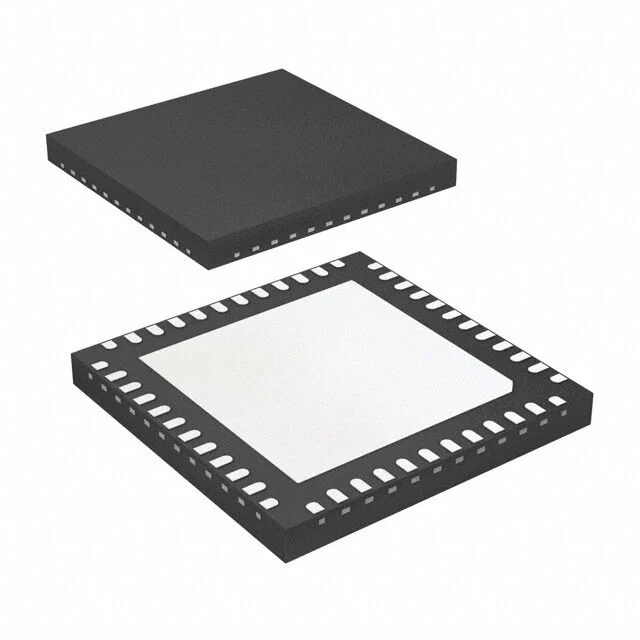
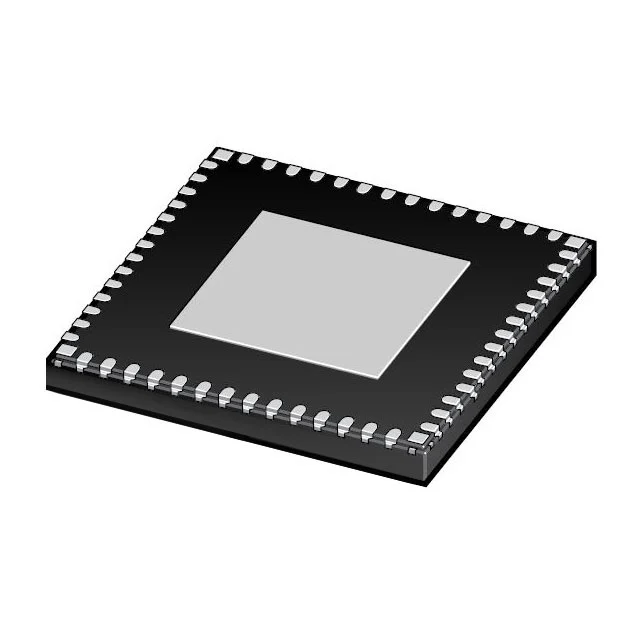
A small package such as TLGA 5x5 saves board area. It also keeps the power loop tight to the pins. That helps a dense card that carries many rails.
Several packages share the current. Heat spreads across the board instead of one hotspot. Each part carries less current, so each part runs cooler.
What the pair delivers
| Current scaling | Add phases to raise current without a new topology. |
| Fast response | Interleaved phases react quickly to a load step. |
| Lower ripple | Phase shifting cuts input and output ripple. |
| Better thermals | Current and heat split across several packages. |
| Telemetry | The digital loop reports rail health to the system. |
| Small footprint | Integrated stages shrink the power area. |
The pattern is now common in compact AI systems. A 200Gb/s network controller can carry its own multi-phase supply. A modern multi-phase controller paired with integrated power stages is one example. The point is not the brand. High-speed interconnect now needs the same power treatment as a processor core.
What to Check When You Select the Power Stage
| Input voltage range | Must match the 12V, 5V, or 3.3V rail on the card. |
| Phase count and rated current | Headroom for peak load and for steady load. |
| Current sense accuracy | Sets phase balance and the truth of the telemetry. |
| Transient window | Decides whether the rail stays inside the load step spec. |
| Switching frequency | Trade-off between efficiency, ripple, and EMI. |
| Efficiency curve | Loss at real load, not only at full load. |
| Telemetry and control | PMBus or I2C reporting and configuration access. |
| Package and thermal path | Footprint, height, and how heat leaves the part. |
| Protection set | OCP, OVP, OTP, and UVLO behaviour under a fault. |
| Default configuration | The stored image and the state at power-up. |
| External part count | Inductor, capacitor, and sense network on the board. |
| Design support | Layout guide, models, and help with the settings. |
1. Start with the thermal budget. A part that passes on the bench can fail in a rack. Check the efficiency curve at the real load and the real ambient.
2. Confirm the transient spec early. Ask for the load step size and the allowed window. A fast loop is worth more than a low part price.
3. Match the phase count to the current. Too few phases means heat and ripple. Too many phases means cost and layout space.
4. Check the configuration path. A digital part needs a stored image. Confirm who holds the file and how a change is approved.
Supply View: EOL, Alternatives, and Long Lead Times
Power ICs sit at the front of the risk list. They carry long lead times. They change less often than the silicon they feed.
- Long lead times. Controllers and DrMOS stages can quote 26 to 52 weeks.
- Not a simple swap. A digital controller needs a configuration image and a firmware check. A similar part is rarely drop-in.
- Layout and requalification. A different pin layout or package forces a new board. That forces a new qualification round.
- End of life while you still ship. A family can reach last time buy while the product still runs.
- Node moves. DrMOS parts shift to newer processes. The replacement may differ in pin count and current rating.
- Single points of failure. One controller can hold up a whole card build. The price of the part does not matter at that point.
The fix is not a panic buy. It is planning. Keep a documented supply channel for these rails. Review an alternative at design stage, when a change is cheap. Ask for options before the shortage, not during it.
Traceability matters as much as stock. Many end customers ask for lot records and factory packaging. That paperwork is slow to rebuild after the order. State the requirement at quoting stage.
How to Take the Risk Out of the Order
1. Send the BOM before the shortage. A full list flags long-lead power parts while you can still plan.
2. Ask for options at quoting stage. Check a supply channel or a compatible option early. Do it before the line stops.
3. Fix the traceability rule at the start. Say early if you need lot records or original packaging. It is the slowest part of any recovery.
4. Buffer the parts that cannot move. A small planned buffer costs less than an expedite fee.
5. Review the board and the parts together. A part change can force a layout change. A layout change can force new qualification.
FAQ
Can you support a design that is still in progress?
Yes. Prototype and pilot quantities are normal. That stage is also the best moment to review options.
Do multi-phase controllers have workable alternatives?
Sometimes. The controller is the harder part. A stage part is often easier to match.
What do you need for a quote?
Part numbers, quantities, target date, and any document or packaging requirement.
Send your BOM or Gerber. You will get a quote within hours.