
How to Source Hard-to-Find and Obsolete Electronic Components
Practical strategies for finding discontinued, end-of-life, and hard-to-source electronic parts
Understanding the Obsolescence Challenge
Semiconductor manufacturers discontinue thousands of part numbers every year as they transition to newer fabrication processes. For products with long lifecycles — industrial equipment that operates for 20 years, military systems designed in the 1990s, medical devices that cannot be redesigned without re-certification — component obsolescence is a constant threat.
When a component goes end-of-life (EOL), manufacturers typically issue a "last-time buy" notice, giving customers a final window to purchase remaining inventory. Missing this window means searching the open market — a process filled with risks and opportunities.
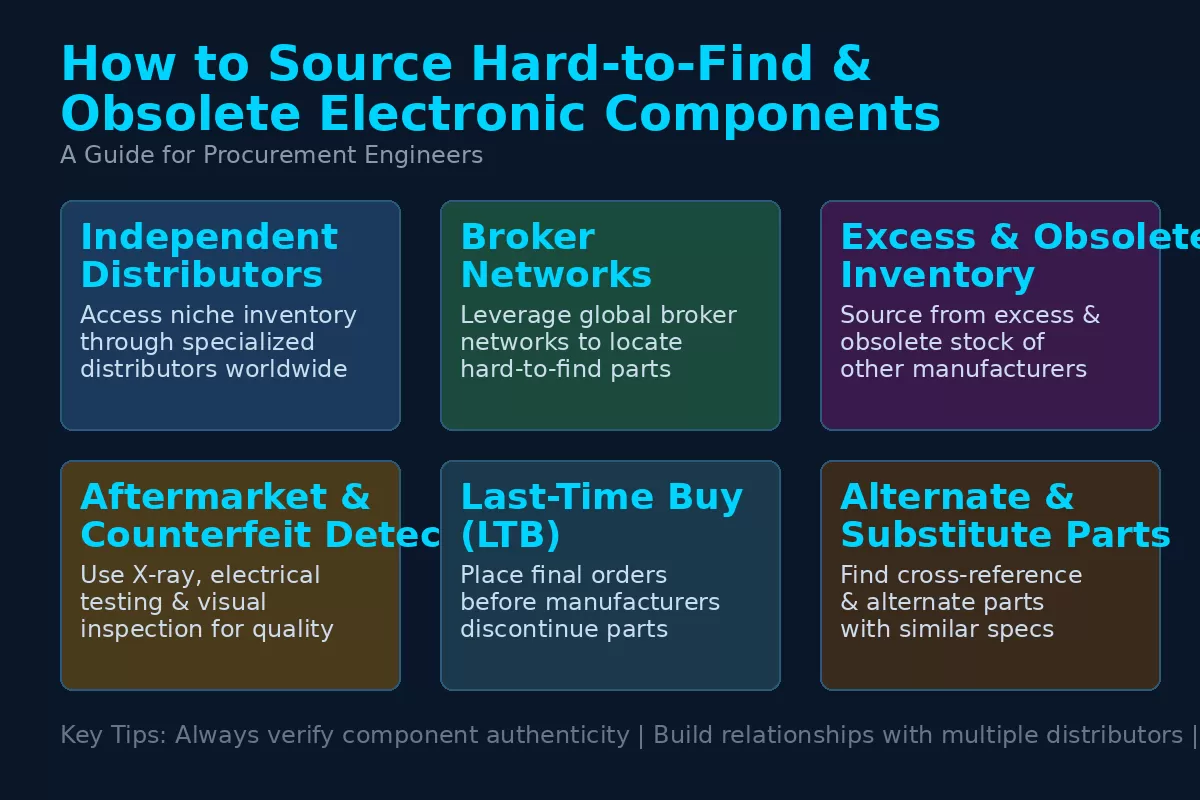
Last-Time Buy Strategies
The most reliable way to secure obsolete parts is through the manufacturer's last-time buy program. When an EOL notice is issued, calculate your lifetime buy quantity — the total number of parts needed for all future production plus service and repair demand. This calculation should include a buffer for yield loss and unexpected demand.
If you missed the last-time buy window, do not panic. trusted distributors often hold significant remaining inventory of recently discontinued parts. Check with multiple distributors — stock levels vary significantly between regions.
Navigating the Open Market Safely
For parts that are no longer available through trusted channels, the open market is the only option. But the open market carries significant risks: counterfeit parts, relabeled date codes, moisture-damaged components, and parts salvaged from e-waste.
Work only with established, reputable independent distributors who offer testing and warranty. Require photographic documentation of the parts, including date codes and lot numbers. For high-value or safety-critical parts, arrange for third-party testing before accepting delivery.
Superb Automation's global network of 7,000+ channels gives us access to verified open-market inventory that would be difficult for an individual buyer to locate. Our incoming inspection process includes visual inspection, date code verification, and X-ray testing to catch counterfeits before they reach your production line.
Alternative and Drop-In Replacement Parts
When a specific part cannot be sourced, the next best option is an alternative — a part from a different manufacturer that is functionally equivalent and pin-compatible. Many common ICs have cross-compatible alternatives from multiple manufacturers, but verifying true compatibility requires careful analysis of datasheets, timing parameters, and package specifications.
Superb Automation's component engineering team can identify and qualify alternative parts for your BOM, helping you avoid costly redesigns when original components become unavailable.